Quiz · Medium
Hydrostatics, Bernoulli, pipe flow, pumps, open-channel concepts and basic hydrology.
Pressure at 10 m depth in fresh water (gauge) is closest to
10 kPa
101 kPa
98 kPa
981 kPa
p = γh = 9.81 × 10 = 98.1 kPa. 101 kPa is atmospheric pressure, which is not included in gauge pressure.
The hydrostatic pressure distribution on a vertical wall retaining water is
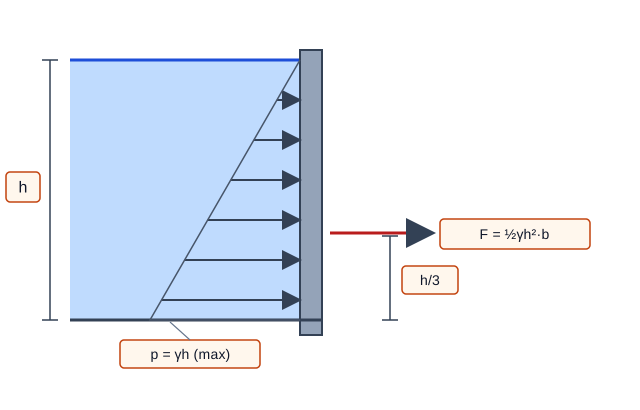
triangular, zero at the surface
uniform
triangular, maximum at the surface
parabolic
Pressure increases linearly with depth, so the diagram is a triangle with its peak at the bottom.
The resultant hydrostatic force on a vertical rectangular gate acts at what height above its bottom, for a gate fully holding depth h?
h/2
2h/3
h
h/3
The resultant passes through the centroid of the triangular pressure diagram, which is h/3 up from the base.
A vertical gate 2 m wide holds 3 m of water. The force on it is
29.4 kN
88.3 kN
58.9 kN
176.6 kN
F = ½γh²b = 0.5 × 9.81 × 9 × 2 = 88.3 kN. Forgetting the half gives 176.6 kN.
A floating body is in equilibrium when
its density exceeds the fluid's
weight equals the buoyant force
the buoyant force exceeds its weight
its center of gravity is at the bottom
Buoyancy equals the weight of fluid displaced; the body floats when this equals its own weight.
A ship is stable when the metacenter is
below the center of gravity
at the waterline
at the center of buoyancy
above the center of gravity
Positive metacentric height produces a righting moment when the ship heels.
Continuity for incompressible flow says that
A1V1 = A2V2
p1 = p2
V1 = V2
A1/V1 = A2/V2
Discharge is conserved. Narrower sections have higher velocity.
Bernoulli's equation assumes
unsteady viscous flow
only laminar flow in pipes
steady, incompressible, frictionless flow along a streamline
compressible flow at high Mach numbers
Add head loss terms for real pipes, and a pump or turbine head when energy is added or removed.
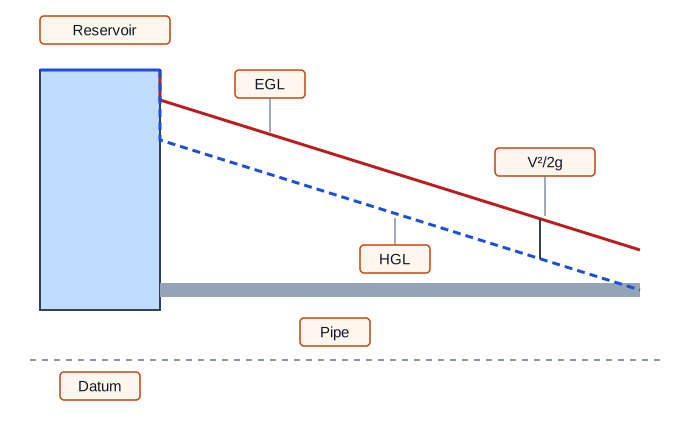
The vertical distance between the EGL and HGL is
p/γ
z
the head loss hf
V²/2g
EGL is the HGL plus velocity head. The head loss is the drop of the EGL along the pipe.
The speed of a jet leaving an orifice 5 m below the water surface (ideal) is
4.9 m/s
9.9 m/s
49 m/s
7.0 m/s
V = √(2gh) = √(98.1) = 9.9 m/s.
Pipe flow is laminar if the Reynolds number is
above 4000
exactly 1
below about 2000
above 10⁶
Between roughly 2000 and 4000 the flow is transitional; above 4000 it is turbulent.
The Darcy-Weisbach head loss equation is
hf = f (L/D) V²/2g
hf = f (D/L) V²/2g
hf = f L V/(2gD)
hf = f L D V²/2g
Longer pipes lose more head; larger diameters lose less.
If the diameter of a pipe doubles with the same discharge and friction factor, the friction head loss becomes
1/32 as large
1/2 as large
1/4 as large
1/16 as large
hf ∝ Q²/D⁵; 2⁵ = 32. 1/16 comes from wrongly using D⁴.
Pipes in parallel have
equal discharge and additive head losses
equal diameters
equal head loss and additive discharges
equal velocities
The reverse describes pipes in series.
Input power to a pump with Q = 0.05 m³/s, H = 30 m and efficiency 0.75 is
14.7 kW
19.6 kW
11.0 kW
26.1 kW
P = γQH/η = 9810 × 0.05 × 30/0.75. Without dividing by η you get 14.7 kW, the water power.
A pump's operating point is found where
power is maximum
NPSH is zero
efficiency is 100%
the pump curve crosses the system curve
At that point the head supplied equals the head required by the system.
If a pump's speed increases by 20%, its head (affinity laws) rises by
20%
73%
44%
40%
H ∝ N², so 1.2² = 1.44. Power rises with N³ (73%).
Cavitation in a pump occurs when
NPSH available is less than NPSH required
the discharge is too small
the pump runs below its rated speed
the pipe velocity is zero
Local pressure falls to vapor pressure and bubbles collapse and damage the impeller.
Water hammer pressure rise on rapid valve closure is
Δp = ρ g h
Δp = ρ V²/2
Δp = γ Q
Δp = ρ a ΔV
The Joukowsky equation uses wave speed a and the velocity change.
In open channel flow, Fr > 1 indicates
subcritical flow
supercritical flow
critical flow
laminar flow
Disturbances cannot travel upstream in supercritical flow.
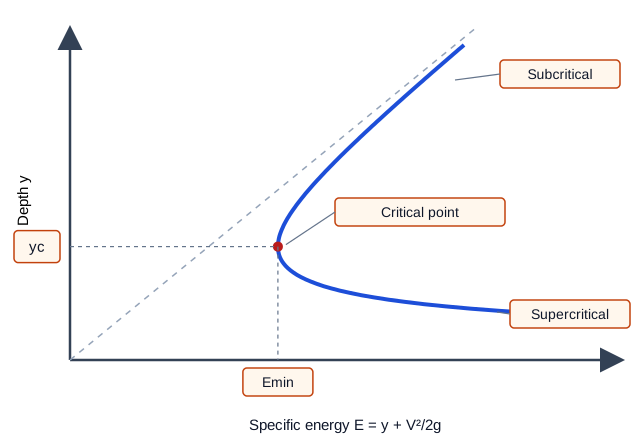
In the specific energy diagram, the minimum energy occurs at
normal depth
critical depth
zero depth
maximum depth
There, Fr = 1. For a rectangular channel Emin = 1.5 yc.
Manning's equation for velocity is
V = n R^(2/3) S^(1/2)
V = (1/n) R^(1/2) S^(2/3)
V = (1/n) A^(2/3) S^(1/2)
V = (1/n) R^(2/3) S^(1/2)
R is the hydraulic radius A/P, not the area. Higher roughness n means lower velocity.
A hydraulic jump occurs when flow changes from
supercritical to subcritical
subcritical to supercritical
laminar to turbulent
critical to uniform
Large energy is dissipated; the downstream depth is the sequent depth.
In a rectangular channel with unit discharge q = 3 m²/s, critical depth is
0.31 m
1.5 m
0.97 m
2.9 m
yc = (q²/g)^(1/3) = (9/9.81)^(1/3) = 0.97 m.
Rational method peak flow with C = 0.6, i = 50 mm/h and A = 20 ha is
0.6 m³/s
10 m³/s
600 m³/s
1.67 m³/s
Q = CiA/360 = 0.6 × 50 × 20/360. The 360 converts mm/h and ha to m³/s.
The probability that a 100-year flood is exceeded at least once in a 30-year period is about 26%.
True
False
1 − (0.99)^30 = 0.26. A '100-year' flood has a 1% chance every year, not once per 100 years.
