Quiz · Medium
Mixed questions on classical, medieval, Renaissance and modern architecture, famous buildings and labeled diagrams.
According to Vitruvius, which three qualities must a building have?
Simplicity, economy, durability
Proportion, light, shelter
Order, symmetry, ornament
Firmitas, utilitas, venustas (strength, utility, beauty)
Vitruvius' triad from De architectura names strength, utility and beauty. The other options mix in real architectural ideas but are not his triad.
Which feature made the Roman Pantheon's huge dome possible?
Flying buttresses around the drum
Concrete poured into a coffered dome, lighter aggregate toward the top
A timber truss hidden under the dome
Pendentives carried on stone ribs
Roman concrete was unreinforced and lightened by using lighter aggregate higher up. Pendentives are Byzantine, and flying buttresses are Gothic.
Which element defines the Gothic style?
Dome on pendentives with mosaics
Round arch, barrel vault and thick walls
Pointed arch, rib vault and flying buttress
Pilotis, free plan and ribbon windows
The Gothic trio moved weight to skeletal supports. The first option describes Romanesque, the second Le Corbusier's Modernism, the last Byzantine.
Who designed the dome of Florence Cathedral?
Donato Bramante
Andrea Palladio
Christopher Wren
Filippo Brunelleschi
Brunelleschi completed the dome in 1436. Palladio designed villas, Bramante the Tempietto and Wren St Paul's in London.
Which is the correct bottom-to-top order of a classical entablature?
Frieze, architrave, cornice
Architrave, frieze, cornice
Cornice, frieze, architrave
Architrave, cornice, frieze
The architrave sits on the columns, the frieze is the middle band and the cornice projects at the top.
Which Greek order has volutes on its capitals?
Ionic
Corinthian
Doric
Tuscan
Ionic capitals have paired scrolls. Doric is plain, Corinthian uses acanthus leaves, and Tuscan is a Roman simplification of Doric.
What is a pendentive?
A hanging stone ornament in a vault
A curved triangular surface that lets a round dome sit on a square base
A pointed arch over a window
A buttress with an arched top
Pendentives are used in Hagia Sophia. The hanging ornament is a pendant and the buttress description refers to a flying buttress.
Which building is usually cited as the first Gothic design?
Durham Cathedral (1093)
Chartres Cathedral (1220s)
The choir of the Abbey of Saint-Denis (1140s)
Hagia Sophia (537)
Abbot Suger's choir at Saint-Denis introduced the new structure and light. Durham is Romanesque, with early rib vaults, and Hagia Sophia is Byzantine.
What does 'béton brut' refer to?
Raw concrete, the root of the term Brutalism
Reinforced steel framing
Glazed brick
Prefabricated panels
Le Corbusier used béton brut in the Unité d'Habitation. The term Brutalism comes from it, not from brutality.
Which of these is NOT one of Le Corbusier's five points?
Free plan
Pilotis
Load-bearing masonry walls
Roof garden
The five points depend on a concrete frame, so walls need not carry loads. Load-bearing masonry is the opposite idea.
Which architect designed Fallingwater?
Ludwig Mies van der Rohe
Louis Kahn
Frank Lloyd Wright
Philip Johnson
Fallingwater (1935 to 1937) is Wright's organic masterpiece. Mies designed the Farnsworth House and Barcelona Pavilion.
The 1932 MoMA exhibition 'The International Style' was organized by:
Walter Gropius and Le Corbusier
Robert Venturi and Denise Scott Brown
Louis Sullivan and Frank Lloyd Wright
Henry-Russell Hitchcock and Philip Johnson
Hitchcock and Johnson defined the style's traits. Venturi and Scott Brown argued against Modernism decades later.
Who is credited with 'less is more'?
Ludwig Mies van der Rohe
Antoni Gaudí
Robert Venturi
Louis Sullivan
Mies promoted reduction to essentials. Venturi countered with 'Less is a bore'. Sullivan's phrase was 'form follows function'.
Which building is widely regarded as the first skyscraper (1885)?
Crystal Palace, London
Wainwright Building, St. Louis
Empire State Building, New York
Home Insurance Building, Chicago
Jenney's Home Insurance Building used an iron and steel skeleton frame. The Wainwright Building came later, and the Crystal Palace was not a high-rise.
The Sydney Opera House was designed by:
Oscar Niemeyer
Renzo Piano
Jørn Utzon
Frank Gehry
Utzon won the 1957 competition; the building opened in 1973. Gehry designed Bilbao and Piano the Pompidou Centre.
Which statement about the Bauhaus is correct?
It was founded by Walter Gropius in Weimar in 1919 and closed in 1933
It was a Gothic Revival workshop in Victorian England
It was founded in Paris by Le Corbusier in 1925
It was founded in Chicago after the 1871 fire
The Bauhaus moved to Dessau in 1925 and Berlin in 1932, and was closed by the Nazi regime. Gothic Revival workshops were Morris and Pugin's world.
The Parthenon was designed by Ictinus and Callicrates in the Doric order.
True
False
It was built 447 to 432 BC; Phidias directed the sculpture. It also has an Ionic frieze inside the colonnade.
Romanesque churches are characterized by large pointed windows and flying buttresses.
True
False
Those are Gothic traits. Romanesque uses thick walls, round arches and small windows.
The Taj Mahal was built by Shah Jahan as a mausoleum for his wife Mumtaz Mahal.
True
False
It is a Mughal masterpiece at Agra, built c. 1632 to 1653.
In the arch diagram, which stone is placed last and locks all the others in compression?
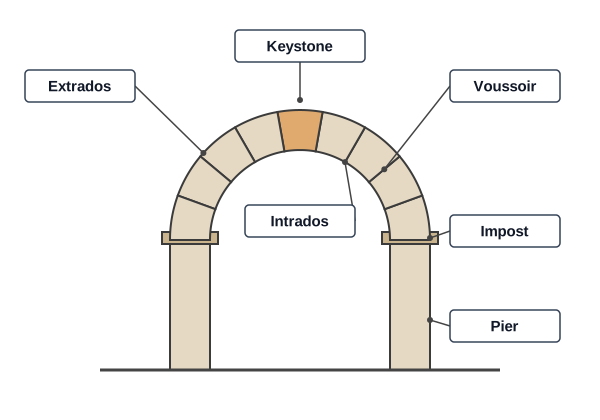
Keystone
Impost
Extrados course
Springer on the pier
The keystone at the crown completes the arch; before it is placed the arch needs temporary support (centering). The impost is the block at the pier top.
In the temple front, which three parts together make up the entablature?
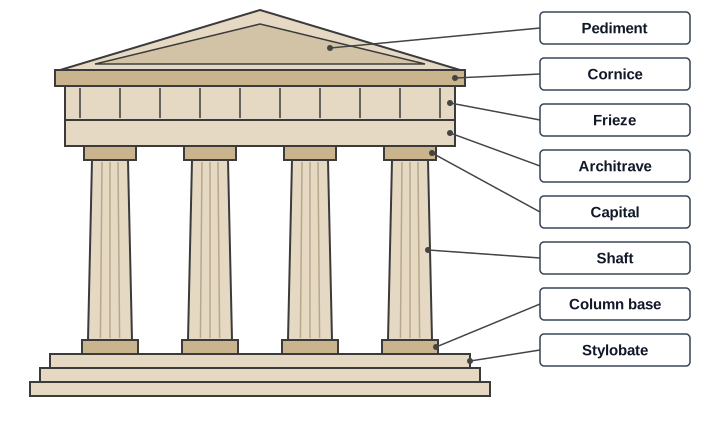
Pediment, tympanum and cornice
Architrave, frieze and cornice
Capital, shaft and base
Stylobate, base and shaft
The entablature is the horizontal assembly carried by the columns. Capital, shaft and base are parts of a column; the stylobate is the platform below.
In the Gothic cross-section, what is the main job of the arch spanning from the outer pier to the upper nave wall?
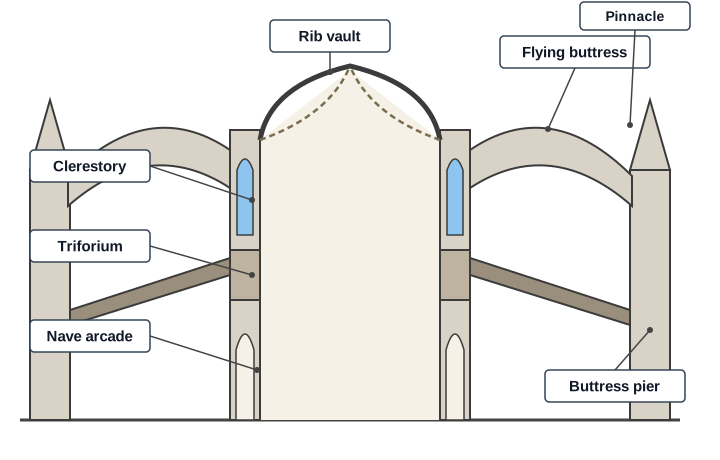
Support the aisle roof's weight
Carry the sideways thrust of the high vault to the outer buttress
Let light into the nave
Tie the two aisle walls together
The flying buttress carries horizontal thrust over the aisle roof. It does not light the nave; the clerestory windows do that.
Which arch in the diagram sends more of its load downward and less sideways than a semicircular arch?
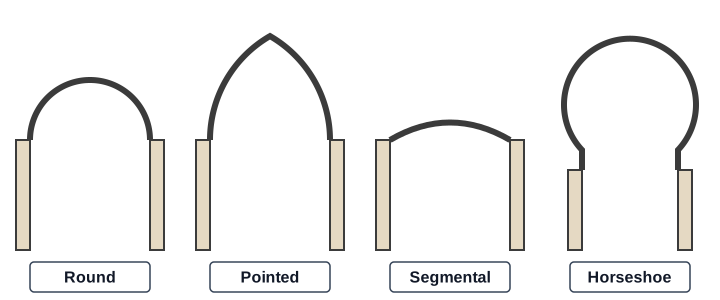
The round arch
The pointed arch
The segmental arch
The horseshoe arch
A pointed arch's steeper sides reduce lateral thrust. The segmental and horseshoe arches push outward more, as does the round arch.
Of the three capitals shown, which order is the oldest?
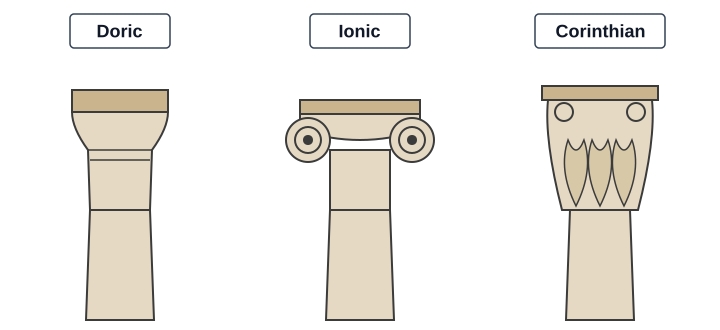
Corinthian
They are all the same age
Doric
Ionic
Doric dates to the 7th century BC; Ionic followed and Corinthian is the latest Greek order.
