Quiz · Medium
Slope, intercepts, point-slope and standard form, parallel and perpendicular lines and linear models, with several graph-reading questions.
What is the slope of the line through and ?
. The reciprocal comes from putting run over rise, and subtracting instead of gives the answer .
Which equation matches the line in the graph?
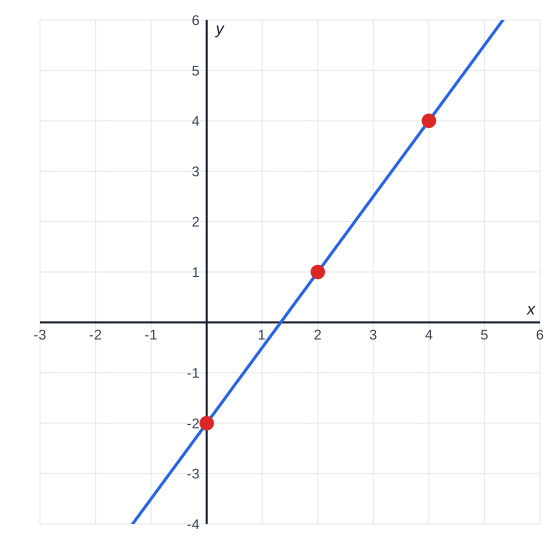
The line crosses the y-axis at and rises 3 for every 2 to the right, so and . swaps rise and run; misreads the intercept; the negative slope would make the line fall.
The line in the graph crosses the axes at (4, 0) and (0, 3). Which is its equation in standard form?
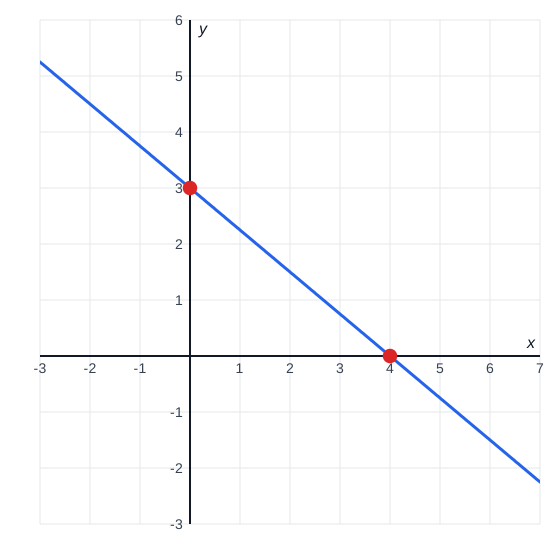
Plug in each intercept: and . would cross at and ; the minus sign gives a rising line.
Which is point-slope form for the line with slope 2 through ?
Point-slope is with , so . The other choices change a sign or swap the coordinates.
What is the slope of ?
Solve for y: , so . Slope . Forgetting that dividing by flips the sign of gives ; the formula is .
A line is perpendicular to . What is its slope?
Perpendicular slopes are negative reciprocals: flip the fraction and change the sign. forgets the sign change and forgets the flip.
Which line is parallel to and passes through ?
has slope . A parallel line has the same slope; through the intercept is 4. has the wrong sign; would be a different slope.
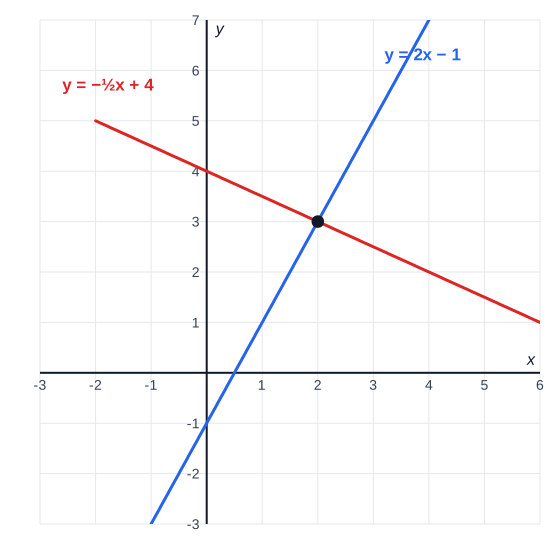
The lines and are graphed. How are they related?
Parallel
Identical
Perpendicular
Neither parallel nor perpendicular
The slopes are 2 and . Their product is , so the lines meet at a right angle.
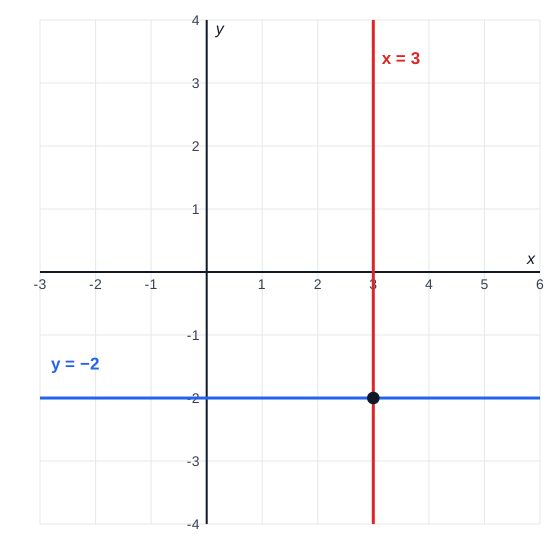
Which statement about the red and the blue line is correct?
Red has slope 0; blue has undefined slope.
Both lines have slope 0.
Red has undefined slope; blue has slope 0.
Red has slope 3 and blue has slope .
A vertical line has an undefined slope because the run is 0; a horizontal line has slope 0 because the rise is 0. The numbers in x = 3 and y = -2 are positions, not slopes.
A vertical line has a slope of 0.
True
False
A vertical line has an undefined slope (the run is 0). A horizontal line has slope 0.
What do the four lines in the graph have in common?
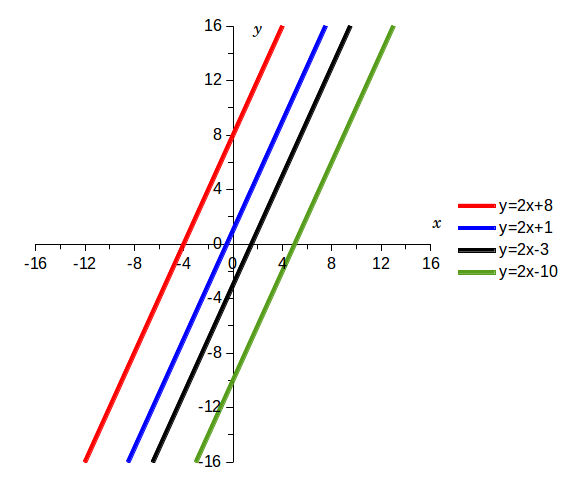
They all have slope 2, so they are parallel.
They all pass through the origin
They all have the same y-intercept
They are all perpendicular to each other
The legend shows y = 2x + 8, 2x + 1, 2x - 3 and 2x - 10: same slope, different intercepts. Image: ASnieckus, CC0, via Wikimedia Commons.
The table shows a linear relationship. Which equation fits it?
x: 0, 2, 4, 6
y: 5, 11, 17, 23
y goes up by 6 when x goes up by 2, so . At , , so . Using 6 as the slope forgets to divide by the change in x.
A phone plan costs $25 a month plus $0.05 per minute. In C = 0.05m + 25, what does 0.05 represent?
The fixed monthly fee
The total cost for one minute including the fee
The number of minutes in a month
The cost per minute (the rate of change)
The slope is the amount the cost changes for each additional minute. The fixed fee is the y-intercept, 25.
What is the x-intercept of ?
Set : , so . is the y-intercept.
Lines with slopes 3 and -1/3 are perpendicular.
True
False
, so the slopes are negative reciprocals.
Gym A costs $30 to join plus $20 a month; Gym B costs $90 to join plus $10 a month. After 8 months, which is cheaper?
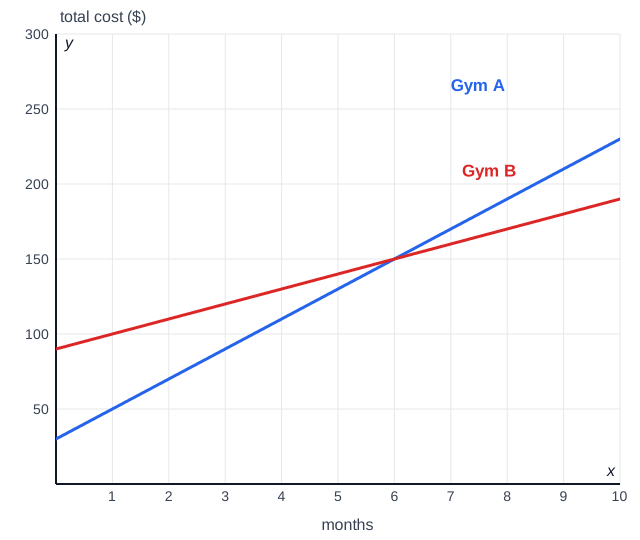
Gym A, by $20
Gym B, by $20
They cost the same
Gym B, by $60
Gym A: . Gym B: . The lines cross at 6 months, after which Gym A's higher monthly rate catches up.
Write in slope-intercept form.
Subtract : . Divide every term by : . A common mistake is to divide only the x term.
What is the y-intercept of ?
Set : , so . The 15 is the constant in standard form, not the intercept, unless you divide by the coefficient of .
Find the equation of the line through (1, 3) and (5, 11).
. Then gives . Using mixes up the y-value of the first point with the intercept.
y varies directly with x, and y = 20 when x = 5. What is y when x = 8?
25
160
32
13
, so and . Adding the difference (20 + 3 = 23) is treating it as additive instead of proportional.
