Quiz · Medium
Twenty-one questions on subspace tests, span, independence, bases, coordinates, dimension counting and orthogonality in vector spaces.
Which of these is a subspace of ℝ³?
{(x, y, z) : x ≥ 0}
{(x, y, z) : x + y + z = 0}
{(x, y, z) : xyz = 0}
{(x, y, z) : x + y + z = 1}
x + y + z = 0 is a plane through the origin, closed under addition and scaling. The plane x + y + z = 1 misses the origin; x ≥ 0 fails for negative scalars; xyz = 0 is a union of three coordinate planes, and (1, 1, 0) + (0, 0, 1) = (1, 1, 1) leaves it.
Which set is NOT a subspace of ℝ²?
{(x, y) : y = −3x}
{(x, y) : x = 0}
{(x, y) : x² + y² ≤ 1}
{(x, y) : x = y}
The closed unit disk is not closed under scalar multiplication: (1, 0) is in it but 5(1, 0) is not. The other three are lines through the origin.
The two vectors in the picture are not parallel. What is the shaded set?
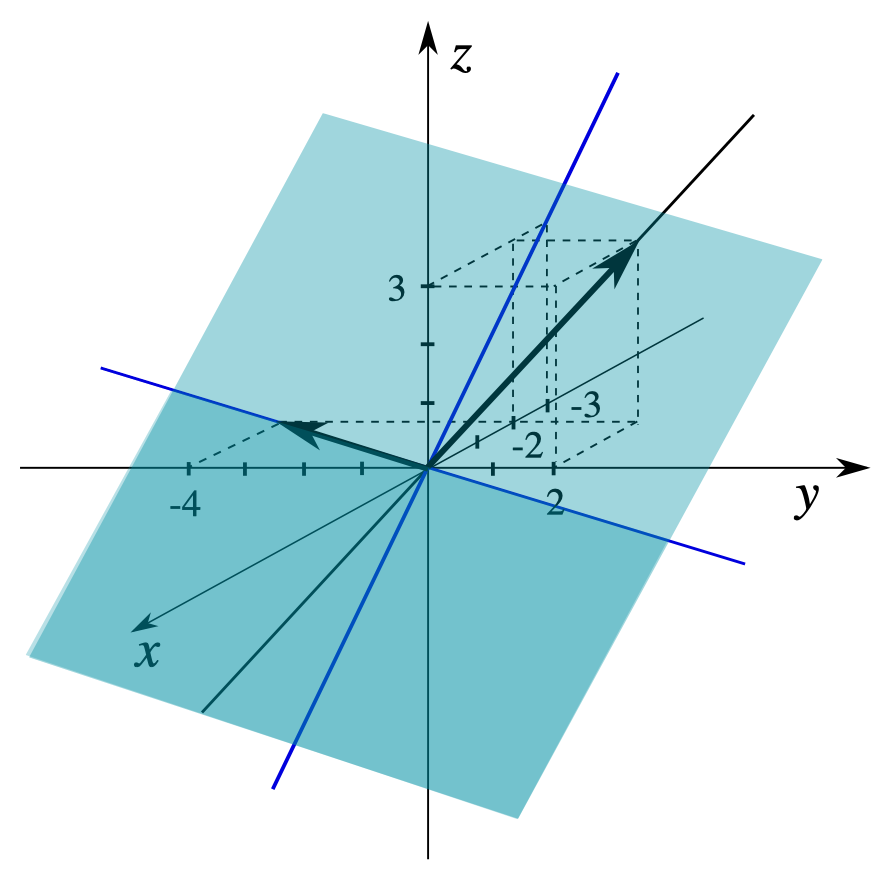
A plane through the origin
A plane that does not contain the origin
All of ℝ³
A line through the origin
The span of two non-parallel vectors is the set of all c₁v₁ + c₂v₂, which is a plane through the origin (take c₁ = c₂ = 0 for the origin). Two vectors can never span all of ℝ³. Image: JozumBjada, CC BY-SA 3.0, via Wikimedia Commons.
Which vector lies in span{(1, 0, 1), (0, 1, 1)}?
(0, 0, 1)
(1, 2, 4)
(1, 1, 1)
(2, 3, 5)
Every combination has the form (a, b, a + b). (2, 3, 5) fits with a = 2, b = 3. In the other options the third entry is not the sum of the first two.
Which set of vectors is linearly dependent?
{(1, 2), (2, 4)}
{(1, 0, 0), (0, 1, 0), (0, 0, 1)}
{(1, 0), (0, 1)}
{(1, 1), (1, −1)}
(2, 4) = 2(1, 2), so the pair is dependent. The other sets are independent (the last is the standard basis of ℝ³).
What is dim P₃, the space of polynomials of degree at most 3?
5
Infinite
3
4
A basis is {1, x, x², x³}, which has 4 elements. Do not subtract 1: the constant term counts.
What is the dimension of M₂ₓ₃, the space of 2 × 3 real matrices?
6
8
2
5
There are 2 · 3 = 6 free entries, and the six matrix units form a basis.
Which set is a basis of ℝ²?
{(1, 1), (2, 2), (3, 3)}
{(1, 0), (1, 1)}
{(1, 2), (2, 4)}
{(0, 0), (1, 1)}
(1, 0) and (1, 1) are independent and there are 2 of them, which is the dimension. The first set is dependent, the second contains 0, and the third has too many vectors, all multiples of one another.
What are the coordinates of v = (5, 1) with respect to the basis B = {(1, 1), (1, −1)}?
(6, 4)
(5, 1)
(3, 2)
(2, 3)
Solve c₁ + c₂ = 5 and c₁ − c₂ = 1: c₁ = 3, c₂ = 2. Check: 3(1, 1) + 2(1, −1) = (5, 1). Swapping the order of the basis vectors would swap the coordinates.
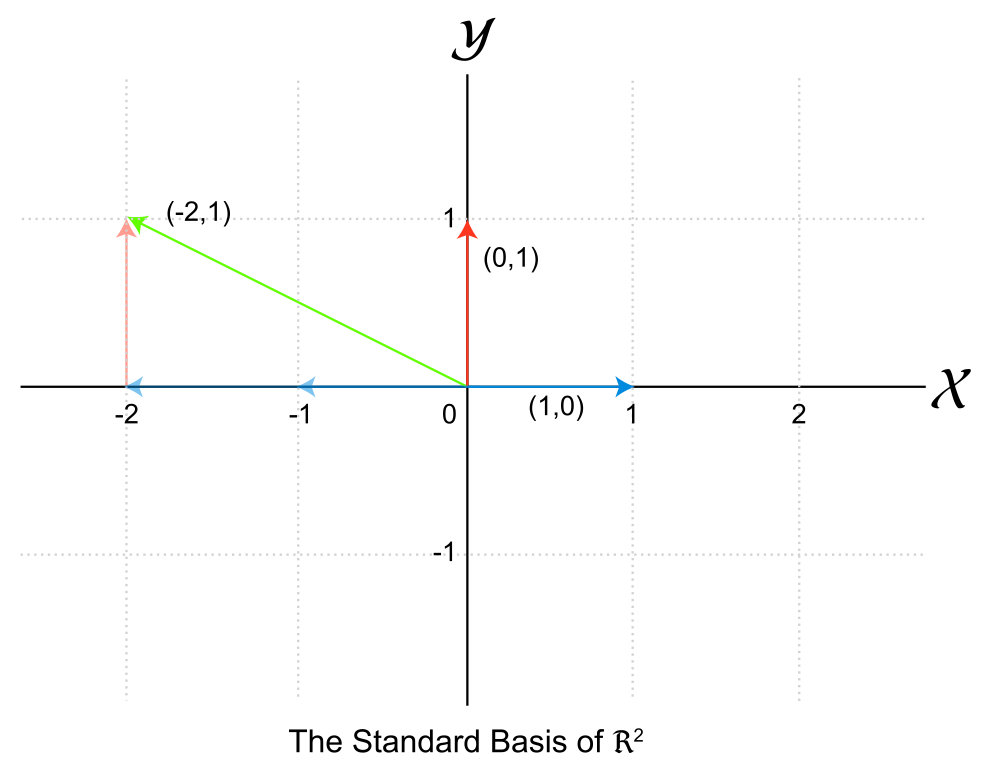
What are the coordinates of the green vector in the standard basis of ℝ² shown?
(2, −1)
(−1, 2)
(1, −2)
(−2, 1)
The green vector ends at x = −2, y = 1, so it equals −2e₁ + 1e₂ with coordinates (−2, 1). Image: Fiachra (derivative work), CC BY-SA 3.0, via Wikimedia Commons.
A is a 3 × 5 matrix of rank 3. What is dim Nul A?
2
3
5
0
Rank-nullity: rank + nullity = number of columns = 5, so nullity = 5 − 3 = 2. Using the number of rows instead gives the wrong answer 0.
A is a 4 × 6 matrix. In which space does its column space live?
It depends on the rank
ℝ⁶
ℝ⁴
ℝ²⁴
Each column has 4 entries, so Col A ⊆ ℝ⁴. The row space and the null space live in ℝ⁶.
W is a 2-dimensional subspace of ℝ⁵. What is dim W⊥?
3
5
7
2
dim W + dim W⊥ = 5, so dim W⊥ = 3.
What is the projection of (3, 4) onto the line spanned by u = (1, 2)?
(3/5, 4/5)
(11/5, 22/5)
(3, 6)
(1, 2)
The projection is ((v·u)/(u·u))u = (11/5)(1, 2) = (11/5, 22/5). The option (3/5, 4/5) is the unit vector in the direction of v, not a projection.
u and v are orthogonal with ‖u‖ = 3 and ‖v‖ = 4. What is ‖u + v‖?
5
1
√7
7
By the Pythagorean theorem ‖u + v‖² = 9 + 16 = 25, so the length is 5. Adding lengths (7) only works for parallel vectors in the same direction.
True or false: four vectors in ℝ³ can be linearly independent.
True
False
False. ℝ³ has dimension 3, so any 4 vectors are dependent: the 3 × 4 matrix has at most 3 pivots, leaving a free variable.
True or false: any two bases of the same vector space have the same number of vectors.
True
False
True. This is the invariance of dimension, and it is what makes 'dimension' well defined.
Why are the invertible 2 × 2 matrices not a subspace of M₂ₓ₂?
They are not closed under transposes
They have the wrong dimension
They are not closed under scalar multiplication
The zero matrix is not invertible, and the sum of invertible matrices can be singular
A subspace must contain the zero matrix, which is singular. Also I + (−I) = 0 shows closure under addition fails. They are closed under nonzero scalars and transposes, but that is not enough.
What is span{(1, 2), (2, 4)}?
Only the zero vector
ℝ²
The line y = 2x
The line y = x/2
Both vectors lie on the line y = 2x, and (2, 4) = 2(1, 2), so the span is that line. It is not ℝ² because the vectors are dependent.
u and v are nonzero and orthogonal. What must be true?
They have the same length
They are unit vectors
u = −v
They are linearly independent
If c₁u + c₂v = 0, dotting with u gives c₁‖u‖² = 0, so c₁ = 0, and similarly c₂ = 0. Orthogonal vectors need not have the same length or length 1.
What is the dimension of {(x, y, z, w) ∈ ℝ⁴ : x + y = 0 and z = w}?
1
2
3
4
Two independent linear conditions remove two dimensions from 4. Free variables y and w give a basis (−1, 1, 0, 0), (0, 0, 1, 1).
