Quiz · Medium
Conceptual and numerical questions on Bernoulli, hydrostatics, Reynolds number, pipe friction, pump power and drag.
Water flows through a horizontal pipe that narrows. What happens to pressure and velocity in the narrow section (ideal flow)?
Velocity increases, pressure decreases
Velocity increases, pressure increases
Velocity decreases, pressure decreases
Velocity decreases, pressure increases
Continuity (A1V1 = A2V2) forces V up in the smaller area; Bernoulli then says static pressure must fall to pay for the extra kinetic energy. The tempting 'squeezing raises pressure' ignores that the fluid accelerates.
Which description matches the velocity profile of fully developed laminar flow in a circular pipe?
Linear from wall to centerline
Flat core with a thin steep layer at the wall
Parabolic, with centerline speed twice the average
Uniform across the whole section
Laminar pipe flow is parabolic with V_max = 2 V_avg. The flat-core profile is turbulent; a linear profile appears in Couette flow between plates; a uniform profile would violate no-slip.
Water (rho = 1000 kg/m3, mu = 0.001 Pa·s) flows at 1 m/s in a 50 mm pipe. The flow is:
Laminar, Re about 50
Laminar, Re about 2000
Transitional, Re about 4000
Turbulent, Re about 50,000
Re = rho V D / mu = 1000 x 1 x 0.05 / 0.001 = 50,000, far above 4000. Forgetting to convert mm to m is the usual mistake.
Fluid exits a small hole 5 m below the free surface of a large open tank. Ideal exit speed?
3.1 m/s
7.0 m/s
49 m/s
9.9 m/s
Torricelli: V = sqrt(2gh) = sqrt(2 x 9.81 x 5) = 9.9 m/s. 49 is 2gh without the square root; 7.0 is sqrt(gh) without the factor 2.
If the flow rate through the Venturi meter shown increases, what happens to the manometer reading Δh?
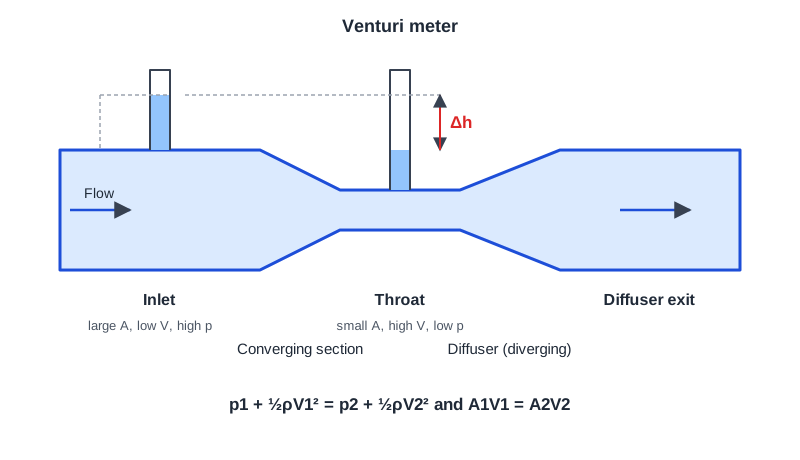
Δh decreases, because the fluid moves faster
Δh increases, because the pressure difference grows with the square of the flow
Δh stays the same, since it depends only on geometry
Δh drops to zero at high flow
The pressure difference is Δp = ½ρ(V2² − V1²), which scales with Q², so Δh rises with flow; that is how the meter measures flow rate. Higher speed does not cancel the pressure drop; it causes it.
The gauge pressure at 10 m depth in fresh water is closest to:
9.81 kPa
101 kPa
98.1 kPa
199 kPa
p = rho g h = 1000 x 9.81 x 10 = 98.1 kPa gauge. 199 kPa is the absolute pressure (adds atmosphere), not gauge.
A vertical rectangular gate is 3 m tall with its top at the water surface. At what depth does the resultant hydrostatic force act?
1.0 m
1.5 m
3.0 m
2.0 m
The pressure distribution is triangular, so the resultant acts at two-thirds of the depth (2 m). The centroid at 1.5 m is a common wrong answer: the center of pressure always lies below it.
True or false: in a static fluid, pressure at a given depth depends on the shape of the container.
True
False
Pressure depends only on depth, density and g. Wide, narrow or slanted vessels give the same pressure at the same depth (hydrostatic paradox).
A fully developed laminar pipe flow has Re = 1600. The Darcy friction factor is:
0.016
0.04
0.064
0.4
f = 64/Re = 64/1600 = 0.04. For laminar flow, roughness does not matter, so the Moody chart is not needed.
If the pipe diameter is halved with everything else held fixed (laminar flow, same pressure drop and length), the flow rate becomes:
1/2
1/4
1/16
1/8
Hagen-Poiseuille: Q is proportional to D^4, so (1/2)^4 = 1/16.
A pump delivers 0.05 m3/s of water against 20 m head with 75% efficiency. Required shaft power?
7.4 kW
13.1 kW
9.8 kW
17.4 kW
P = rho g Q H / eta = 1000 x 9.81 x 0.05 x 20 / 0.75 = 13.1 kW. Forgetting to divide by efficiency gives 9.8 kW (hydraulic power).
A pump's speed is increased by 50%. Power consumption changes by a factor of:
1.5
2.25
3.375
5.06
Affinity laws: P is proportional to N^3, and 1.5^3 = 3.375. 2.25 is the head factor (N^2).
Where on a pump-system plot does the pump actually run?
At shutoff head
At the intersection of the pump curve and system curve
At the maximum-flow end of the pump curve
At the minimum of the system curve
Only at the intersection do the head supplied and head required match, fixing Q. The system curve is static head plus losses proportional to Q^2.
A car body has Cd = 0.5, frontal area 2 m2, speed 20 m/s in air of 1.2 kg/m3. Drag force?
120 N
4800 N
480 N
240 N
F = 0.5 x 1.2 x 20^2 x 0.5 x 2 = 240 N. 480 N omits the one-half.
Doubling the speed of a vehicle (constant Cd) raises the aerodynamic drag power by a factor of:
2
4
8
16
Drag force goes as V^2 and power = force x speed, so P is proportional to V^3: 8 times.
Why do golf-ball dimples reduce drag?
They make the ball lighter
They increase the Reynolds number by changing viscosity
They remove skin friction entirely
They trigger a turbulent boundary layer that separates later, shrinking the wake
A turbulent boundary layer resists adverse pressure gradients better, so separation is delayed and pressure drag falls. Friction drag actually rises slightly, but pressure drag dominates on a sphere.
The Buckingham Pi theorem gives how many dimensionless groups for 5 variables involving 3 primary dimensions?
1
8
3
2
n - k = 5 - 3 = 2, provided the 3 dimensions really are independent.
Which dimensionless number must a ship model match to reproduce wave-making resistance?
Froude
Reynolds
Mach
Weber
Wave resistance is gravity-driven, so Froude number V/sqrt(gL) is matched. Reynolds is impractical to match simultaneously.
Which statement about the boundary layer on a flat plate is correct?
Velocity is maximum at the wall
Pressure is zero inside it
Velocity is zero at the wall and rises to the free-stream value
It is always thinner downstream
No-slip makes u = 0 at the wall. The layer thickens downstream, and turbulence thickens it faster.
A water jet of area 0.001 m2 and speed 10 m/s strikes a fixed flat plate normally and flows off sideways. Force on the plate?
100 N
50 N
10 N
1000 N
F = rho A V^2 = 1000 x 0.001 x 100 = 100 N: mass flow 10 kg/s times 10 m/s.
Cavitation in a pump begins when:
Reynolds number exceeds 4000
Flow becomes supersonic
The fluid becomes non-Newtonian
Local pressure drops to the liquid's vapor pressure
Local static pressure at the impeller eye falls to the vapor pressure so bubbles form; keep NPSH available above NPSH required.
Which fluid shows shear-thickening behavior?
Cornstarch suspension
Water
Ketchup
Toothpaste
Cornstarch in water gets more viscous under rapid shear. Ketchup is shear-thinning; toothpaste is a Bingham plastic; water is Newtonian.
Why can Bernoulli's equation not be applied directly across a pump?
The fluid becomes compressible
Bernoulli only works for gases
The pump adds energy (shaft work), which Bernoulli excludes
Pressure is zero inside pumps
Bernoulli assumes no shaft work; add a pump head term to the energy equation instead.
