Quiz · Hard
Choosing a test, computing t, z and chi-square statistics, intervals and conditions for one- and two-sample procedures.
Which test compares the mean of one sample to a hypothesized value when sigma is unknown?
One-sample z test
One-sample t test
Chi-square test
Two-proportion z test
Unknown sigma requires the t distribution.
Degrees of freedom for a one-sample t test with n = 16 are...
15
16
14
32
df = n - 1.
For x-bar = 52, s = 6, n = 16 and H0: mu = 50, t is approximately...
0.33
2.00
0.67
1.33
SE = 6/4 = 1.5; t = 2/1.5 = 1.33.
Which interval is the 95% CI for the mean (x-bar = 52, s = 6, n = 16, t* = 2.131)?
46.0 to 58.0
50.0 to 54.0
48.8 to 55.2
51.0 to 53.0
Margin = 2.131 x 1.5 = 3.2; 52 ± 3.2.
A 95% CI for mu is (48.8, 55.2). For H0: mu = 50 versus Ha: mu not 50 at alpha = 0.05, you should...
Reject H0 since 50 is inside
Fail to reject H0 since 50 is inside the interval
Reject H0 since the interval is wide
Accept H0 with probability 0.95
Two-sided tests match intervals: 50 lies inside, so no rejection.
A poll of 400 people finds p-hat = 0.60. The 95% margin of error is about...
4.8%
2.4%
9.6%
0.5%
1.96 x sqrt(0.6 x 0.4/400) = 0.048.
To halve the margin of error for a proportion, the sample size must...
Be doubled
Be multiplied by 2.5
Stay the same but use higher confidence
Be multiplied by 4
ME is proportional to 1/sqrt(n), so 4n halves it.
Which choice increases the width of a confidence interval?
Increasing n
Decreasing the standard deviation
Raising the confidence level from 95% to 99%
Lowering the confidence level
A higher confidence level needs a larger critical value.
Two groups of the SAME subjects measured before and after treatment call for...
A two-sample t test
A paired t test on the differences
A chi-square test
A one-proportion z test
The data are matched pairs, not independent samples.
Which test compares success rates in two independent groups?
Two-proportion z test
Paired t test
One-sample t test
ANOVA
Categorical outcomes in two independent samples compare two proportions.
In the two-proportion z test, the standard error uses the pooled proportion because...
It is always more accurate
The sample sizes are equal
alpha is small
H0 assumes the two population proportions are equal
Under H0, a single common proportion is estimated by pooling.
A test of 45/100 versus 30/100 successes has pooled p-hat of...
0.15
0.75
0.375
0.45
(45 + 30)/(100 + 100) = 0.375.
A fair-die test with 60 rolls and counts 8, 12, 9, 11, 10, 10 has a chi-square statistic of...
10
1.0
0.1
6
Sum (O - E)^2/E = (4+4+1+1)/10 = 1.0.
The degrees of freedom for that goodness-of-fit test are...
5
6
59
1
k - 1 with k = 6 categories.
A 3 x 4 two-way table has how many degrees of freedom for a chi-square independence test?
12
7
5
6
(3 - 1)(4 - 1) = 6.
Which is a requirement for a chi-square test?
Observed counts equal to expected counts
Normal quantitative data
Expected counts of at least 5 in each cell
Paired observations
Expected counts must be large enough for the chi-square approximation.
ANOVA is used to compare...
Two proportions
Three or more group means
Variances of a single sample
A mean and a median
A single F test compares all means at once and controls the Type I error.
For the right-tailed z test shown, z = 1.80 and the p-value is about...
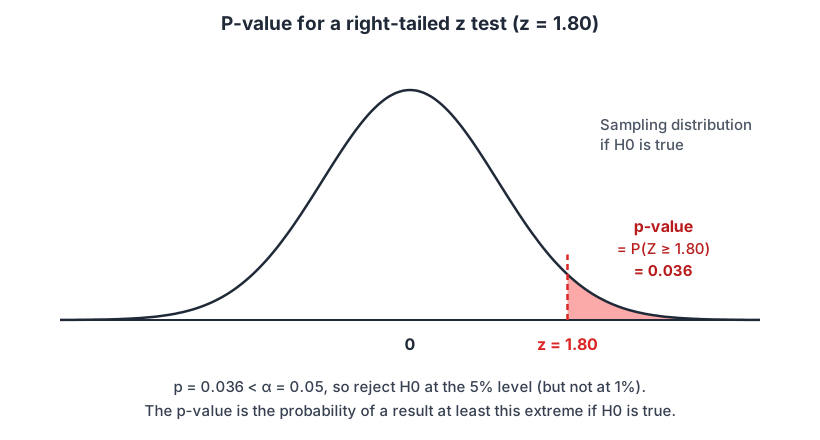
0.036
0.072
0.18
0.964
P(Z >= 1.80) = 0.0359.
A researcher states the result with a one-tailed test only after seeing which direction the data went. The problem is...
The power is lowered
The sample is biased
The test statistic is wrong
The Type I error rate is inflated
The direction must be set before seeing the data.
