Quiz · Medium
Twenty questions on the basics: lift and drag, angle of attack, boundary layers, induced drag, stall and compressible flow.
Which statement correctly describes lift?
It is the aerodynamic force component perpendicular to the relative wind.
It is the aerodynamic force component perpendicular to the ground.
It is the aerodynamic force component along the chord line.
It is always equal to the weight of the aircraft.
Lift is defined relative to the freestream, not the horizon. It equals weight only in steady, level flight.
The angle between the chord line and the relative wind is called:
Angle of incidence
Pitch angle
Angle of attack
Flight-path angle
Incidence is the fixed angle between the wing chord and the fuselage reference line. Pitch is measured from the horizon. Flight path angle is the path relative to the horizon.
An aircraft doubles its airspeed at the same angle of attack and altitude. Lift becomes:
2 times greater
Unchanged
8 times greater
4 times greater
: lift scales with , so doubling V gives four times the lift.
What does the Reynolds number represent?
The ratio of flow speed to the speed of sound
The ratio of inertial forces to viscous forces
The ratio of lift to drag
The ratio of pressure to density
. The ratio of speed to sound speed is the Mach number.
The speed of sound in air mainly depends on:
Pressure
Air density alone
Temperature
Wind speed
For an ideal gas . Pressure and density change together with altitude but cancel out in the formula.
Which labeled part of this airfoil is the chord line?
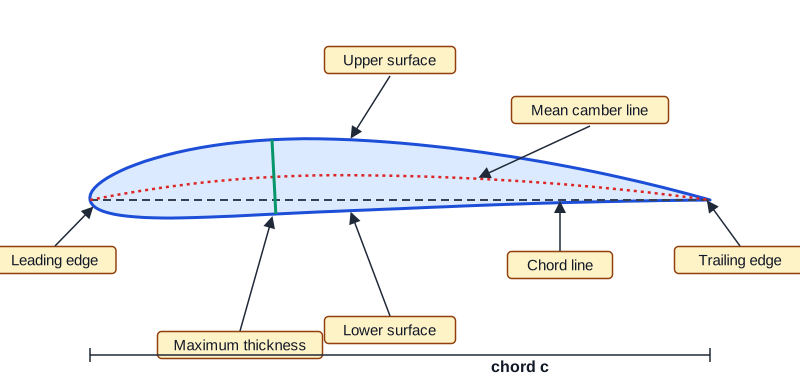
The straight dashed line from the leading edge to the trailing edge
The dotted line halfway between the surfaces
The green line across the thickest part
The curved upper surface
The dotted line is the mean camber line, and the green line shows the maximum thickness.
Which phenomenon causes induced drag?
Friction between air and the wing skin
Downwash from wingtip vortices tilting the lift vector aft
Shock waves on the wing
Flow separation behind the fuselage
Induced drag is a by-product of producing lift on a finite wing. Skin friction and separation are parasite drag, and shock waves cause wave drag.
Why do sailplanes have very long, slender wings?
A high aspect ratio reduces skin friction
Long wings reduce wave drag
Long wings raise the stall speed
A high aspect ratio reduces induced drag
: more aspect ratio, less induced drag. Skin friction depends mainly on wetted area.
On this lift curve, which feature marks the stall?
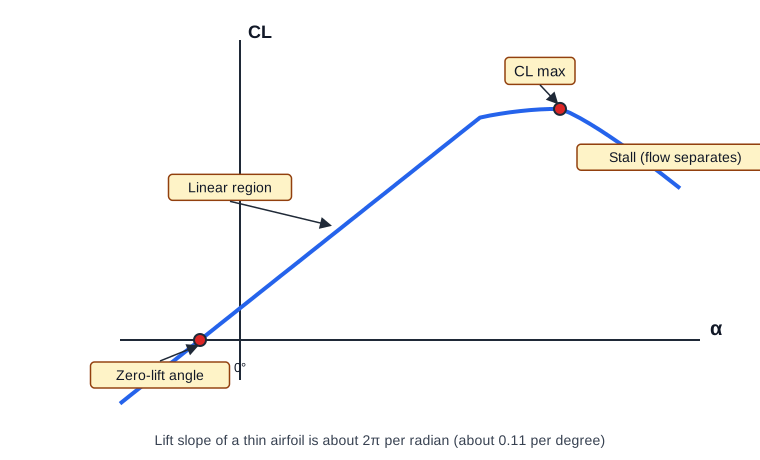
The peak of the curve, followed by falling lift
The point where the curve crosses the horizontal axis
Any point on the straight section
The origin of the graph
CL max occurs at the critical angle of attack. After this the flow separates and lift decreases.
A wing can stall at any airspeed.
True
False
Stall depends on exceeding the critical angle of attack. The usual stall speed applies only to 1 g level flight; a high load factor stalls the wing at a higher speed.
Compared with a laminar boundary layer, a turbulent boundary layer generally has:
Lower skin friction and worse resistance to separation
Lower skin friction and better resistance to separation
Higher skin friction but better resistance to separation
The same skin friction but thinner thickness
Turbulent mixing brings fast air toward the wall, which keeps the layer attached longer but increases shear at the wall.
Which of these is the best definition of the critical Mach number?
The Mach number at which the aircraft becomes supersonic everywhere
The Mach number at which the wing stalls
M = 0.3, where compressibility starts to matter
The freestream Mach number at which the local flow first reaches M = 1
Local acceleration over the wing means sonic flow appears while the aircraft is still subsonic.
What happens to the flow across a normal shock?
Mach number rises and static pressure falls
Mach number falls below 1 and static pressure rises
Mach number stays the same
Total pressure rises
A normal shock turns supersonic flow subsonic with an abrupt pressure and temperature rise. Total pressure drops because the process is irreversible.
Which of the following shows the flow around a convex corner at supersonic speed?
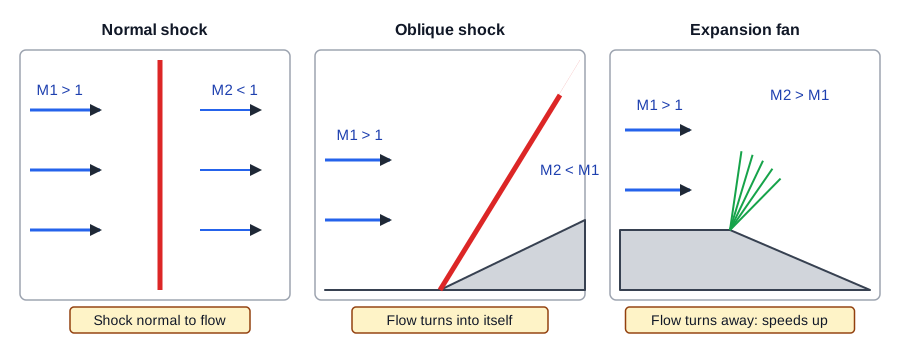
An oblique shock with a pressure rise
A normal shock
An expansion fan, with acceleration and a pressure drop
A stagnation point
A convex corner turns the flow away from itself, so it expands (Prandtl-Meyer). A concave corner produces an oblique shock.
What do trailing-edge flaps mainly do?
Increase camber and therefore CL max
Decrease the induced drag
Move the aerodynamic center forward
Increase the stall angle of attack by a large amount
Flaps raise the maximum lift and lower the stall speed, but add drag and often reduce the stall angle of attack.
Ground effect increases induced drag.
True
False
Close to the ground the wingtip vortices are suppressed and induced drag decreases, which is why aircraft seem to float before touchdown.
A supercritical airfoil is designed mainly to:
Maximize lift at low speed
Delay and weaken shock waves near Mach 0.8
Reduce skin friction in laminar flow
Operate only in supersonic flow
Its flat upper surface keeps the flow from accelerating to a strong supersonic peak, raising the drag-divergence Mach number.
The Mach angle of a body moving at Mach 2 is:
45°
60°
26.6°
30°
, so . 45° would correspond to M = 1.41, and 60° to M = 1.15.
Where is the aerodynamic center of a thin airfoil in subsonic flow?
About one quarter of the chord from the leading edge
At the leading edge
At the midpoint of the chord
At the trailing edge
The moment about this point does not change with angle of attack. In supersonic flow it moves to about half chord.
The curve labeled in this graph with a red dot at its lowest point shows:
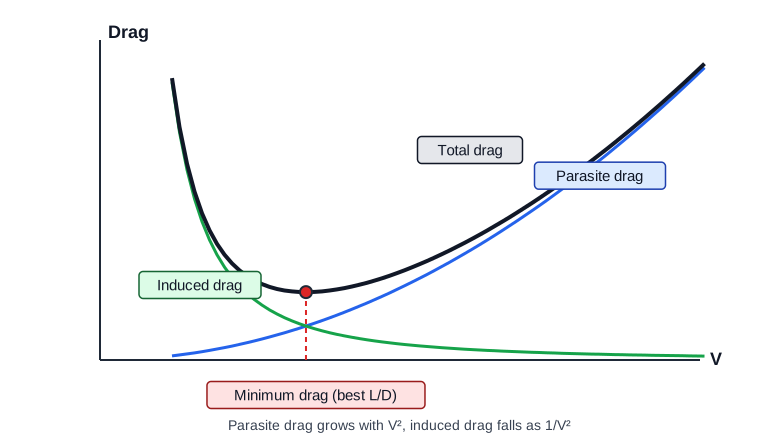
Induced drag, which is lowest at low speed
Parasite drag, which is lowest at high speed
Total drag, with minimum drag at the speed of best L/D
Lift, which is highest at low speed
Total drag is the sum of the parasite drag (rising with V²) and the induced drag (falling with V²). Their sum has a minimum where the two are equal.
