Quiz · Medium
Foundational questions on three-phase relations, power factor, transformers, motors and system structure.
In a balanced wye connection, the line-to-line voltage is
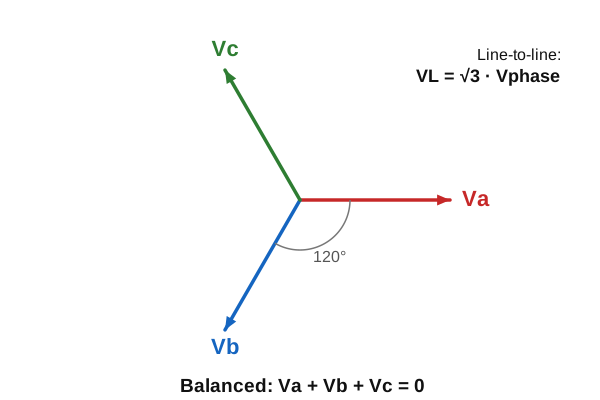
sqrt(3) times the phase voltage
equal to the phase voltage
1/sqrt(3) times the phase voltage
3 times the phase voltage
Each line voltage is the difference of two phase voltages 120 degrees apart, giving sqrt(3) V_ph. Equality holds for delta, not wye.
In a balanced delta connection, the line current is
equal to the phase current
sqrt(3) times the phase current
1/sqrt(3) times the phase current
3 times the phase current
Each line current is the difference of two phase currents, so it is sqrt(3) larger. Equality of current holds for wye.
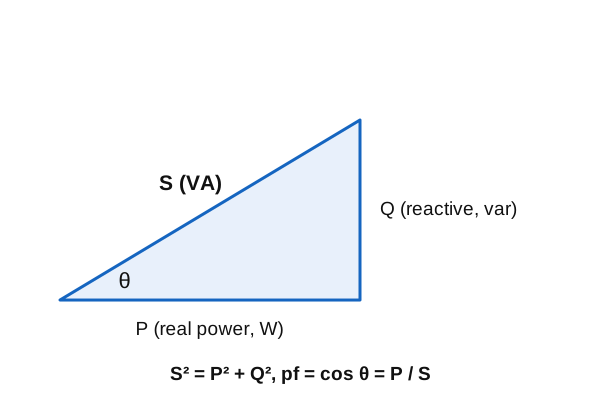
A load draws S = 600 VA with pf 0.8 lagging. What are P and Q?
P = 360 W, Q = 480 var
P = 600 W, Q = 480 var
P = 480 W, Q = 360 var
P = 480 W, Q = 600 var
P = S cos(theta) = 480 W, Q = S sin(theta) = 360 var (3-4-5 triangle). Swapping them is the usual slip.
A load with a leading power factor is
inductive
purely resistive
always generating real power
capacitive
Leading pf means current leads voltage, which is the behavior of a capacitive load. Inductive loads are lagging.
A 10 kVA, 2400/240 V transformer carries rated load. What is the secondary current?
41.7 A
4.17 A
417 A
24 A
I2 = 10000 / 240 = 41.7 A. 4.17 A is the primary current.
What is the main reason power is transmitted at high voltage?
Higher voltage makes the line impedance zero
For a given power, higher voltage means lower current and therefore lower I^2R losses
Generators can only produce high voltage
It increases the power factor
Current falls in inverse proportion to voltage and loss falls with its square. Line impedance does not change with voltage.
Which test on a transformer gives the core loss and magnetizing branch?
Short-circuit test
Insulation test
Open-circuit test
Polarity test
With the secondary open and rated voltage on the primary, the current and power drawn are those of the shunt (core) branch. The short-circuit test gives the series winding impedance.
A 4-pole induction motor runs on a 60 Hz supply. Its synchronous speed is
3600 rpm
900 rpm
1200 rpm
1800 rpm
Ns = 120 f / p = 120 x 60 / 4 = 1800 rpm. 3600 rpm applies to a 2-pole machine.
An induction motor rotates at 1710 rpm with Ns = 1800 rpm. The slip is
5%
0.5%
10%
95%
s = (1800 - 1710)/1800 = 0.05. 95% is the speed as a fraction of synchronous speed.
Bus types in a power flow study: which bus has both |V| and angle specified?
PV bus
Slack (swing) bus
PQ bus
Load bus with constant impedance
The slack bus fixes the voltage reference and absorbs the system's mismatch of real power and losses. PV buses specify P and |V|; PQ buses specify P and Q.
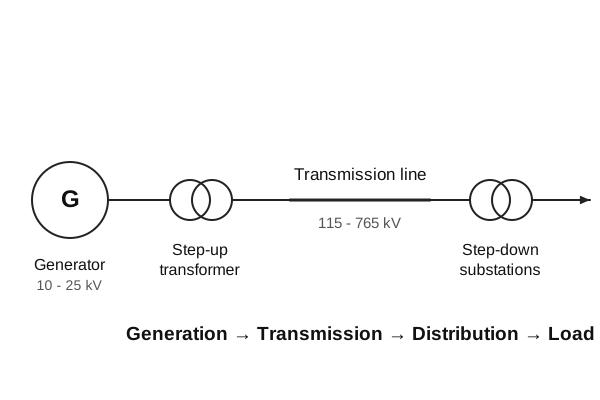
In the single-line diagram shown, which component raises the voltage before long-distance transmission?
The generator
The step-down substation
The step-up transformer
The load
A step-up transformer at the generating station raises voltage to cut transmission current and losses.
Which fault type is the most common on overhead lines?
Three-phase
Line-to-line
Double line-to-ground
Single line-to-ground
Single line-to-ground faults account for the large majority of faults (roughly 70-80%). Three-phase faults are rare but severe.
Which sequence networks does a three-phase symmetrical fault involve?
Positive sequence only
Positive and negative only
Positive and zero only
All three
A balanced fault has no negative or zero sequence components.
Reactive power flow between two buses depends mainly on
the difference in voltage angle
the difference in voltage magnitude
the line length only
the frequency
Q flows from the higher-voltage bus to the lower. Real power flow follows the angle difference.
A transformer can step up DC voltage if its turns ratio is large enough.
True
False
Transformers rely on a changing flux to induce voltage. Steady DC produces constant flux, hence no secondary voltage.
