Quiz · Hard
Harder questions: choosing and executing the right method, undetermined coefficients with overlap, resonance, Laplace transforms, stability from eigenvalues and uniqueness.
Solve , .
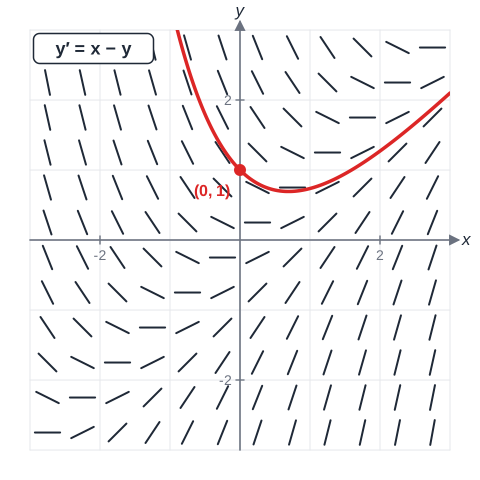
General ; so . This is the solution drawn on the slope field of .
Solve .
gives , and gives .
The IVP has a solution that
exists for all x
decays to 0
is periodic
blows up at x = 1
. Nonlinear equations can have solutions that exist only on a finite interval.
Which IVP fails the uniqueness hypothesis and indeed has two solutions?
Both and solve it. is discontinuous at 0; the others have continuous f and .
A 100 L tank holds pure water. Brine at 0.5 kg/L enters at 2 L/min and the mixture leaves at 2 L/min. The amount of salt tends to
100 kg
50 kg
0.5 kg
25 kg
, with equilibrium A = 50. (The concentration tends to 0.5 kg/L, times 100 L.)
A particular solution of is
: . No overlap with the homogeneous roots 1 and 2, so no extra x.
For , what is the correct form of the guess for ?
r = 2 is a simple root of the characteristic equation, so is already a homogeneous solution and the guess needs one extra factor of x.
The method for is
undetermined coefficients
separation of variables
variation of parameters
an integrating factor
does not have finitely many derivative forms, so undetermined coefficients fails.
What does the graph of show?
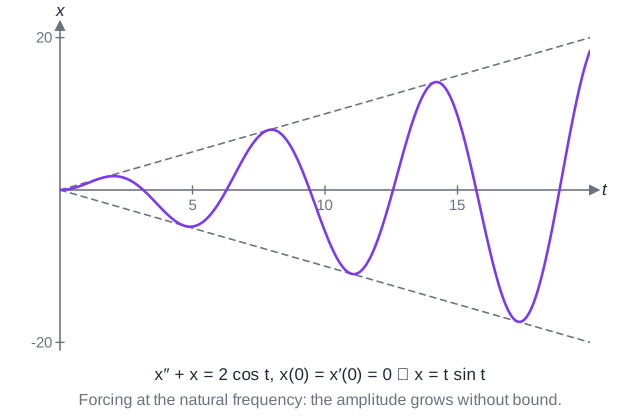
Resonance: oscillations growing like
Damped oscillation to zero
Steady-state oscillation of constant amplitude
Exponential growth
The forcing frequency matches the natural frequency (1). The envelope is ±t, linear rather than exponential growth.
Solve .
: the real part −1 goes in the exponent, the imaginary part 2 in the trig functions.
Using Laplace transforms, the solution of is
, so , and .
equals
, and the shift multiplies by .
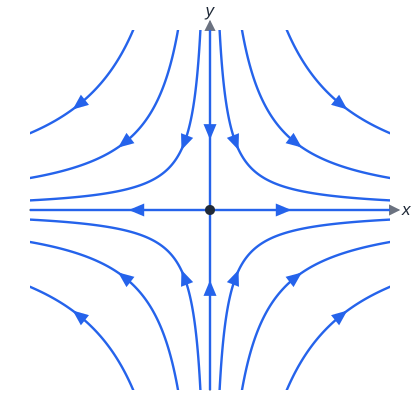
The system has an equilibrium at the origin that is
a stable node
a spiral sink
a saddle: unstable
a center
Eigenvalues +1 and −1 have opposite signs. Trajectories approach along the y-axis and leave along the x-axis.
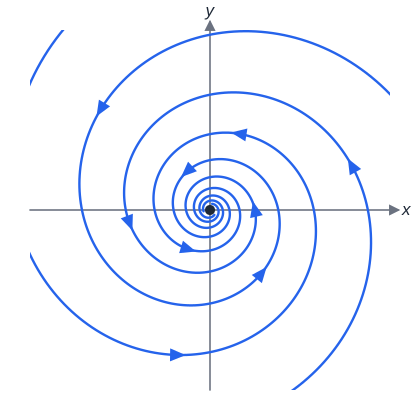
The eigenvalues are . The solution curves
spiral outward
form closed circles
spiral inward toward the origin
go straight into the origin
Negative real part means decay; the imaginary part makes the solution rotate.
Convert to a system with .
Solve the ODE for and rewrite in terms of u and v.
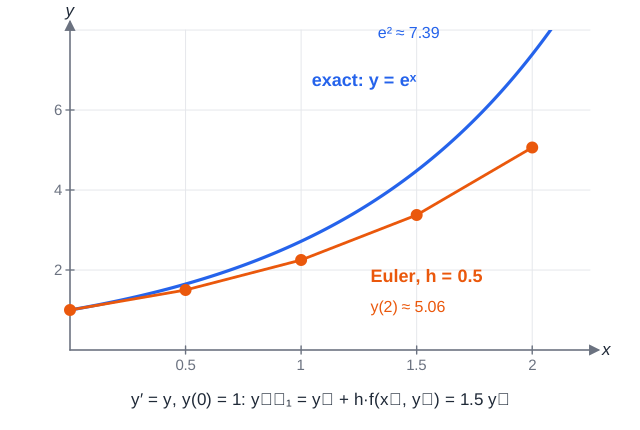
Euler's method with approximates the solution of at x = 2 as 5.0625 while the exact value is 7.389. This is because
Euler's method is exact for exponential equations
h is too large to be used
the initial value is wrong
the solution is convex, so tangent-line steps lie below it
Each step multiplies by 1.5 instead of . Smaller steps shrink the error.
