Quiz · Medium
Core statics: reactions, couples, distributed loads, trusses and friction. Foundational, mixed images.
Which set of equations must hold for a rigid body in 2D equilibrium?
ΣFx = 0 and ΣFy = 0 only
ΣFx = 0, ΣFy = 0, ΣM = 0
ΣM = 0 only
ΣF = ma and ΣM = Iα
A rigid body needs both force balance and moment balance. Force balance alone allows a pure rotation, and ΣF = ma, ΣM = Iα describe bodies that accelerate (dynamics).
In the figure, the support at B is a roller. Which reaction does it provide?
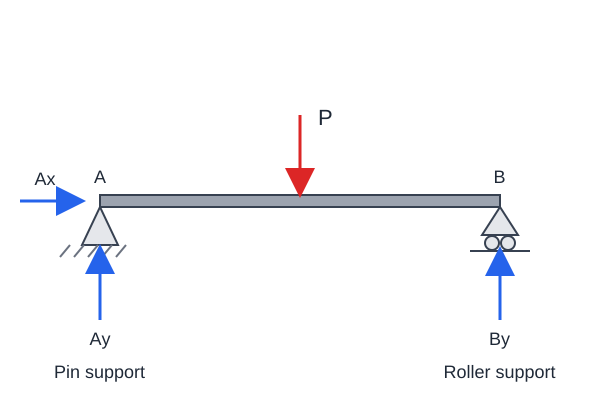
One vertical force By
Horizontal and vertical forces
A moment only
Vertical force and a moment
A roller cannot resist motion parallel to its supporting surface, so its single reaction is perpendicular to that surface. Horizontal force and moment belong to a pin (force only) and a fixed support (both).
How many unknown reaction components does a 2D pin support have?
1
3
4
2
A pin prevents translation in both directions (Rx, Ry) but allows rotation, so no moment. One unknown is a roller and three is a fixed support.
A 50 N force acts perpendicular to a lever arm 0.4 m long. What is its moment about the pivot?
125 N·m
0.008 N·m
20 N·m
50.4 N·m
M = Fd = 50 × 0.4 = 20 N·m. Dividing (125) or adding lengths are unit errors; the moment arm multiplies the force.
What is true of a couple?
It produces a net force and no moment
Net force is zero, but it produces a moment
It has a moment that depends on the point chosen
It requires two collinear forces
A couple is two equal, opposite, parallel forces with different lines of action. The forces cancel but the moment Fd is the same about every point. Collinear equal and opposite forces would give no moment at all.
A uniform load of 5 kN/m acts over a 4 m span. What is the equivalent single force and where does it act?
20 kN at the midpoint
20 kN at the left end
10 kN at the midpoint
20 kN at one third of the span
The resultant is the area under the load, 5 × 4 = 20 kN, and it acts at the centroid of that rectangle, the midpoint. One third of the span is the location for a triangular load.
A weightless member pinned at two points with no loads between them is a:
Three-force member
Zero-moment member
Couple member
Two-force member
The two end forces must be equal, opposite and collinear, so the force acts along the line joining the pins.
True or False: a force on a rigid body can be moved along its line of action without changing the external effects.
True
False
This is the principle of transmissibility. It would be false for the internal stresses or for a deformable body.
A triangular load of peak intensity w0 acts over length L. Where does the resultant act?
L/2 from either end
L/3 from the peak end
L/3 from the zero end
At the peak
The resultant ½w0L acts at the centroid of the triangle, one third of the base from the tall side. L/3 from the zero end is the common mix-up.
A 100 N weight hangs from the midpoint of a rope; each half of the rope makes 30° with the horizontal. Tension in the rope?
100 N
50 N
86.6 N
200 N
Vertical balance: 2T sin 30° = 100, so T = 100 N. 50 N forgets that sin 30° = 0.5 halves the vertical component; 200 N inverts the relation.
A truss has 8 members, 6 joints and 3 reaction components. It is:
Statically determinate
Statically indeterminate
A frame
Unstable (too few members)
m + r = 11 but 2j = 12, so there are fewer unknowns than equations and the structure is a mechanism. Determinate would need m + r = 2j.
At a joint of three truss members, two collinear, with no load or reaction, the third member is:
In tension
In compression
A zero-force member
Carrying half the load
Forces perpendicular to the collinear members can only be balanced by the third member being zero.
A 10 kg block rests on a horizontal floor with μs = 0.4 (g = 9.81). The largest static friction force is:
98.1 N
39.2 N
24.5 N
3.92 N
Fmax = μsN = 0.4 × 10 × 9.81 = 39.2 N. 98.1 N is the weight, and 24.5 N divides by μs.
How far above its base is the centroid of a triangle?
One third of the height
Half the height
Two thirds of the height
One quarter of the height
The centroid lies at the intersection of the medians, h/3 from any base. Two thirds is its distance from the apex.
The second moment of area of a rectangle (b × h) about its centroidal axis parallel to b is:
bh³/3
b³h/12
bh²/6
bh³/12
Ī = bh³/12. bh³/3 is about the base edge, and b³h/12 is about the other axis.
For the simply supported beam with a central load P shown, the maximum bending moment is:
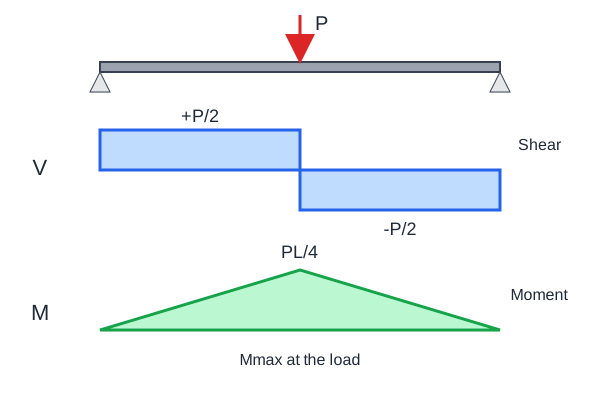
PL/2
PL/8
PL/4
P/2
Reaction P/2 at each support gives M at midspan = (P/2)(L/2) = PL/4. PL/2 and PL/8 do not match this loading; PL is the cantilever result and wL²/8 belongs to a uniform load.
A 2D beam is supported by a pin and two rollers. Is it statically determinate?
Yes, 3 unknowns
No, it has 4 unknowns for 3 equations
Yes, 4 unknowns
No, it has 2 unknowns
Pin (2) + two rollers (1 each) = 4 reactions but only 3 equations, so it is indeterminate to the first degree.
In the method of sections, how many members with unknown force should be cut?
At most three
Exactly two
At least four
Any number
Only three independent equations are available in 2D, so at most three unknown member forces can be found from one cut.
True or False: the friction force between two surfaces grows in proportion to the contact area.
False
True
In Coulomb friction, F ≤ μN depends on the normal force and material pair, not on contact area.
A block on an incline is just about to slide when the incline is at 26.6°. What is μs?
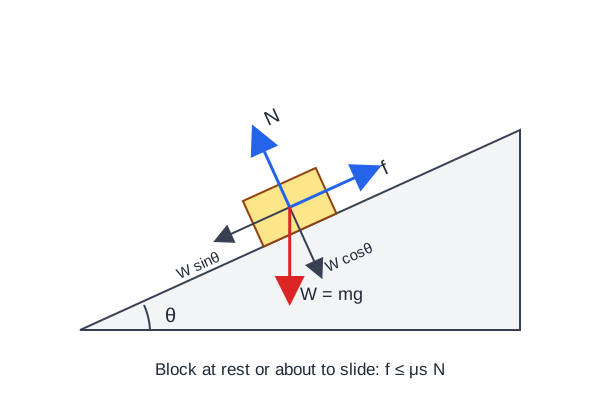
About 0.45
About 0.89
About 0.50
About 1.0
At impending slip tan θ = μs, so μs = tan 26.6° ≈ 0.50. The weight of the block does not matter.
In the figure, which expression gives the normal force on the block?
W sin θ
W cos θ
W
W tan θ
Perpendicular to the incline the weight component is W cos θ, which N balances. W sin θ is the component along the slope.
The truss shown has joints A, B, C, D and members AC, CB, AD, DB, CD. How many reaction components does it have?
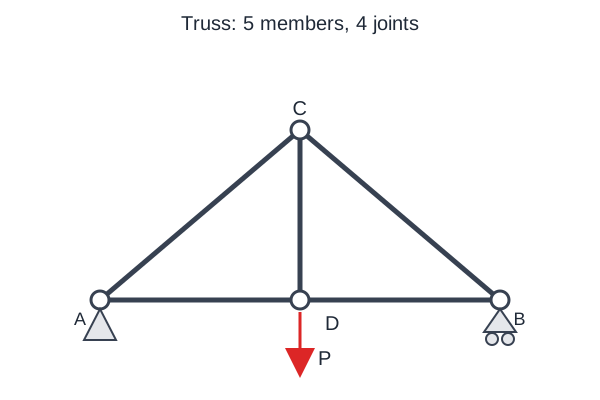
3
2
4
5
Pin at A gives 2 and the roller at B gives 1. Then m + r = 5 + 3 = 8 = 2j, so it is determinate.
