Quiz · Medium
Foundational practice with graphs: left, right, midpoint and trapezoid sums, signed area, displacement and distance from velocity, area between curves, volumes by washers, and the Fundamental Theorem.
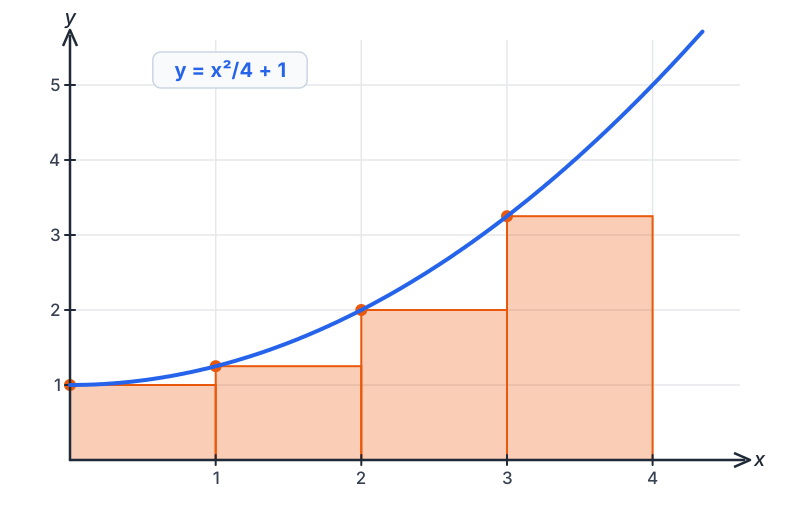
Using the graph of on , what is the left Riemann sum with 4 equal subintervals?
11.5
9.5
7.5
9.25
Left endpoints are x = 0, 1, 2, 3: 1 + 1.25 + 2 + 3.25 = 7.5, with Δx = 1. 11.5 uses the right endpoints.
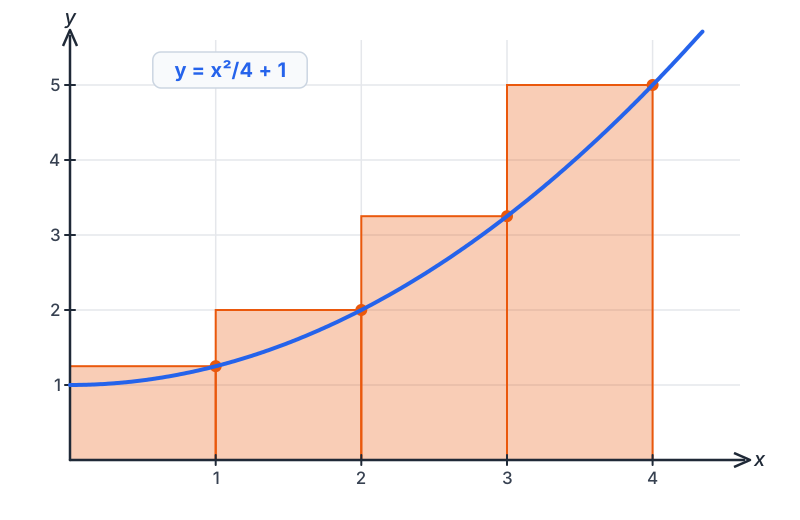
For the same function and the right Riemann sum with 4 subintervals, what is the value?
11.5
7.5
9.25
9.5
Right endpoints x = 1, 2, 3, 4: 1.25 + 2 + 3.25 + 5 = 11.5. Since f is increasing, every rectangle is taller than the curve.
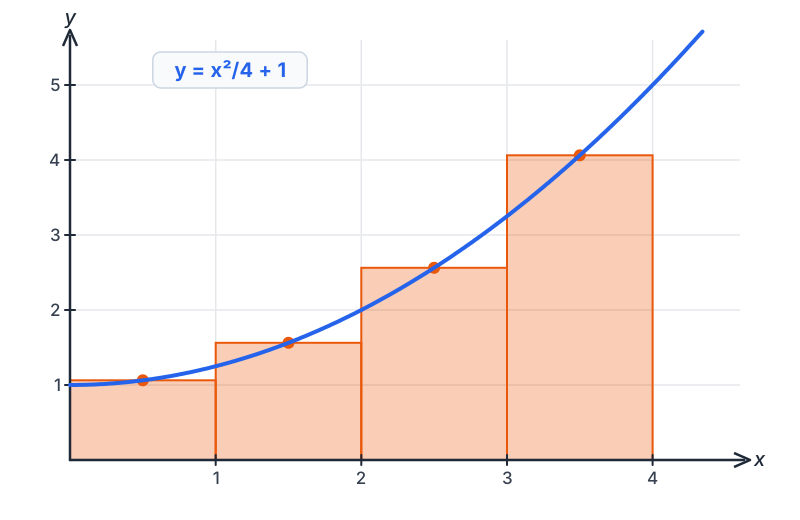
What is the midpoint sum with 4 subintervals for this function?
9.5
7.5
10
9.25
Midpoints 0.5, 1.5, 2.5, 3.5 give 1.0625 + 1.5625 + 2.5625 + 4.0625 = 9.25.
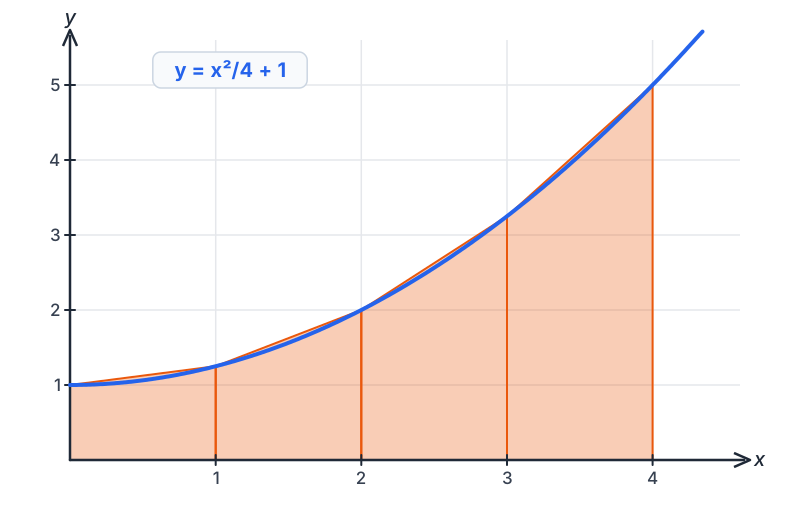
What is the trapezoidal sum with 4 subintervals for this function?
9.25
9.5
11.5
8.5
(Δx/2)[f(0) + 2f(1) + 2f(2) + 2f(3) + f(4)] = (1/2)(1 + 2.5 + 4 + 6.5 + 5) = 9.5. The average of the left and right sums (7.5 and 11.5) is also 9.5.
The function f is increasing on [0, 4]. Which statement about the left Riemann sum is true?
It overestimates the integral
It underestimates the integral
It equals the integral exactly
It depends on n, so nothing can be said
For an increasing function, the left endpoint is the lowest point of each subinterval, so every rectangle fits under the curve. The right sum overestimates.
What is the exact value of ?
9.5
8
The antiderivative is x³/12 + x. At 4: 64/12 + 4 = 28/3 ≈ 9.33, between the left sum (7.5) and the right sum (11.5). It is not 9.5; that is the trapezoidal estimate.
f is concave up on [a, b]. Which statement is true?
The trapezoidal rule overestimates and the midpoint rule underestimates
The trapezoidal rule underestimates and the midpoint rule overestimates
Both overestimate
Both are exact
Chords lie above a concave-up curve, so trapezoids are too big. Midpoint rectangles are equivalent to tangent-line strips, which lie below a concave-up curve. In the example: 9.5 > 9.33 > 9.25.
The graph of on is a trapezoid above the x-axis (and a semicircle below it on ). What is ?
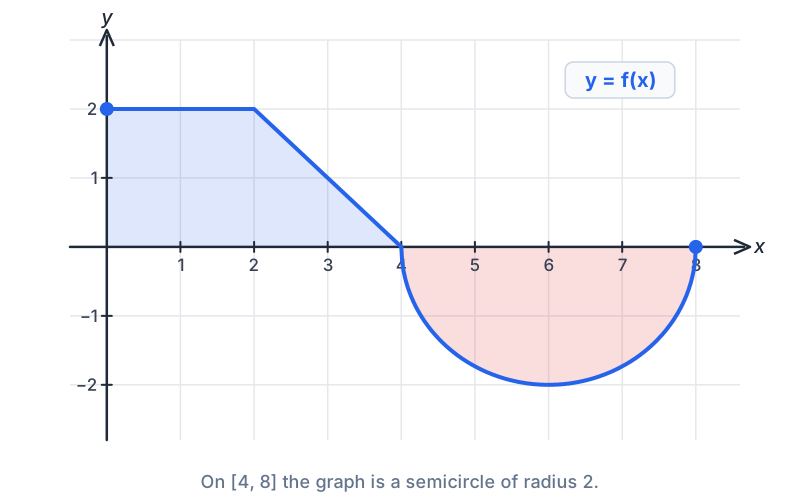
4
8
6
Trapezoid with parallel sides 4 and 2 and height 2: (1/2)(4 + 2)(2) = 6.
What is when the graph on is a semicircle of radius 2 below the axis?
The semicircle has area (1/2)π(2²) = 2π, counted negative below the axis. 2π would be the unsigned area.
What is ?
6
Signed areas add: 6 + (-2π). The 6 + 2π option is the total unsigned area.
What is the total (unsigned) area between the graph and the x-axis on [0, 8]?
12
Total area = ∫|f| dx: treat the region below the axis as positive.
The graph shows the velocity of a particle in m/s. What is its displacement from t = 0 to t = 10?
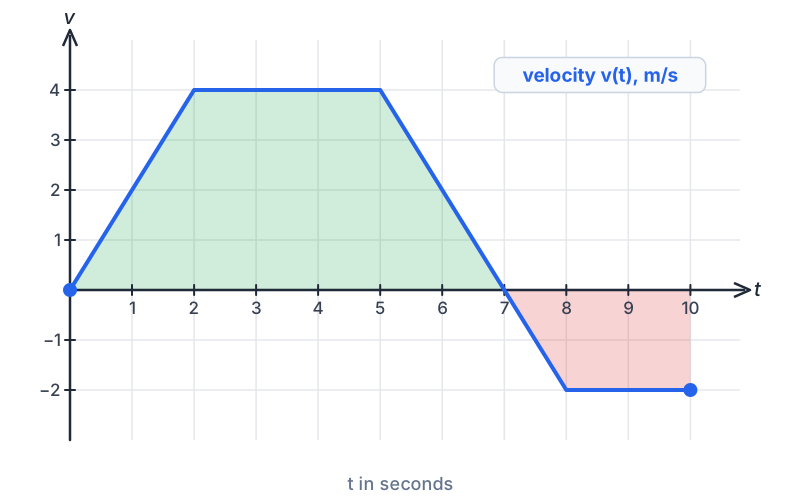
25 m
20 m
15 m
5 m
Positive area on [0, 7] is 20; negative area on [7, 10] is 1 + 4 = 5. Net: 20 - 5 = 15. The total distance is 25.
Using the same velocity graph, what is the total distance traveled from t = 0 to t = 10?
15 m
25 m
20 m
30 m
Distance = ∫|v| dt = 20 + 5 = 25. The particle turns around at t = 7.
The particle starts at s(0) = 3 m. Using the same velocity graph, where is it at t = 10?
15 m
28 m
18 m
8 m
s(10) = s(0) + displacement = 3 + 15 = 18. Forgetting the initial position gives 15.
Find the area of the region enclosed by and .
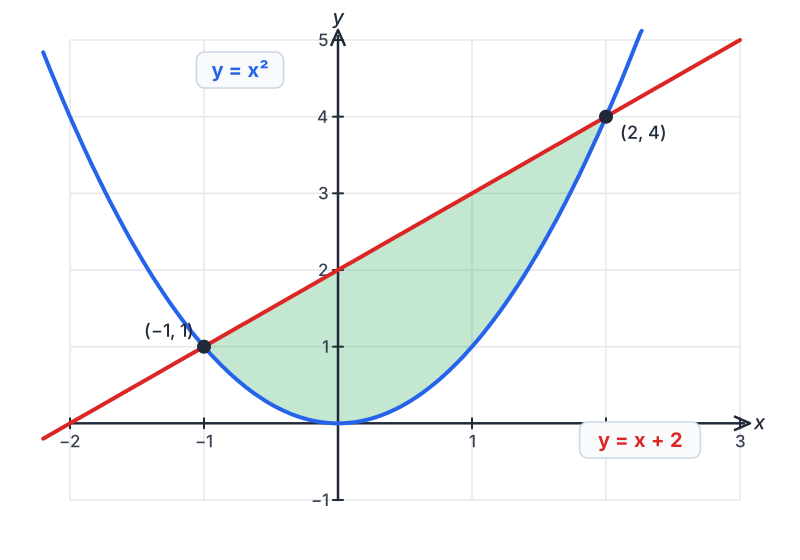
9
The curves meet at x = -1 and x = 2, and the line is on top: ∫(x + 2 - x²)dx = 9/2. Subtracting in the wrong order gives -9/2, not a valid area.
The region between an outer curve y = R(x) and an inner curve y = r(x) is rotated about the x-axis. Which integral gives the volume?
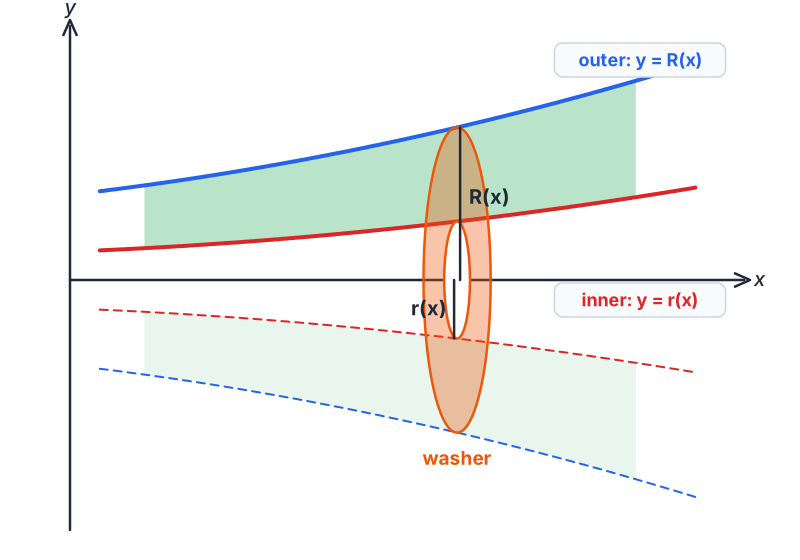
A washer has area π(R² - r²). Squaring the difference is the common mistake; the shell formula with x as the radius is for rotation about the y-axis.
What is ?
FTC Part 1 plus the chain rule: sin(upper limit) times the derivative of the upper limit.
In the notation shown, which part tells you the variable of integration?
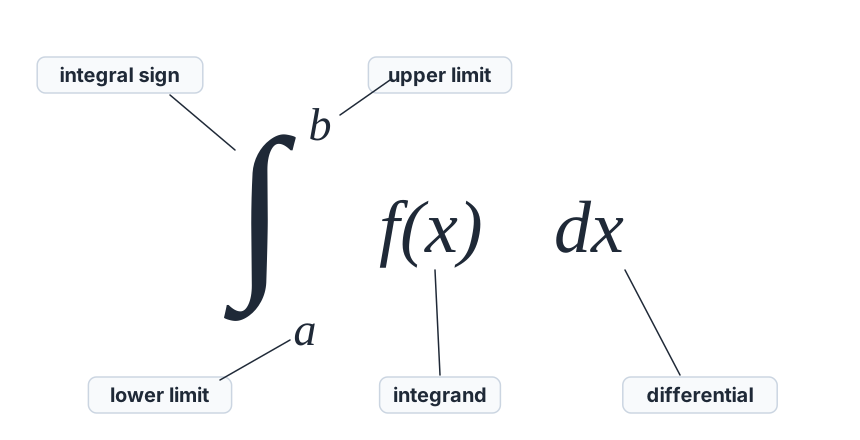
The differential dx
The integrand f(x)
The lower limit a
The integral sign
dx names the variable. In u-substitution it must be converted to du as well.
for any integrable function f.
True
False
Swapping the limits reverses the direction of integration and flips the sign.
because the interval is symmetric about 0.
True
False
The cancellation rule is for ODD functions. x² is even, so the integral is 2/3, twice the half-interval integral.
converges exactly when .
True
False
For p = 1 it gives ln t and diverges; for p > 1 it equals 1/(p - 1).
