Quiz · Medium
Mixed concept and calculation questions on crystal structure, the iron-carbon diagram, tensile properties, fracture, fatigue and creep.
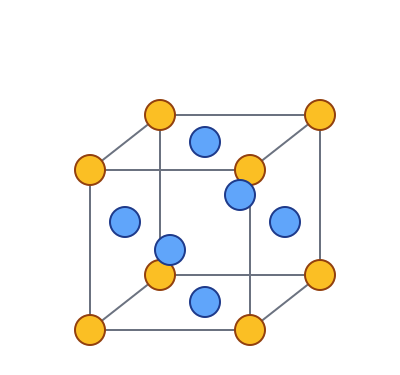
Which crystal structure has 4 atoms per unit cell and an atomic packing factor of 0.74?
BCC
Simple cubic
FCC
BCC with interstitials
FCC: 8 corners x 1/8 + 6 faces x 1/2 = 4 atoms. BCC has 2 atoms and APF 0.68.
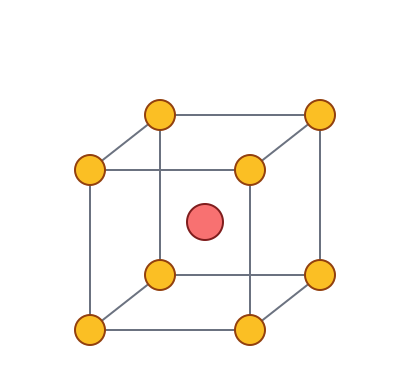
The unit cell shown has an atom at the center and at the 8 corners. Which structure is it?
FCC
BCC
HCP
Simple cubic
Corner atoms plus one body-centered atom is BCC: 2 atoms per cell, coordination number 8. It is the structure of ferrite (alpha-iron).
Which metal is most likely to show a ductile-to-brittle transition?
Copper
Low-carbon (BCC) steel
Aluminum
Austenitic stainless steel
BCC metals lose toughness at low temperature (Liberty ships). FCC metals such as Cu, Al and austenitic stainless stay ductile.
Which change increases yield strength by Hall-Petch?
Larger grains
Annealing at high temperature
Smaller grains
Removing dislocations
Smaller grains mean more grain boundaries blocking dislocations, so yield strength rises as d^(-1/2).
A 200 mm bar (E = 200 GPa) is stressed elastically to 300 MPa. Its elongation is:
0.30 mm
0.15 mm
1.5 mm
3.0 mm
Strain = 300/200,000 = 0.0015; elongation = 0.0015 x 200 mm = 0.30 mm.
On the curve below, what is the point labelled 'Ultimate tensile strength'?
Where permanent deformation starts
The maximum engineering stress, where necking begins
The fracture stress
The proportional limit
UTS is the peak of the engineering curve; necking starts there. Fracture stress is usually lower than UTS on an engineering curve because the area is still referenced to the original.
Why does engineering stress drop after necking begins?
The material softens at the atomic level
True area shrinks faster than the load can compensate, but engineering stress uses the original area
Hooke's law no longer applies so stress is undefined
Dislocations are annihilated
Engineering stress = F/A0. The load falls as the neck forms, and A0 stays constant in the formula, so the plot drops. True stress keeps rising.
Poisson's ratio for a metal is 0.3. If axial strain is +0.004, the lateral strain is:
+0.0012
-0.0133
-0.0012
+0.004
Lateral strain = -nu x axial = -0.0012 (the bar thins).
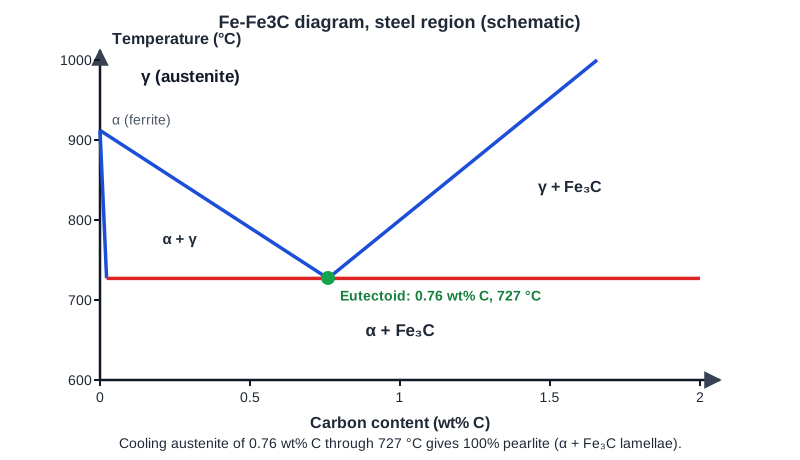
A 0.40 wt% C steel is slowly cooled to just below 727 C. What fraction of the microstructure is pearlite?
51%
38%
24%
76%
Lever rule: (0.40 - 0.022)/(0.76 - 0.022) = 0.51. The remaining 49% is proeutectoid ferrite.
What microstructure forms when austenite of eutectoid composition cools slowly through 727 C?
Martensite
Pearlite
Bainite
Ledeburite
Slow cooling lets carbon diffuse, forming alternating lamellae of ferrite and cementite (pearlite). Martensite needs rapid quenching.
True or false: martensite forms by diffusion of carbon out of austenite.
True
False
Martensite forms by a diffusionless shear transformation when austenite is quenched, trapping carbon in a body-centered tetragonal lattice.
Why is quenched steel tempered?
To raise hardness
To reduce brittleness and relieve stress at the cost of some hardness
To convert it to austenite
To increase carbon content
Tempering lets carbon precipitate as carbides, increasing toughness. Hardness goes down, not up.
A component has K_Ic = 50 MPa sqrt(m), Y = 1 and a 2.5 mm crack. At about what stress does it fracture?
100 MPa
280 MPa
564 MPa
1000 MPa
sigma = K_Ic / (Y sqrt(pi a)) = 50 / sqrt(pi x 0.0025) = 564 MPa.
Which statement about the S-N curve shown is correct?
Steel shows a knee: below Se it survives essentially unlimited cycles
Aluminum has a sharp endurance limit like steel
Fatigue life is independent of stress amplitude
Both curves go to zero stress at low N
Many steels have an endurance limit; aluminum does not and is given a fatigue strength at a stated life.
The three stages of creep in order are:
Tertiary, secondary, primary
Primary, tertiary, secondary
Primary, secondary, tertiary
Secondary, primary, tertiary
Decreasing rate (primary), constant rate (secondary), accelerating rate to rupture (tertiary).
Which is NOT a way to strengthen a metal by impeding dislocations?
Cold working
Solid-solution alloying
Grain refinement
Annealing to grow large grains
Annealing with grain growth lowers strength. The others increase dislocation obstacles.
A steel bar is held rigidly between walls and heated by 50 K (E = 200 GPa, alpha = 12e-6 /K). The compressive stress is about:
12 MPa
60 MPa
600 MPa
120 MPa
sigma = E alpha dT = 200,000 MPa x 12e-6 x 50 = 120 MPa.
Which ratio gives the upper bound on the modulus of a fiber composite?
1/Ec = Vf/Ef + Vm/Em
Ec = (Ef + Em)/2
Ec = Ef x Em
Ec = Vf Ef + Vm Em
Parallel loading (isostrain) is the rule of mixtures, the upper bound. The reciprocal form is the lower bound (transverse loading).
Stainless steel resists rusting mainly because of at least ~11% of which element?
Nickel
Carbon
Manganese
Chromium
Chromium forms a thin, self-healing chromium oxide passive film. Nickel stabilizes austenite but is not what makes it stainless.
In galvanic corrosion of a steel bolt in contact with a zinc plate in seawater, which corrodes?
The zinc
The steel bolt
Neither
Both equally
Zinc is more active (anodic) and corrodes preferentially, protecting the steel: the principle of a sacrificial anode.
Which pair is correct?
Hardness: energy absorbed to fracture
Toughness: resistance to indentation
Resilience: elastic energy per volume, sigma_y^2/2E
Ductility: stiffness
Resilience is the area under the elastic region. Toughness is energy to fracture; hardness is indentation resistance; ductility is plastic strain to failure.
Copper has R = 0.128 nm and is FCC. What is its lattice parameter?
0.256 nm
0.296 nm
0.362 nm
0.512 nm
a = 2R sqrt(2) = 2 x 0.128 x 1.414 = 0.362 nm.
