Quiz · Medium
Core networking concepts with diagram questions: OSI layers, TCP vs UDP, ports, headers, DNS and ARP.
Which OSI layer is responsible for routing packets between networks using logical addresses?
Data Link (Layer 2)
Network (Layer 3)
Transport (Layer 4)
Session (Layer 5)
Routing and IP addressing are Layer 3. The Data Link layer uses physical (MAC) addresses within one network, and the Transport layer deals with end-to-end delivery between ports.
In the diagram, what is the data unit (PDU) called at the Data Link layer?
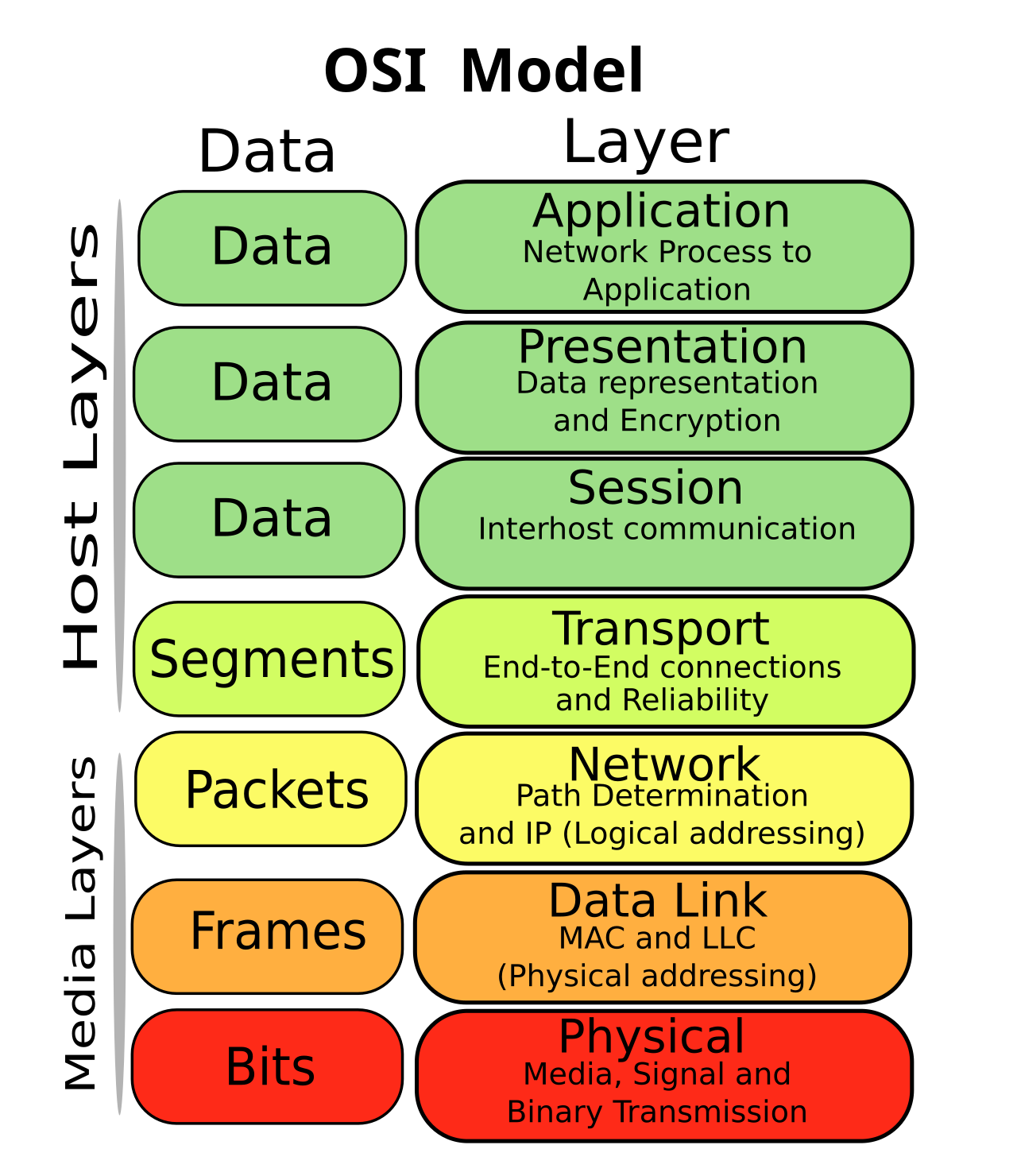
Frame
Packet
Segment
Bits
Layer 2 PDUs are frames. Packets are Layer 3, segments Layer 4, and bits Layer 1.
Image: SVG edition: Gorivero, CC BY-SA 3.0, via Wikimedia Commons.
A technician sees that a switch is forwarding traffic using destination MAC addresses. At which OSI layer is the switch operating?
Layer 1
Layer 3
Layer 4
Layer 2
Standard switches work at the Data Link layer. A multilayer switch can also route at Layer 3, but MAC-based forwarding is Layer 2.
Which transport protocol would be the best fit for a live VoIP call where a lost packet should simply be skipped?
TCP
ICMP
UDP
FTP
UDP has no retransmission delay, which suits real-time voice where late data is useless. TCP would stall to retransmit lost segments. ICMP is a diagnostic protocol and FTP is an application protocol.
Which statement about TCP is true?
It is connectionless and has no flow control
It uses sequence numbers and acknowledgments to guarantee ordered delivery
It is used by DNS for every query
It has an 8-byte header with no options
TCP is connection-oriented and reliable. UDP is connectionless with an 8-byte header, and DNS normally queries over UDP.
What is the correct order of the TCP three-way handshake?
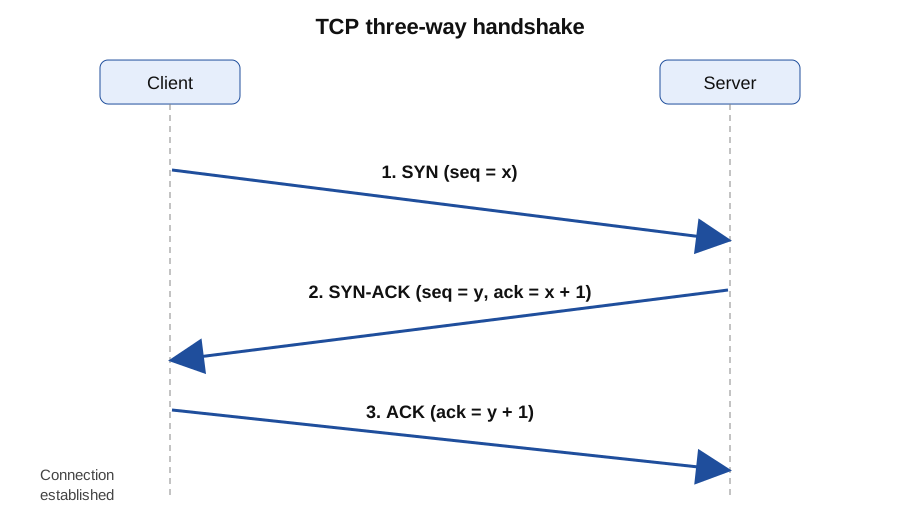
SYN, ACK, SYN-ACK
SYN, SYN-ACK, ACK
ACK, SYN, SYN-ACK
SYN-ACK, SYN, ACK
The client sends SYN, the server answers SYN-ACK, and the client confirms with ACK. Only after the third step is the connection established.
Which port does HTTPS use by default?
443
80
8080
22
HTTPS is HTTP over TLS on TCP 443. Port 80 is plain HTTP, 8080 is a common alternate HTTP port, and 22 is SSH.
Which protocol and port combination is used by SSH?
TCP 23
UDP 22
TCP 3389
TCP 22
SSH uses TCP 22. Port 23 is Telnet, which sends data in clear text, and 3389 is RDP.
Which port pair is used by DHCP?
TCP 20 and 21
UDP 53 and 123
UDP 67 (server) and UDP 68 (client)
TCP 25 and 110
DHCP uses UDP 67 on the server and UDP 68 on the client. 20/21 is FTP, 53 is DNS and 123 is NTP.
A user's PC shows the address 169.254.12.7. What is the most likely cause?
The PC has a static public IP
The PC could not reach a DHCP server
The DNS server is down
The default gateway is misconfigured
169.254.0.0/16 is the APIPA link-local range a Windows host assigns itself when DHCP fails. DNS or gateway problems would not change the address.
In the IPv4 header shown, which field is decremented by each router and prevents endless loops?
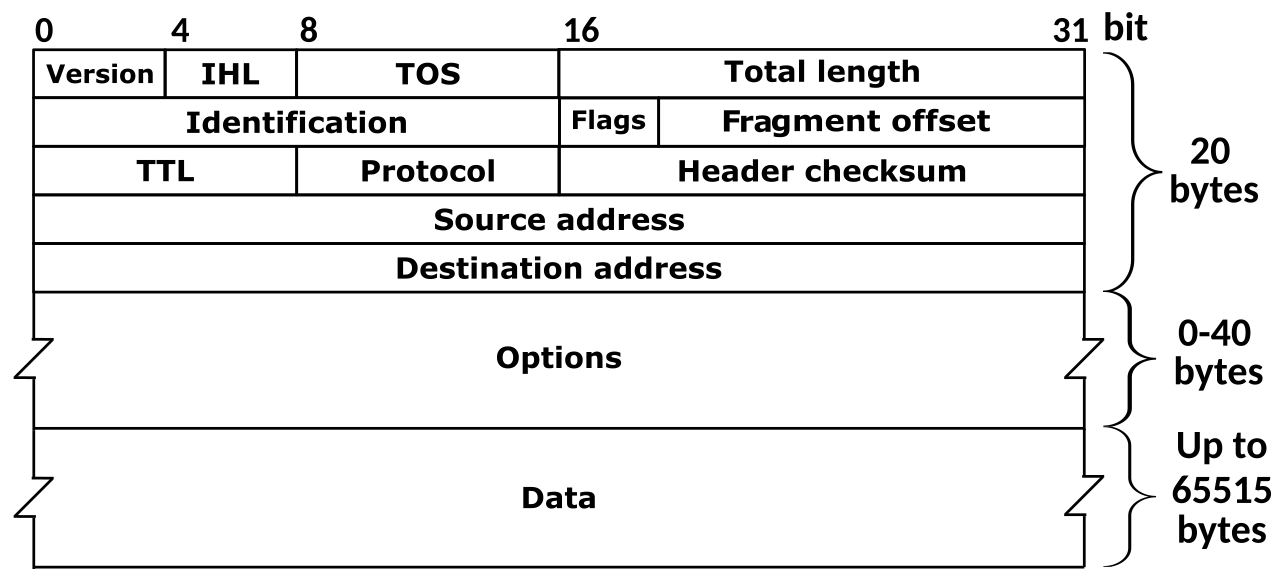
TTL
Protocol
Header checksum
Identification
TTL (Time To Live) is reduced by 1 at every hop; at 0 the packet is dropped and ICMP Time Exceeded is returned.
Image: Michel Bakni, CC BY-SA 4.0, via Wikimedia Commons.
Which Ethernet frame field identifies the type of payload, such as IPv4 or ARP?

CRC checksum
Preamble
Destination MAC
EtherType
EtherType (0x0800 for IPv4, 0x0806 for ARP). The CRC detects corruption and the MAC addresses identify devices.
According to the diagram, which part of the name en.wikipedia.org is the top-level domain?
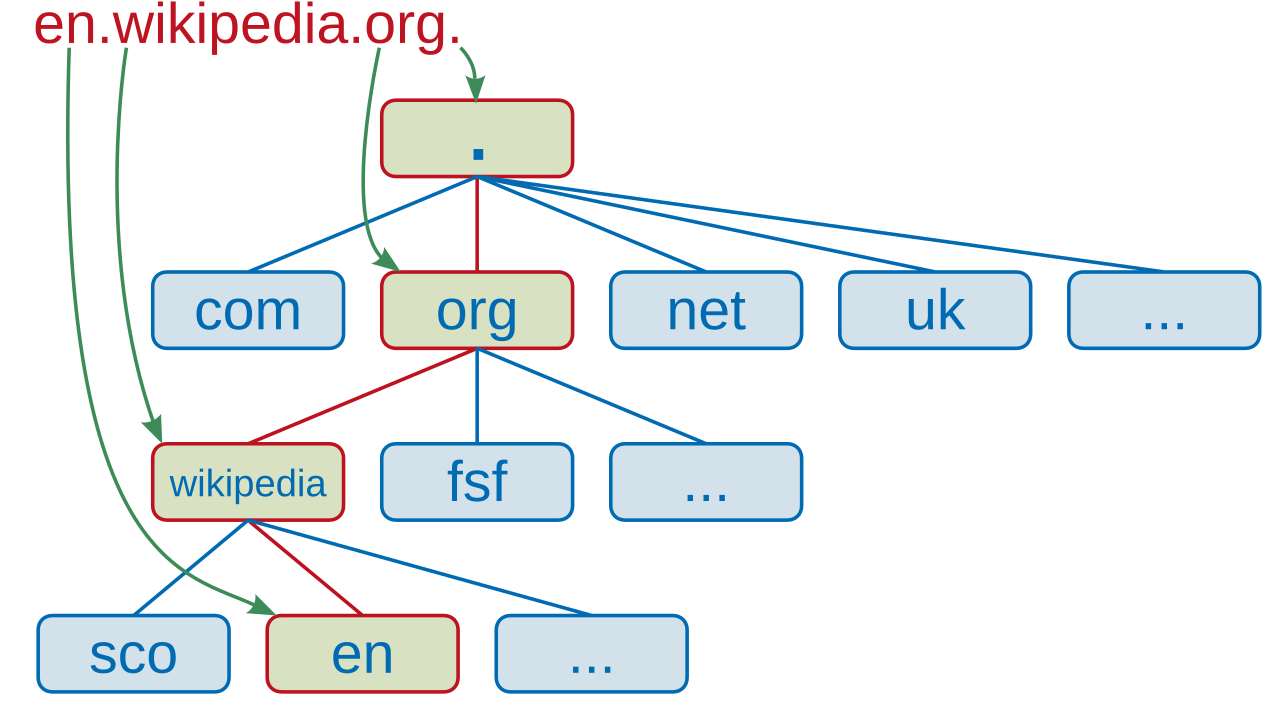
wikipedia
en
org
The trailing dot
Reading right to left: the root (.), the TLD (org), the second-level domain (wikipedia) and the subdomain (en).
Image: TilmannR, CC BY-SA 2.5, via Wikimedia Commons.
What is the standard Ethernet MTU for the payload of a frame?
1518 bytes
1500 bytes
1024 bytes
9000 bytes
1500 bytes is the standard MTU. 1518 is the maximum total frame size including headers and FCS. 9000 is a jumbo frame setting.
Which DNS record type points a name to an IPv6 address?
AAAA
A
CNAME
PTR
AAAA ('quad A') holds an IPv6 address. A is IPv4, CNAME is an alias, and PTR is the reverse lookup.
What does ARP resolve?
A hostname to an IP address
A MAC address to a port number
A private IP to a public IP
An IPv4 address to a MAC address
ARP finds the MAC address that owns an IPv4 address on the local network. Hostname resolution is DNS and private-to-public translation is NAT.
In the diagram, which description fits the Star topology?
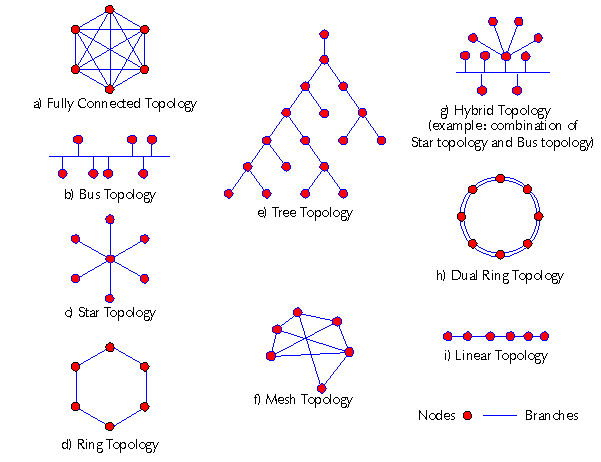
Every node connects to exactly two neighbors
All nodes share a single backbone cable
A central switch or hub connects every node
Every node connects to every other node
In a star, each device has its own link to a central device. The ring has two neighbors per node, the bus a single shared cable, and a full mesh connects all pairs.
Which command shows the path packets take to a remote host, hop by hop, on Windows?
tracert
netstat
nslookup
arp -a
tracert sends packets with increasing TTL values to reveal each router. netstat shows connections, nslookup queries DNS, and arp -a shows the ARP cache.
A host sends a packet to a destination in another subnet. Which address does the host use as the destination MAC of the frame?
The destination host's MAC address
The DNS server's MAC address
The broadcast MAC address
The default gateway's MAC address
MAC addresses only matter on the local link. The frame is addressed to the gateway, which then forwards the packet; the IP destination stays the remote host.
True or false: a Layer 2 switch separates broadcast domains by default.
True
False
A switch forwards broadcasts out of every port in the VLAN. Routers (or VLANs) separate broadcast domains, whereas each switch port is its own collision domain.
Which layer adds the FCS trailer to the data?
Network
Transport
Data Link
Physical
The Data Link layer builds the frame, adding a header and a trailer (the Frame Check Sequence).
Which protocol would a network admin use to synchronize device clocks?
SNMP
NTP
TFTP
LDAP
NTP (UDP 123) distributes time. SNMP monitors devices, TFTP transfers files and LDAP queries directories.
Which pair is correctly matched?
SMB - TCP 445
POP3 - TCP 143
LDAPS - TCP 389
Syslog - TCP 25
SMB uses TCP 445. POP3 is 110 (143 is IMAP), LDAPS is 636 (389 is LDAP), and syslog usually uses UDP 514.
Which transport behavior prevents a fast sender from overwhelming a slow receiver in TCP?
Port numbering
The TTL field
Fragmentation
Flow control using the window size
The receiver advertises a window size indicating how much data it can buffer. TTL limits hops and fragmentation splits packets for the MTU.
A web server must be reachable at example.com from the internet, but the admin wants it listed under an alias www.example.com. Which record type should be created for www?
MX
NS
CNAME
PTR
A CNAME maps the alias name to the canonical name. MX is for mail, NS names authoritative servers, and PTR is for reverse lookups.
