Quiz · Hard
Multi-step numerical statics problems at exam level.
A beam is simply supported at A and B, 8 m apart, carrying 12 kN at 3 m from A and 6 kN at 6 m from A. What is Ay?
12 kN
9 kN
8 kN
10.5 kN
ΣM about A: By(8) = 12(3) + 6(6) = 72, so By = 9 kN. Ay = 18 − 9 = 9 kN. The tempting 12 kN is one of the loads.
A 4 m cantilever carries 5 kN/m over its whole length and a 10 kN load at the tip. The fixed-end moment magnitude is:
80 kN·m
60 kN·m
40 kN·m
100 kN·m
UDL: (5 × 4) × 2 = 40 kN·m; tip load: 10 × 4 = 40 kN·m; total 80 kN·m. Treating the UDL as acting at the tip gives the wrong 120.
A 6 m simply supported beam carries 4 kN/m over the whole span. The maximum bending moment is:
36 kN·m
72 kN·m
24 kN·m
18 kN·m
M max = wL²/8 = 4 × 36/8 = 18 kN·m at midspan. wL²/2 (72) is the cantilever result.
A 800 N weight hangs from two cables, each making 45° with the vertical. Tension in each cable?
400 N
1131 N
566 N
800 N
2T cos 45° = 800, so T = 800/(2 × 0.7071) = 566 N. 400 N would ignore the cosine; 1131 N uses the wrong factor.
A 20 kg block on a 30° incline (g = 9.81) is sliding with μk = 0.25. The kinetic friction force is:
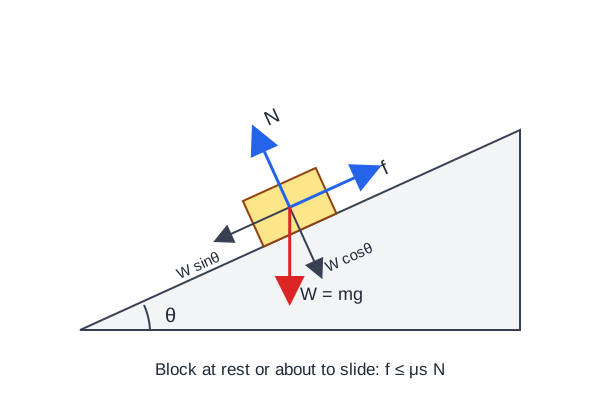
49.1 N
42.5 N
24.5 N
98.1 N
N = mg cos 30° = 196.2 × 0.866 = 169.9 N and f = 0.25 × 169.9 = 42.5 N. 49.1 N forgets the cos 30° factor.
A uniform ladder of weight W leans against a smooth wall at 60° to a rough floor. Minimum floor μs to avoid slipping?
0.289
0.577
0.866
0.500
Moments about the foot: Nw L sin 60° = W (L/2) cos 60°, so Nw = W/(2 tan 60°). Floor friction equals Nw and N = W, hence μ = 1/(2 tan 60°) = 0.289. 0.577 is 1/tan 60°, missing the factor 2 from the ladder's center of gravity.
An L-shaped plate: a 6 × 2 horizontal rectangle with a 2 × 4 rectangle standing on its left end (total height 6). The centroid x̄ from the left edge is:
3.0
2.0
1.8
2.2
A1 = 12 at x = 3, A2 = 8 at x = 1: x̄ = (36 + 8)/20 = 2.2. Averaging 3 and 1 without weighting by area gives 2.0.
A rectangle 60 mm wide and 100 mm tall: the second moment of area about its base edge is:
5 × 10⁶ mm⁴
2 × 10⁶ mm⁴
20 × 10⁶ mm⁴
60 × 10⁶ mm⁴
Ī = bh³/12 = 5 × 10⁶ mm⁴ and the parallel-axis term is Ad² = 6000 × 50² = 15 × 10⁶, giving 20 × 10⁶ mm⁴ (= bh³/3). 5 × 10⁶ is only the centroidal value.
A 6 m simply supported beam carries 10 kN/m. The bending moment 1 m from the left support is:
30 kN·m
25 kN·m
20 kN·m
50 kN·m
Ay = 30 kN. M = 30(1) − 10(1)(0.5) = 25 kN·m. Forgetting the load between the support and the cut gives 30.
A flat belt wraps 180° around a drum with μ = 0.3. The slack side tension is 100 N. The tight side tension is about:
257 N
130 N
300 N
94 N
T2 = T1 e^(μβ) with β = π rad: e^(0.942) = 2.57, so 257 N. Using β = 180 inside the exponent gives an absurd number; the angle must be in radians.
A force F = 30i − 40j + 120k N acts at the point (0, 0, 2) m. The magnitude of its moment about the origin is:
240 N·m
130 N·m
80 N·m
100 N·m
r × F = (0,0,2) × (30,−40,120) = (80, 60, 0), magnitude √(80² + 60²) = 100 N·m. 130 N is the magnitude of F itself.
A uniform 4 m horizontal beam weighing 200 N is hinged to a wall at A and held by a cable at the tip at 30° above horizontal. The cable tension is:
400 N
100 N
200 N
346 N
Moments about A: T sin 30° × 4 = 200 × 2, so T sin 30° = 100 and T = 200 N. 400 N sets the vertical component equal to the weight, which ignores the moment arms.
A 100 N force acts perpendicular to the end of a 2 m arm. Replacing it with an equivalent force-couple system at the other end gives:
200 N force and a 100 N·m couple
100 N force and a 200 N·m couple
100 N force and no couple
100 N force and a 2 N·m couple
Moving a force to a new point adds a couple equal to the moment of the force about that point: 100 × 2 = 200 N·m.
A trapezoidal load varies from 2 kN/m to 8 kN/m over 3 m. Its resultant acts at what distance from the 2 kN/m end?
1.8 m
1.5 m
2.0 m
1.2 m
R = 15 kN. Split into a rectangle (6 kN at 1.5 m) and a triangle (9 kN at 2 m): x̄ = (9 + 18)/15 = 1.8 m. 1.5 m would be the midpoint of a uniform load.
A 1 m wide, 2 m tall crate of weight 500 N sits on a floor with μs = 0.6. A horizontal push is applied at the top edge. What happens first?
It slides at P = 300 N
It slides at P = 125 N
It tips at P = 300 N
It tips at P = 125 N
Tipping about the toe: P(2) = 500(0.5), so P = 125 N. Slipping needs μsN = 300 N. The smaller force governs, so the crate tips first.
