Quiz · Medium
Foundational questions on system properties, convolution, transforms, stability and aliasing.
Which system is linear?
Only y = 5x satisfies additivity and homogeneity. Squaring and absolute value are nonlinear, and adding a constant breaks homogeneity (zero input gives nonzero output).
Which system is NOT causal?
y(t) = x(t+2) needs the future input. A delay or an integral up to the present is causal.
Which signal is a power signal?
A periodic sinusoid has infinite energy but finite average power. The decaying exponential and rect have finite energy.
Evaluate
0
1
pi
-1
By the sifting property the result is cos(pi) = -1.
The convolution of and (starting at n = 0) is
{1, 3, 5, 3}
{1, 2, 3, 0}
{1, 3, 6}
{2, 3, 5}
y[0]=1, y[1]=1+2=3, y[2]=2+3=5, y[3]=3. The output has 3+2-1 = 4 samples.
An LTI system is causal if and only if its impulse response
is zero for t > 0
is zero for t < 0
is an even function
is absolutely integrable
A causal system cannot respond before the impulse is applied. Absolute integrability is the BIBO stability condition.
The Fourier transform of is
1
An impulse contains all frequencies equally, so its spectrum is flat: 1. The transform of the constant 1 is the impulse 2 pi delta(omega).
What happens to the spectrum when a signal is compressed in time by a factor of 2?
It compresses to half the bandwidth
It is shifted in frequency
It is unchanged
It expands to twice the bandwidth (with half the amplitude)
Time scaling x(at) gives (1/|a|)X(w/a): narrower in time means wider in frequency.
Multiplying a signal by cos(wc t) in the time domain does what to its spectrum?
Shifts copies to plus and minus wc, each at half amplitude
Convolves the spectrum with a rectangle
Multiplies the spectrum by cos(w)
Compresses the spectrum
Modulation property: X(w) becomes 1/2[X(w-wc) + X(w+wc)].
The Laplace transform of is
L{e^{-at}u(t)} = 1/(s+a). A pole at s = -3 is in the left half-plane, so the signal decays.
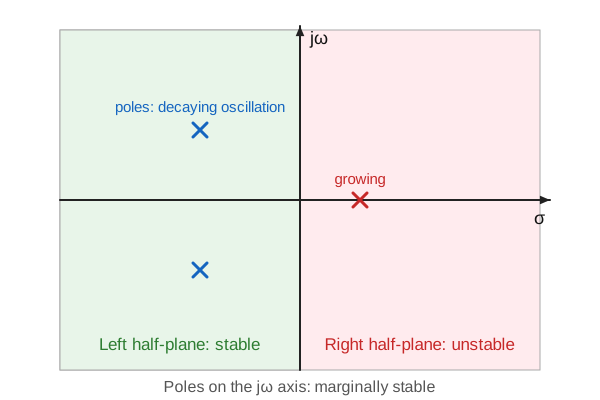
A causal LTI system has poles at s = -1 and s = -4. It is
unstable
marginally stable
stable
stable only for bounded inputs of finite duration
Both poles are in the left half-plane, so the impulse response decays and the system is BIBO stable.
A system has a pole at s = +2. Its impulse response behaves like
e^(-2t), decaying
a constant
an oscillation of frequency 2 rad/s
e^(2t), growing without bound
A right-half-plane pole gives a growing exponential, so the system is unstable. A pole on the jw axis would give a constant or oscillation.
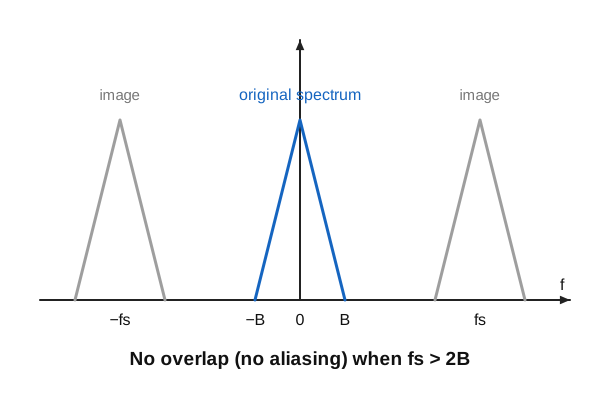
To avoid aliasing, a signal with highest frequency 4 kHz must be sampled faster than
8 kHz
4 kHz
2 kHz
16 kHz
The Nyquist rate is twice the highest frequency: 8 kHz. Sampling at exactly 4 kHz would alias.
A 6 kHz sine wave is sampled at 8 kHz. What frequency does it appear to have?
6 kHz
2 kHz
14 kHz
1 kHz
6 kHz is above fs/2 = 4 kHz, so it aliases to |6 - 8| = 2 kHz.
A first-order low-pass filter's magnitude falls by 3 dB at its cutoff frequency.
True
False
At wc the gain is 1/sqrt(2) = 0.707, which is -3 dB. The asymptotic Bode line is at 0 dB there, which is why the real curve is 3 dB below the corner.
The impulse response of the ideal low-pass filter is a
rectangular pulse
decaying exponential
sinc function
unit step
A rectangle in frequency transforms to a sinc in time. It extends to negative time, so the ideal filter is non-causal.
