Quiz · Medium
Foundational practice on solving and graphing linear inequalities, interval notation, compound and absolute value inequalities, and simple quadratic inequalities.
Solve .
-4x < 12, and dividing by -4 flips the symbol: x > -3. The tempting x < -3 forgets the flip.
Which graph shows ?




The closed circle at 2 includes it, and the arrow points right for larger values. The first graph has an open circle (x > 2).
Which inequality is graphed?
The closed circle means 2 is included, and the arrow points left toward smaller numbers.
Which interval notation is the same as ?
[-2, 3)
(-2, 3]
[-2, 3]
(-2, 3)
The left end is excluded (parenthesis) and the right end is included (bracket).
Solve .
2x - 2 ≥ 3x + 4 gives -6 ≥ x, which is x ≤ -6. Moving x terms to the right is a good habit because it avoids a negative coefficient.
Solve .
Add 2: -3 ≤ 3x < 9. Divide by 3: -1 ≤ x < 3. The inequality symbols stay as they are.
Which statement is true about the solution of or ?
It is two separate rays
It is the interval (1, 4)
It has no solution
It is one connected interval
"Or" gives the union of two rays: (-∞, 1) ∪ (4, ∞). The interval (1, 4) is the complement.
Solve .
or
Within 2 units of 3: from 1 to 5. Values less than or equal to a positive number give a single "and" interval.
Solve .
or
or
2x + 1 > 5 gives x > 2. 2x + 1 < -5 gives x < -3. Greater than gives "or".
What is the solution of ?
x < -3
-3 < x < -1
All real numbers
No solution
An absolute value is never negative, so it can't be less than -1.
This graph shows which inequality?
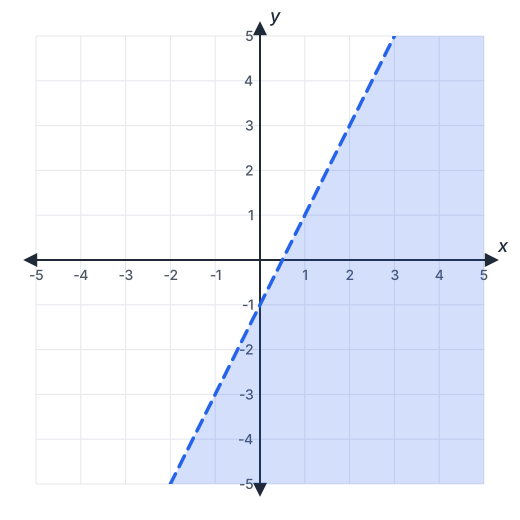
Dashed boundary means strict. The shading is below the line, so y < 2x - 1. Test (0, 0): 0 < -1 is false, so the origin side is not shaded.
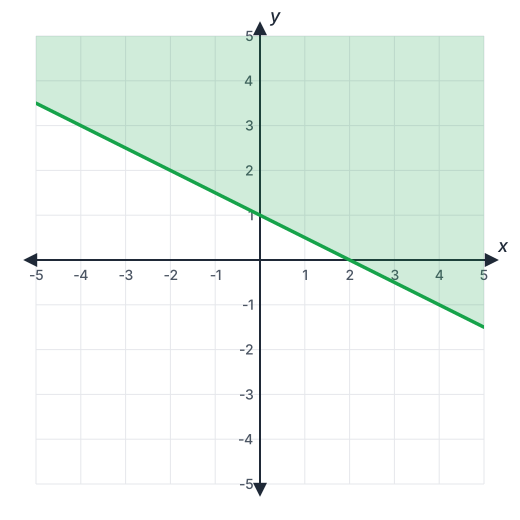
The graph shows y ≥ -x/2 + 1. Which description is right?
Dashed line, shaded below
Solid line, shaded above
Dashed line, shaded above
Solid line, shaded below
≥ means a solid line and the region y larger than the line, so above it.
Is a solution of ?
Yes, because 5 > 2
No, 5 < 4
No, because the point lies on the line
Yes, 5 > 4
3(2) - 2 = 4 and 5 > 4 is true.
Solve .
or
(x - 4)(x + 2) < 0 is negative between the zeros -2 and 4. The 'or' answer is for > 0.
Solve .
or
x² ≥ 25 means |x| ≥ 5. Taking x ≥ 5 alone loses the negative side, e.g. x = -6 also works.
How many solutions does have?
None
Two
One
Infinitely many
x² + 9 is at least 9 for all real x, so it is never at most 0.
Which number line shows the solution of |x - 1| ≥ 3?



|x - 1| ≥ 3 means x is at least 3 away from 1: x ≤ -2 or x ≥ 4, which is the second picture.
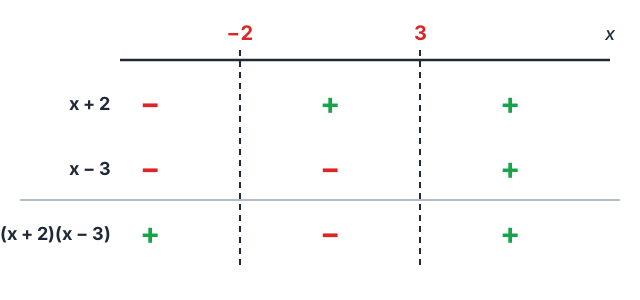
What is the sign of when ?
Positive
Negative
Zero
Undefined
(2)(-3) = -6, so it is negative. This matches the middle interval of the sign chart.
True or false: if a < b then a² < b² for all real numbers.
True
False
False. -3 < 2, but 9 > 4. Squaring only preserves order for non-negative numbers.
