Quiz · Medium
Service and deployment models, shared responsibility, storage types, networking, serverless and Kubernetes basics.
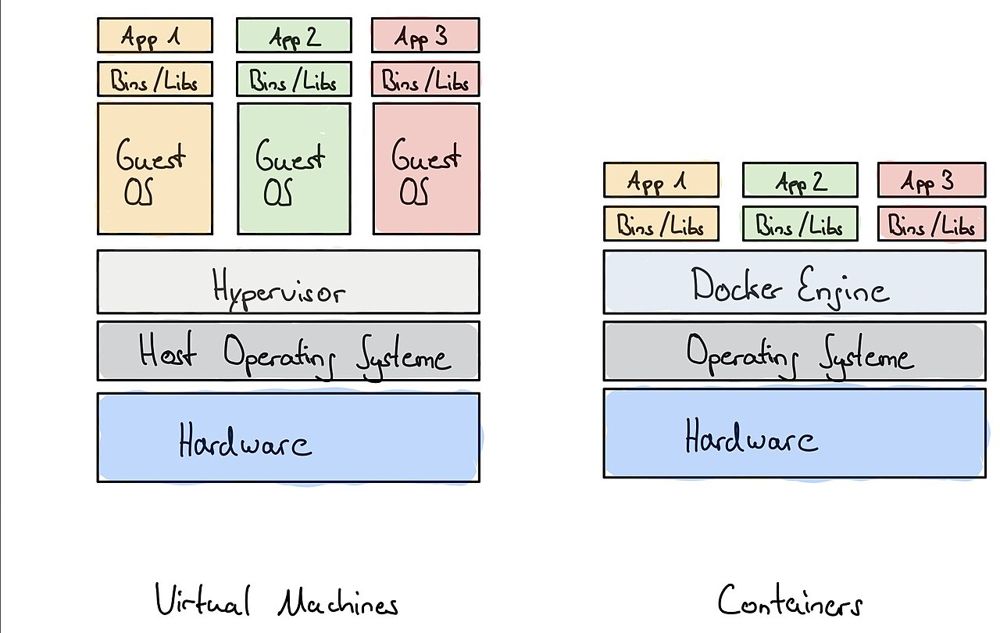
In the diagram, which workload uses a separate guest operating system for each application?
Containers
Virtual machines
Serverless functions
Bare-metal only
Each VM runs its own guest OS on top of a hypervisor. Containers share the host kernel, which makes them lighter.
Image: Drinkler, CC BY-SA 4.0, via Wikimedia Commons.
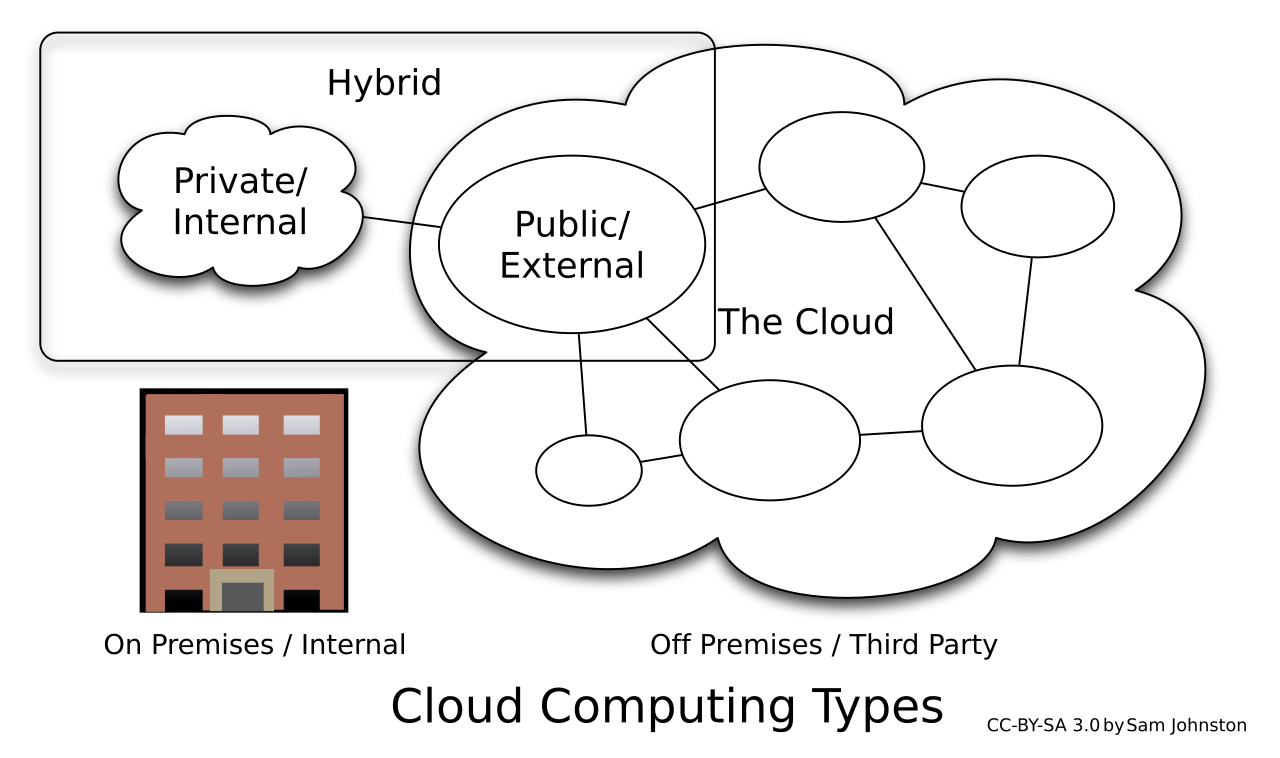
The diagram shows a private cloud connected to a public cloud. What is this deployment model?
Hybrid cloud
Community cloud
Multi-tenant SaaS
Edge cloud
Hybrid cloud combines private and public environments that can share workloads and data.
Image: Sam Johnston, CC BY-SA 3.0, via Wikimedia Commons.
A company wants to run its own app code without managing servers or operating systems, but it controls the application. Which service model fits?
IaaS
SaaS
DaaS
PaaS
PaaS (for example Elastic Beanstalk, App Engine, Azure App Service) manages the OS and runtime while you deploy code. IaaS leaves the OS to you and SaaS gives a finished app.
Which service model describes Dropbox or Gmail?
SaaS
PaaS
IaaS
FaaS
They are complete applications delivered to end users.
Which is an example of SaaS?
Amazon EC2
Google Compute Engine
Microsoft 365 or Salesforce
Azure Virtual Network
SaaS delivers complete applications over the internet. EC2, Compute Engine and VNets are IaaS building blocks.
In the shared responsibility model for IaaS, who patches the guest operating system?
The cloud provider
The customer
The hypervisor vendor only
The internet service provider
The provider secures the cloud (facilities, hardware, hypervisor). The customer secures what runs in it, including guest OS patches, applications and data.
An e-commerce site expects traffic spikes during sales and low traffic otherwise. Which cloud characteristic is most valuable?
Rapid elasticity
Fixed capacity
Dedicated hardware
Manual provisioning
Elasticity adds and removes capacity automatically as demand changes, so you pay only for what you use.
Which AWS storage service is object storage designed for 11 nines of durability?
Amazon EBS
Amazon EFS
Instance store
Amazon S3
S3 is object storage. EBS is block storage for instances, EFS is a managed file system and instance store is temporary.
Which storage type is best for the boot volume and database files of a VM?
Object storage
Archive storage
Block storage
Tape
Block storage gives low-latency raw volumes. Object storage has higher latency and archive tiers are slow to retrieve.
Which AWS feature gives an EC2 instance in a private subnet outbound internet access without exposing it to inbound connections?
Internet gateway attached to the instance
NAT gateway
Elastic IP on the DB
VPC peering
A NAT gateway lets private resources initiate outbound traffic while blocking inbound connections from the internet.
Security groups in AWS are...
stateful and allow-only
stateless with deny rules
applied at the subnet level only
unable to filter by port
Return traffic for allowed connections is automatically permitted (stateful) and you can only add allow rules. Network ACLs are the stateless, subnet-level control.
Which load balancer type routes requests by URL path at layer 7?
Network Load Balancer
Classic NAT
Gateway Load Balancer
Application Load Balancer
An ALB inspects HTTP(S) to route by path or host. NLB works at layer 4 on TCP/UDP.
Which service is the best fit for running code in response to file uploads without managing servers?
Amazon EC2 Dedicated Host
Amazon RDS
AWS Lambda
AWS Direct Connect
Lambda is event-driven serverless compute. EC2 hosts, relational databases and dedicated network links do not fit the use case.
Which is the key difference between scalability and elasticity?
Scalability means only vertical growth
Elasticity adds and removes resources automatically with demand
Elasticity requires physical servers
They are identical terms
Scalability is the ability to handle growth; elasticity is the automatic, dynamic matching of capacity to demand in both directions.
Which database service is a managed NoSQL key-value store with single-digit millisecond latency?
DynamoDB
Amazon RDS for MySQL
Amazon Redshift
Amazon Aurora
DynamoDB is NoSQL. RDS and Aurora are relational and Redshift is a data warehouse.
What does Infrastructure as Code (IaC) provide?
Faster physical cabling
Free cloud usage
Automatic security without configuration
Repeatable, version-controlled environments defined in files
IaC (Terraform, CloudFormation) lets you review, version and recreate infrastructure the same way every time.
Which Kubernetes object is the smallest deployable unit?
Node
Deployment
Pod
Namespace
A Pod holds one or more tightly coupled containers. Deployments manage pods and nodes are the machines that run them.
A team wants a managed Kubernetes service on Google Cloud. Which should they choose?
EKS
GKE
AKS
Lambda
GKE is Google's managed Kubernetes; EKS is AWS and AKS is Azure.
A company wants an exact copy of its data in a different geographic region to recover from a regional disaster. Which capability do they need?
A larger instance size
A second NAT gateway in the same AZ
Elastic IP addresses
Cross-region replication
Replicating across regions protects against region-wide failures. Same-AZ or same-region measures do not.
True or false: moving to the cloud removes the customer's responsibility for data security.
True
False
Under the shared responsibility model customers always remain responsible for their data, identities and configuration.
