Quiz · Medium
Conceptual dynamics: graphs, projectile and circular motion, work-energy, collisions and vibrations.
On a position-time graph, the slope at a point gives the particle's:
Acceleration
Velocity
Displacement
Jerk
Slope of s-t is ds/dt = v. The slope of the v-t graph would be acceleration, which is the usual confusion.
In the figure, what does the shaded area under the velocity-time curve represent?
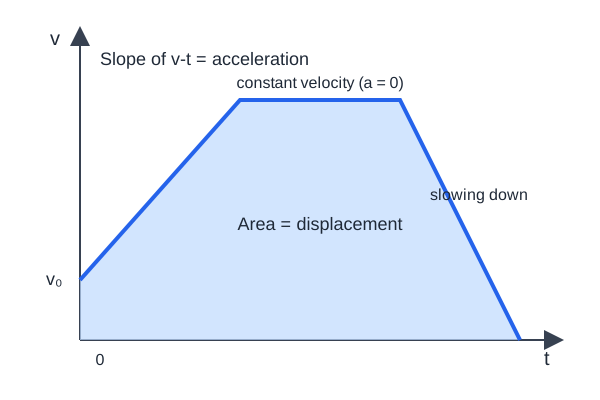
Displacement
Acceleration
Average speed
Force
Integrating v dt gives the change in position. Slope, not area, gives acceleration.
A ball is thrown upward. At the very top of its flight its acceleration is:
Zero
g, upward
Equal to its launch speed
g, downward
Only the velocity is zero there. Gravity continues to act, so a = g downward throughout the flight.
In the projectile figure, which statement about the apex is true?
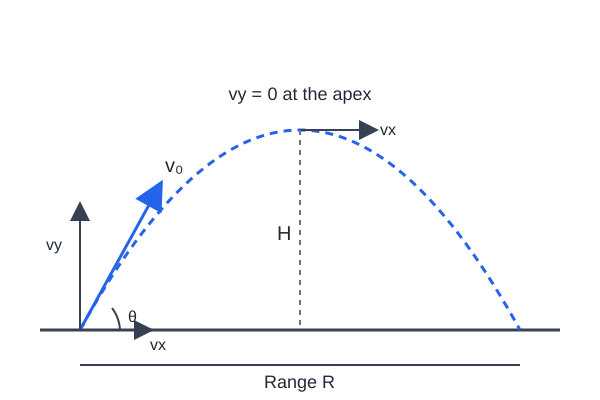
vx = 0 and vy is maximum
The speed is zero
vy = 0 and vx is unchanged
The acceleration is zero
With no drag, horizontal velocity is constant for the whole flight, and vertical velocity passes through zero at the top.
A particle moves at constant speed on a circle. Its acceleration is directed:
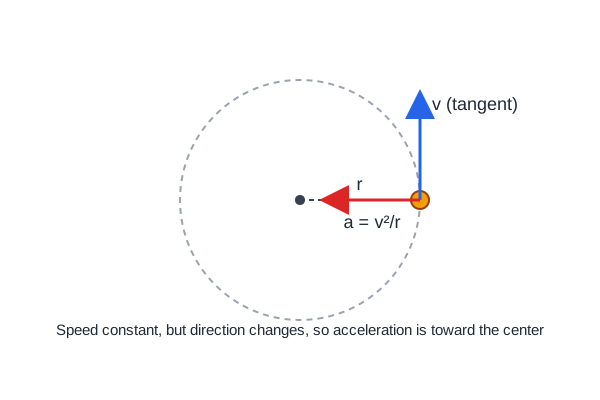
Along the tangent
Toward the center
Away from the center
It has none, speed is constant
The velocity direction keeps changing, which requires an inward acceleration v²/r. Constant speed does not mean zero acceleration.
Newton's second law for a particle of constant mass states:
ΣF = ma
ΣF = mv
ΣF = m/a
ΣF = a/m
The net force equals mass times acceleration (or rate of change of momentum). mv is momentum, not force.
A box slides down a rough incline. Which force does no work on it?
Friction
Gravity
None of them
The normal force
The normal force is perpendicular to the displacement. Gravity does positive work and friction does negative work.
True or False: linear momentum is conserved in every collision if there is no net external impulse.
True
False
It holds for elastic and inelastic collisions alike. Kinetic energy is conserved only in elastic collisions.
Which collision has a coefficient of restitution of 0?
Perfectly elastic
Perfectly plastic (bodies stick)
Elastic with rotation
Any collision with a wall
e = 0 means no separation after impact, so the bodies move together. e = 1 is elastic.
Two projectiles are launched at the same speed, one at 30° and one at 60°. Their ranges (level ground, no drag) are:
Equal
Larger for 30°
Larger for 60°
Zero for 30°
R = v0² sin 2θ / g, and sin 60° = sin 120°, so complementary angles give the same range.
The work done by a spring force when stretching from 0 to x is:
−k x
+½ k x²
−k x²
−½ k x²
The spring does negative work on the mass as it stretches: −½kx². The energy stored is +½kx².
Power delivered by a force F acting on a body moving at velocity v along F is:
F / v
F t
F v
F s
P = F·v. F s is work, and F/v has no meaning here.
The rotational analog of F = ma for a fixed axis is:
ΣM = mα
ΣM = Iα
ΣF = Iα
ΣM = Iω
Moment equals moment of inertia times angular acceleration. Iω is angular momentum.
For a wheel rolling without slipping on level ground, the velocity of the contact point is:
Zero
vG
2vG
ωr away from the center
The contact point is the instantaneous center of zero velocity, so the center moves at vG = ωr and the top point at 2vG.
Which uniform body has the largest moment of inertia about its center for the same mass and radius?
Solid disk (½mr²)
Solid sphere (⅖mr²)
They are equal
Thin ring (mr²)
I = Σmr² grows as mass moves farther from the axis, so the ring is the largest.
A conservative force is one whose work:
Is always zero
Depends on the path
Depends only on the end points
Equals the friction force
Gravity and springs have potential energy functions because their work is path independent. Friction is path dependent.
A spring-mass system has m = 2 kg and k = 200 N/m. Its natural angular frequency is:
100 rad/s
10 rad/s
20 rad/s
1.6 rad/s
ω = √(k/m) = √100 = 10 rad/s. 1.6 Hz is the frequency f = ω/2π.
A damped system with damping ratio ζ = 1 is:
Critically damped
Underdamped
Overdamped
Undamped
ζ = 1 returns to equilibrium fastest without oscillating. ζ < 1 oscillates; ζ > 1 creeps back.
A ball is dropped from rest from 10 m. Ignoring drag, it takes about:
2.04 s
1.02 s
3.2 s
1.43 s
t = √(2h/g) = √(20/9.81) = 1.43 s. 1.02 s is √(2h/g) with h = 5 m.
The tangential component of acceleration of a particle on a curved path changes:
The direction of the velocity
Neither
The speed
The mass
a_t = dv/dt alters the speed, while the normal component v²/ρ alters the direction.
True or False: a car going around a flat curve at constant speed has zero net force on it.
False
True
It has a net inward force (friction) equal to mv²/r. Zero net force would mean straight-line motion.
