Quiz · Medium
Twenty questions on critical path, PERT, earned value, risk, contracts and agile.
In the network (A 3 days; B 4 after A; C 2 after A; D 5 after B; E 3 after C; F 2 after D and E) what is the project duration?
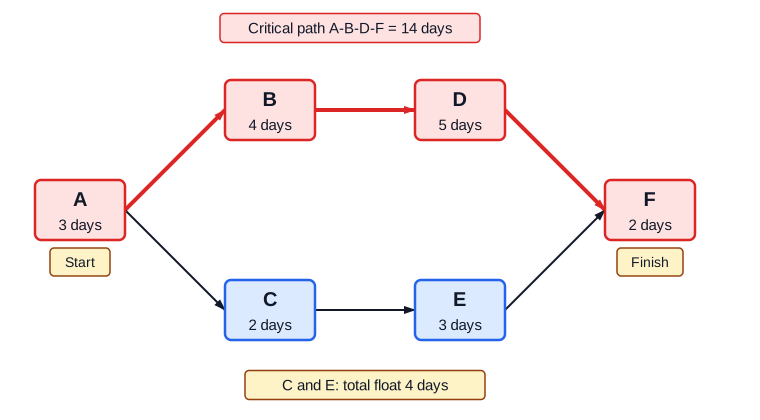
14 days
11 days
16 days
10 days
Path A-B-D-F = 14 is the longest; A-C-E-F = 10. The project duration is the longest path.
Which activities have float in that network?
C and E
All activities
B and D
A and F
The 10-day path has 4 days of float; the critical path has none.
An activity has O = 3, M = 6, P = 15. PERT expected time is:
6 days
8 days
7 days
9 days
(3 + 24 + 15)/6 = 7. Using the simple average (8) is the common mistake.
The standard deviation of the same activity is:
12 days
1 day
2 days
3 days
(P - O)/6 = (15 - 3)/6 = 2.
BAC = $200,000, EV = $80,000, AC = $100,000. CPI is:
0.40
1.25
0.80
0.50
CPI = EV/AC = 0.8. The inverse (1.25) answers 'cost per unit of value'.
EV = $80,000 and PV = $100,000. SPI is:
-20,000
0.80
0.20
1.25
SPI = EV/PV = 0.8; the project is behind schedule. SV, not SPI, is -20,000.
With CPI = 0.8 and BAC = $200,000, EAC (typical variance) is:
$250,000
$200,000
$280,000
$160,000
EAC = BAC/CPI = 250,000. Multiplying by CPI would underestimate.
A 20% chance of a $40,000 loss has an EMV of:
+$8,000
-$8,000
-$40,000
-$20,000
EMV = 0.2 x -40,000 = -8,000.
A team has 8 members. The number of communication channels is:
56
28
16
8
n(n-1)/2 = 8 x 7/2 = 28; 56 double counts the pairs.
Which action is fast tracking?
Doing activities in parallel that were planned in sequence
Adding people to a critical task
Adding a buffer
Cutting scope
Fast tracking overlaps activities (more risk of rework); adding people is crashing.
Which risk response is buying insurance?
Accept
Avoid
Transfer
Mitigate
Transfer shifts the financial impact to a third party; the risk itself still exists.
Who is accountable for the product backlog in Scrum?
Product Owner
Developers
Scrum Master
Project Manager
The Product Owner manages the product backlog and its ordering.
Which life cycle plans in short cycles and welcomes changing requirements?
Critical path
Adaptive (agile)
Waterfall
Predictive
Adaptive approaches deliver in small increments and adjust the plan each cycle.
Which person authorizes the project through the charter?
Team member
Vendor
Sponsor
Regulator
The sponsor (or initiator) issues the charter, which authorizes the project manager.
TCPI is greater than 1.0. This means:
Remaining work must be done more efficiently than planned
The schedule is ahead
The project is under budget
The project is complete
A TCPI above 1.0 means the remaining budget is tight and efficiency has to improve.
What is the lowest level of the WBS called?
Deliverable only
Control account
Work package
Milestone
Work packages are the lowest level, which are estimated and assigned.
A cost-plus contract places most cost risk on:
The seller
The buyer
The regulator
Neither party
Under cost-plus the seller is reimbursed for costs, so the buyer carries the cost risk.
True or false: Float on the critical path is normally zero.
True
False
The critical path has the least total float, usually zero.
Which Tuckman stage involves conflict over roles and approach?
Norming
Forming
Performing
Storming
Storming is where disagreements appear; norming follows as agreements form.
A task has total float 5 days and slips 3 days. The project finish:
Does not change
Slips 5 days
Slips 3 days
Slips 2 days
Slipping within the float does not affect the finish date (float falls to 2 days).
