Quiz · Medium
Capacitors and inductors, impedance, RMS, resonance, Thevenin and time constants with short calculations.
A 2 μF capacitor's voltage ramps linearly from 0 to 10 V in 1 ms. What current flows?
20 mA
20 μA
2 mA
200 mA
A. 20 μA comes from forgetting that 1 ms is 10^-3 s.
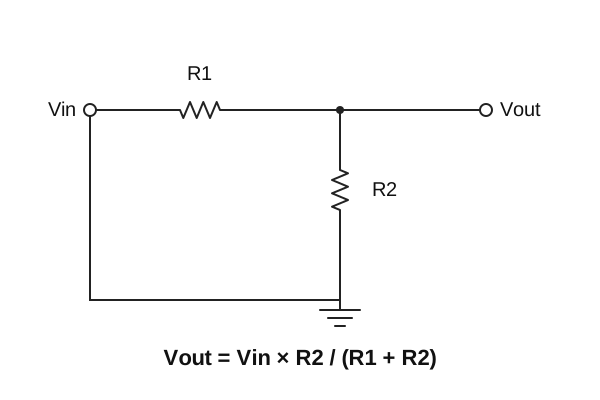
In the voltage divider shown, V, kΩ and kΩ. What is ?
3 V
9 V
6 V
4 V
V. 3 V is the voltage across R1, not R2.
Time constant of a series RC circuit with R = 4.7 kΩ and C = 22 μF?
About 103 s
About 10.3 ms
About 103 ms
About 4.7 ms
s.
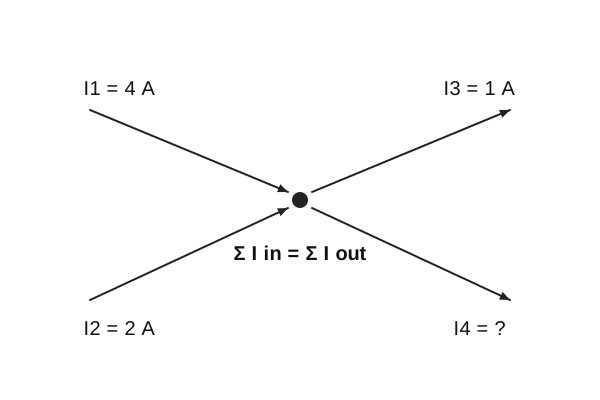
In the node shown, what is I4?
6 A
7 A
3 A
5 A
Currents in = 4 + 2 = 6 A. Currents out = 1 + I4. So I4 = 5 A. 6 A forgets I3 leaves through the other branch.
In DC steady state, an inductor behaves like a
short circuit
open circuit
current source
voltage source
With constant current, di/dt = 0, so v = L di/dt = 0: no voltage drop, i.e. a short. A capacitor is the one that acts as an open circuit.
Impedance of a 5 mH inductor at 1 kHz?
, positive imaginary for an inductor. j5 forgets the 2π; −j31.4 has the capacitor's sign.
A series circuit has and . What is ?
Resistance and reactance add at right angles: |Z| = sqrt(9+16) = 5. Adding them directly (7) ignores the 90-degree phase.
A sine wave has a peak of 311 V. What is its RMS value?
About 155 V
About 311 V
About 440 V
About 220 V
V. Dividing by 2 gives 155 V, which is the common error.
Series RLC with mH and nF. Resonant frequency?
About 15.9 kHz
About 100 kHz
About 1.59 kHz
About 159 kHz
rad/s, so kHz. 100 kHz confuses rad/s with Hz.
How do you find R_th of a network containing only independent sources?
Leave all sources on and measure the resistance at the terminals
Turn off the independent sources and find the resistance seen at the terminals
Open the terminals and add up every resistor in the network
Divide the short-circuit current by the open-circuit voltage
With sources off (voltage sources shorted, current sources opened) the network reduces to a single resistance. Dividing I_sc by V_oc gives 1/R_th (a conductance), which is the inverse of the correct ratio V_oc / I_sc.
A source has V and . Maximum power it can deliver to a load?
10 W
20 W
5 W
2.5 W
W. 20 W would be V^2/R_th, which is the short-circuit power and cannot reach a load.
Superposition can be used to add the power dissipated in a resistor due to each source acting alone.
True
False
Superposition holds for voltages and currents in linear circuits, but power is quadratic, so it must be computed from the total voltage or current.
A switch closes at t = 0 and a capacitor was charged to 6 V beforehand. The capacitor voltage at t = 0+ is
0 V
the source voltage
Undefined until the transient ends
6 V
Capacitor voltage cannot jump, so v_C(0+) = v_C(0-) = 6 V.
A load has a power factor of 0.8 lagging. This means
the load is inductive and current lags voltage by about 37°
the load is capacitive and current leads voltage by about 37°
the load is resistive and uses 80% of the current
voltage lags current by 80°
cos theta = 0.8 gives theta = 36.9°. Lagging means current lags voltage, which an inductive load does.
What fraction of the final value has a charging RC capacitor reached after 3 time constants?
About 63%
About 95%
About 86%
About 99%
. 63% is after one tau, 86% after two, 99% after five.
At series RLC resonance, which statement is true?
The impedance is at its maximum
The current lags the voltage by 90°
The impedance is purely resistive and at its minimum
The capacitor and inductor voltages are zero
X_L = X_C so the reactances cancel and Z = R. The individual L and C voltages can actually be larger than the source voltage (Q times).
A balanced Wheatstone bridge has , , . What is ?
Balance: R1/R2 = R3/R4, so R4 = R3 R2 / R1 = 150 x 200 / 100 = 300 ohms. 75 results from inverting the ratio.
Three resistors form a delta. The equivalent Y has resistors of
each
each
each
each
. Multiplying by 3 is the Y-to-delta direction.
