Quiz · Medium
Twenty foundational questions on body axes, static stability, flight modes, climb and glide performance, load factor and the atmosphere.
Which axis does an aircraft roll about?
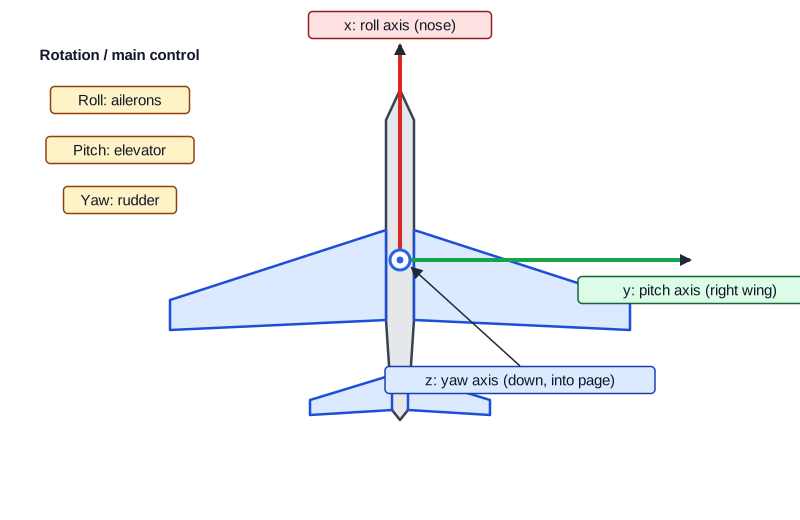
The longitudinal (x) axis through the nose
The lateral (y) axis through the wings
The vertical (z) axis
The axis perpendicular to the wing chord
Roll is about x, pitch about y and yaw about z. Ailerons, elevator and rudder control them respectively.
A statically stable aircraft in pitch has:
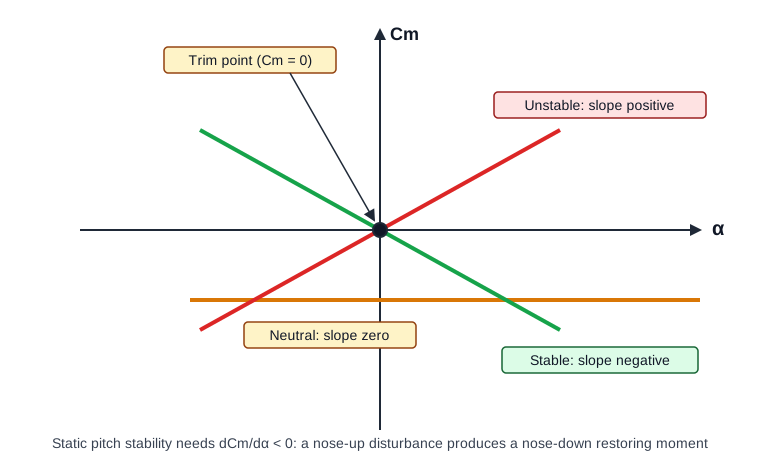
A positive
A negative
A negative
Negative means a nose-up disturbance produces a nose-down restoring moment.
Moving the center of gravity forward generally:
Decreases static stability and stall speed
Decreases stall speed only
Has no effect on stability
Increases static stability and stall speed
A forward CG enlarges the static margin; the tail needs more download, so the wing carries more load and the stall speed rises.
The static margin is:
The distance between the CG and the aerodynamic center of the wing as a fraction of span
The distance between the CG and the neutral point as a fraction of mean chord
The ratio of lift to weight
The difference between stall speed and cruise speed
. Positive means stable.
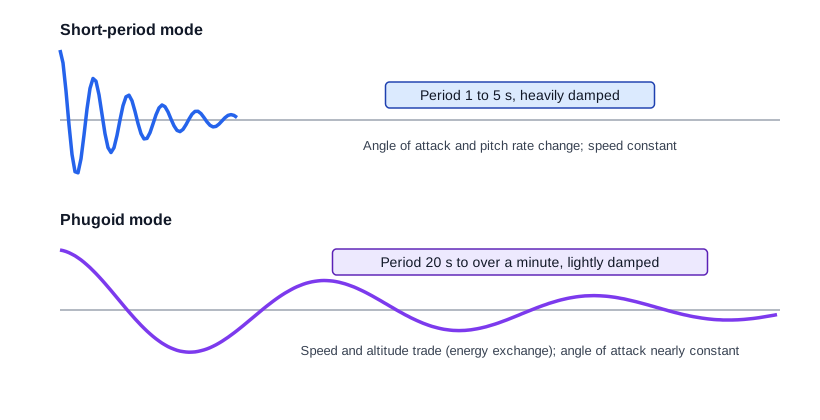
Which motion is the long-period, lightly damped oscillation in speed and altitude?
Short period
Dutch roll
Phugoid
Spiral
Phugoid periods are tens of seconds, and the angle of attack stays nearly constant.
Adverse yaw is the tendency of the nose to yaw:
Opposite to the direction of a commanded roll
In the direction of the roll
Only with the rudder neutral and wings level
Only in a stall
The down-aileron wing makes more lift and induced drag, pulling the nose away from the turn. Differential ailerons and rudder coordination counter it.
In a steady climb, which equation holds along the flight path?
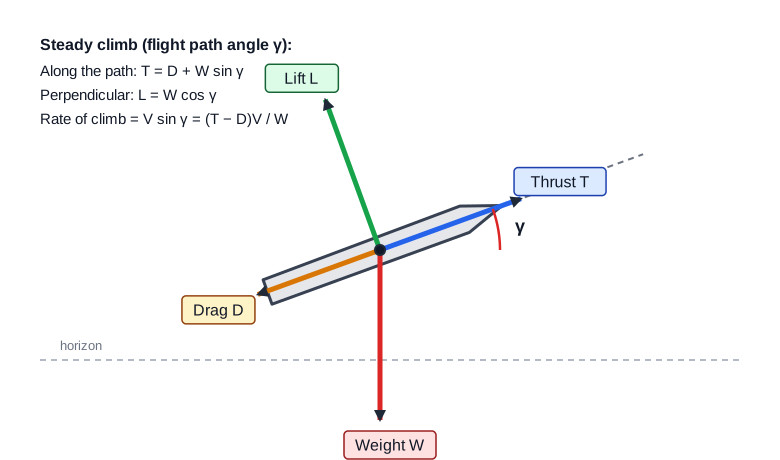
Part of the weight acts along the path and must be balanced by excess thrust. Lift equals , not W.
The speed for best angle of climb (VX) compared with the speed for best rate of climb (VY) is:
Higher
Always the same
Unrelated
Lower
VX uses maximum excess thrust and VY uses maximum excess power; for a typical aircraft VX < VY, and they meet at the absolute ceiling.
For maximum still-air glide distance, fly at the speed for:
Maximum L/D
Minimum airspeed
Maximum CL
Minimum power
Glide distance . Minimum power gives minimum sink rate, which is slower than best glide speed.
Increasing aircraft weight decreases the maximum glide ratio.
True
False
The maximum L/D depends on aerodynamics, not weight. Weight only changes the speed at which it occurs.
Load factor in a steady level 60° banked turn is:
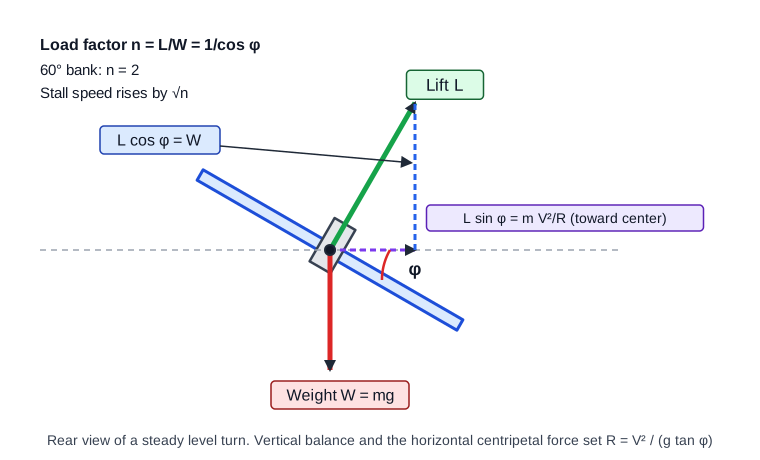
1.15
1.41
2
0.5
. The pilot feels twice normal weight.
The stall speed in a steady 60° banked turn compared with level flight is:
The same
Twice as high
About 15% higher
About 41% higher
. Twice (n=2) is the load factor itself, not the speed ratio.
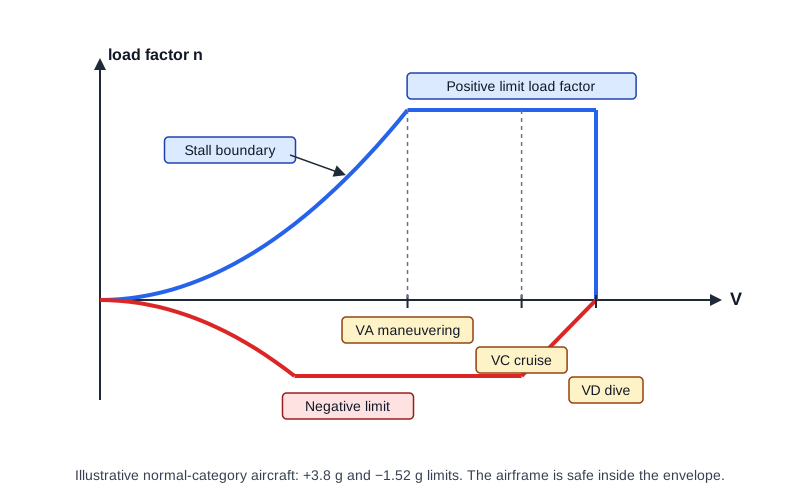
What does the V-n diagram show?
Fuel burn versus altitude
The structural and aerodynamic limits on load factor versus airspeed
Drag versus Mach number
Rate of climb versus weight
It displays the stall boundary, the positive and negative limit load factors and the dive speed.
The design maneuvering speed VA decreases when:
Weight increases
Altitude increases
Weight decreases
Air temperature falls
because a lighter aircraft reaches a given load factor at a lower speed.
TAS compared with IAS at high altitude is:
Higher
Lower
The same
Depends on heading
Thinner air requires a higher true speed for the same dynamic pressure.
What does 'density altitude' describe?
The height above the terrain
The altitude in the standard atmosphere at which the air density equals the actual density
Altitude at 1013 hPa
Altitude corrected for wind
High, hot days have a high density altitude, reducing engine power and lift.
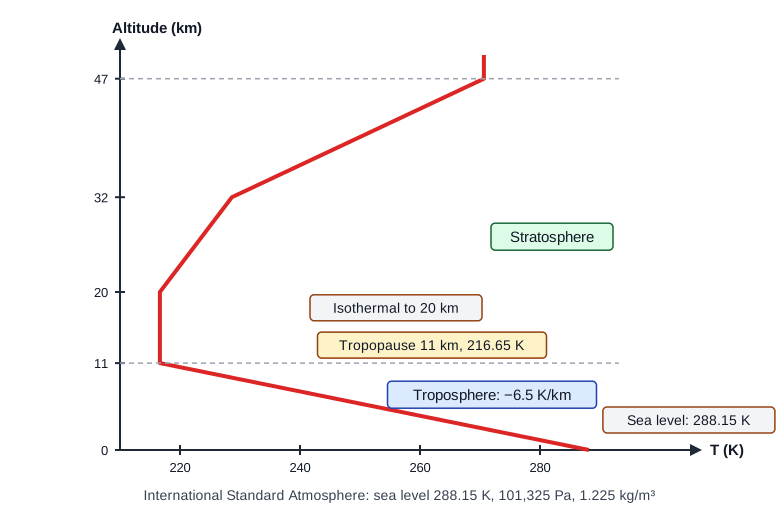
Which statement about the ISA troposphere is correct?
Temperature is constant up to 11 km
Temperature rises 6.5 K per km
Pressure is constant
Temperature falls 6.5 K per km up to 11 km
The standard lapse rate is 6.5 K/km (about 1.98 °C per 1000 ft).
Which surface mainly provides directional (weathercock) stability?
Vertical fin
Horizontal tail
Ailerons
Flaps
A positive from the fin turns the nose into the relative wind.
A yaw damper primarily damps:
Phugoid
Stall
Dutch roll
Roll subsidence only
It senses yaw rate and commands rudder to suppress the coupled yaw-roll oscillation.
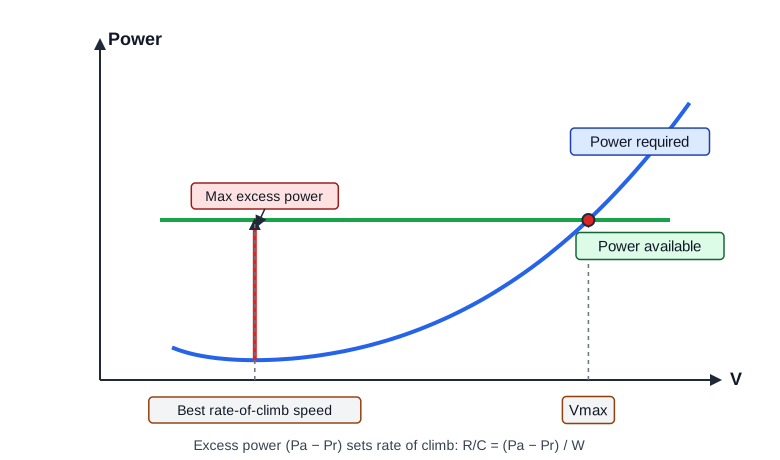
Which power condition gives maximum endurance for a propeller aircraft?
Flight at minimum drag speed
Flight at maximum speed
Flight at VNE
Flight at minimum power required
Endurance is maximized by minimizing fuel flow, which is proportional to power for a propeller aircraft.
