Quiz · Medium
Conceptual questions on Fick's law, two-film theory, which phase controls and distillation basics.
A binary distillation column runs at total reflux. Compared with any finite reflux, the number of equilibrium stages required is:
The same
The maximum
Zero
The minimum
No product is withdrawn, the operating lines coincide with y = x, and the stair-steps are as large as possible, so the fewest stages are needed (Fenske equation).
In the two-film model, where is the concentration assumed to be in equilibrium?
Across the whole gas film
At the bulk gas
At the bulk liquid
At the interface
The model puts all resistance in the two films and assumes no resistance at the interface, so the interface compositions are in equilibrium. Bulk phases are well mixed but not in equilibrium with each other, otherwise there would be no net transfer.
Fick's first law says the diffusive flux is proportional to:
The concentration itself
The concentration gradient
The temperature gradient
The square of the velocity
J = -D dc/dz. Temperature gradient drives heat flux (Fourier), not Fickian mass flux.
Which dimensionless group is the mass-transfer analog of the Nusselt number?
Sherwood
Stanton
Lewis
Schmidt
Sh = k L / D. Schmidt is the analog of Prandtl; Lewis is a ratio of thermal to mass diffusivity.
Roughly how do diffusion coefficients in gases and liquids compare?
Gas values are about 10^4 times larger
Liquid values are about 10^4 times larger
They are about equal
Gas values are about 10 times larger
Gases are of order 10^-5 m²/s, liquids 10^-9 m²/s. This large gap is why liquid-side resistance is often dominant for sparingly soluble gases.
For equimolar counterdiffusion of A and B in an ideal gas, the net bulk flow is:
Equal to N_A
Always toward the higher concentration
Equal to N_A + N_B, which is nonzero
Zero
N_B = -N_A, so N_A + N_B = 0 and the flux is purely diffusive.
A gas A diffuses through a stagnant film of B. Compared with equimolar counterdiffusion at the same partial pressure drop, the flux is:
Larger by the factor P/p_B,lm
Smaller
The same
Zero
Bulk flow toward the sink adds to diffusion. P/p_B,lm is always at least 1; it approaches 1 when A is dilute.
In penetration theory, how does k_L depend on D?
k_L is independent of D
k_L is proportional to D
k_L is proportional to 1/D
k_L is proportional to the square root of D
k_L = 2 sqrt(D/(π t_c)). In film theory k_L is proportional to D; real systems often lie in between.
Ammonia in water is absorbed from air. The main resistance is likely to be in the:
Gas phase
Liquid phase
Interface
It is equally split by definition
Ammonia is very soluble (small m), so m/k_x is small in 1/K_y = 1/k_y + m/k_x and the gas film controls.
Carbon dioxide absorption in water is typically:
Liquid-phase controlled
Controlled at the interface
Independent of the film coefficients
Gas-phase controlled
CO2 is sparingly soluble (large m), so the m/k_x term dominates and liquid-side resistance controls.
The Schmidt number compares:
Convective and diffusive mass transport
Momentum and mass diffusivity
Heat and mass diffusivity
Momentum and thermal diffusivity
Sc = ν/D. Option 3 is Pr; option 4 is Sh; option 1 is the Lewis number (thermal diffusivity over mass diffusivity).
Which statement about gas-phase diffusivity is correct?
It increases with pressure
It decreases with temperature
It increases with temperature and decreases with pressure
It is independent of both
D is proportional to roughly T^1.5 to T^1.75 divided by P.
What does a relative volatility of exactly 1 mean?
The mixture is easy to separate
No separation by ordinary distillation is possible at that composition
Distillation can separate it at any reflux
The components have the same molecular weight
alpha = 1 means y = x for all compositions (as at an azeotrope point), so vapor and liquid are identical in composition.
In McCabe-Thiele, the q-line for a saturated-liquid feed is:
A line of slope 1
Vertical
A line of slope -1
Horizontal
q = 1 gives slope q/(q-1) = infinity: a vertical line at x = x_F. Saturated vapor (q = 0) gives horizontal.
What does this diagram's stair-step construction represent?
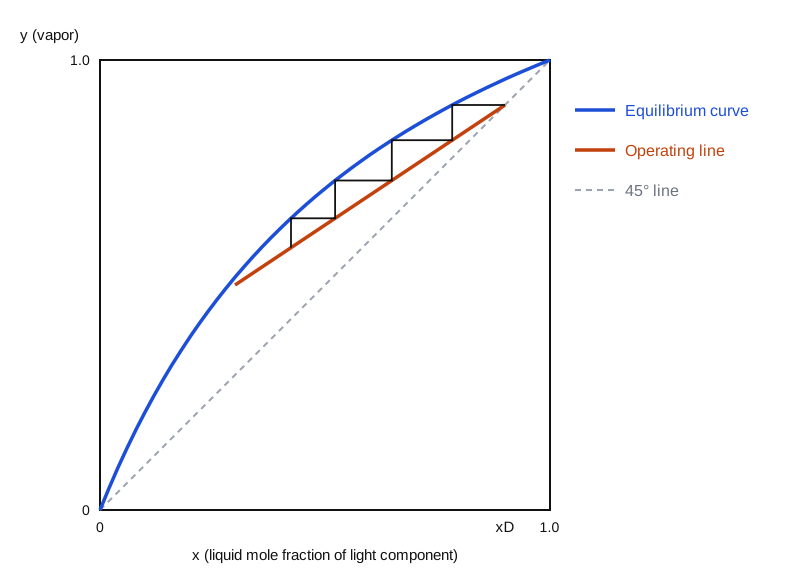
A single continuous mass-transfer unit
The reflux ratio
The feed stage only
One theoretical stage per step
Each horizontal-plus-vertical step corresponds to one equilibrium stage: equilibrium at the curve, then material balance on the operating line.
If the minimum reflux ratio is reached, the number of stages needed is:
Zero
Infinite
One
Minimal
At minimum reflux the operating lines meet at a pinch on the equilibrium curve, so the stair-steps become infinitely small.
In the two-film diagram, which pair of quantities are in equilibrium with each other?
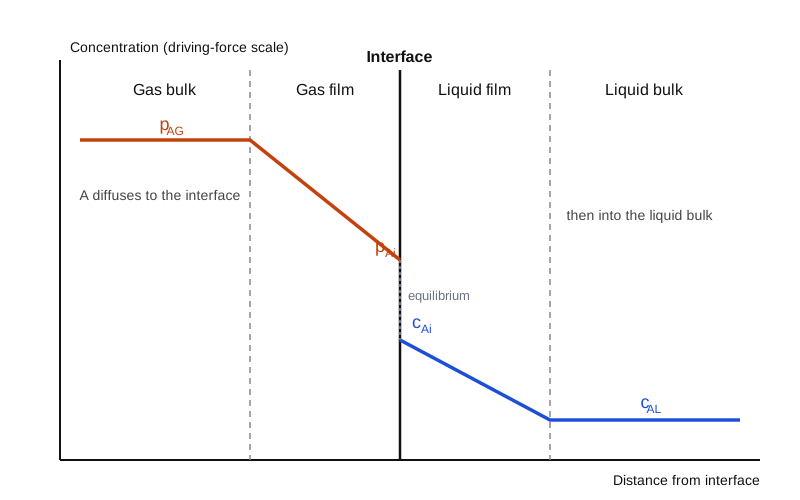
p_AG and c_AL
p_Ai and c_Ai
c_Ai and c_AL
p_AG and p_Ai
Interface concentrations on the two sides satisfy the equilibrium relation, for example p_Ai = H c_Ai.
An absorber is operated at L/G equal to 1.3 times its minimum. Compared with the minimum, the column height is:
Zero
Infinite
Unchanged
Finite
At L_min the operating line touches equilibrium and the column must be infinitely tall; above it the height is finite. Using 1.2 to 1.5 times the minimum balances height against solvent cost.
True or False: increasing total reflux ratio always lowers the total cost of a distillation column.
True
False
Higher reflux reduces the number of stages (capital) but increases reboiler and condenser duty and column diameter. There is an economic optimum around 1.1 to 1.5 times R_min.
Which pair of temperatures is nearly equal for the air-water system?
Wet-bulb and adiabatic saturation
Dry-bulb and wet-bulb
Wet-bulb and dew point
Dew point and dry-bulb
Because the Lewis number is about 1 for air-water, the wet-bulb and adiabatic-saturation temperatures nearly coincide.
