Quiz · Hard
DNS resolution, HTTP semantics, HTTP/3 and TLS, switching, routing protocols, delays and attacks.
Which DNS record maps a name to an IPv6 address?
A
AAAA
CNAME
MX
AAAA records hold IPv6 addresses; A records hold IPv4.
In the diagram, which server tells the resolver which servers are responsible for example.com?
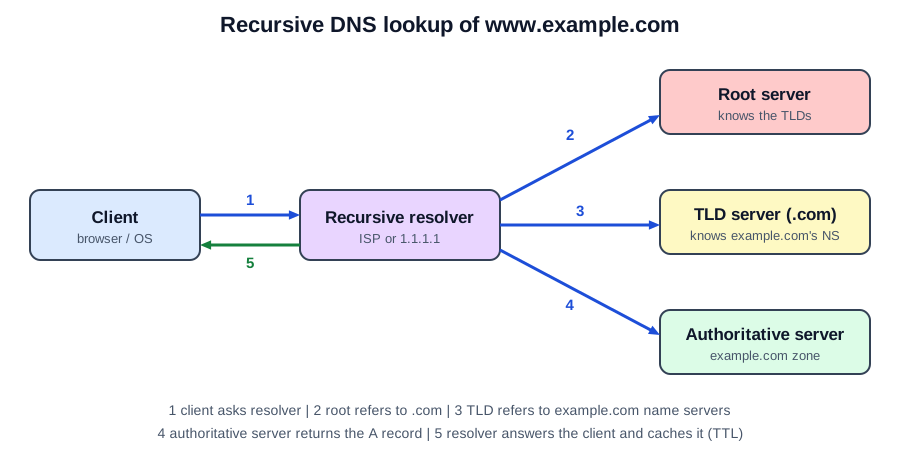
Root server
TLD server (.com)
Authoritative server
The client
The .com TLD server refers the resolver to the domain's authoritative name servers.
Which port and protocol does DNS mainly use for ordinary queries?
TCP 80
UDP 53
UDP 123
TCP 22
DNS uses UDP port 53 for most queries and falls back to TCP for large responses.
Which HTTP method is both safe and idempotent?
POST
PUT
GET
DELETE
GET does not change server state and repeating it gives the same result. PUT and DELETE are idempotent but not safe.
A request returns 403. What does it mean?
Not found
Server crashed
Authenticated but not allowed
Rate limited
403 Forbidden: the server understood the request and refuses it. 401 is for missing or invalid credentials.
Which status code indicates a permanent redirect that preserves the request method?
301
302
307
308
308 is permanent and keeps the method; 307 is temporary and keeps the method.
What is the main advantage of HTTP/2 over HTTP/1.1?
Plain text headers
Multiple multiplexed streams over one connection
Using UDP
No TLS needed
HTTP/2 multiplexes many requests on one TCP connection with binary framing and header compression.
Which protocol does HTTP/3 run on?
TCP
QUIC over UDP
SCTP
ICMP
HTTP/3 maps HTTP onto QUIC, which runs over UDP and includes TLS 1.3.
Why does TLS use symmetric encryption for bulk data?
It is more secure than asymmetric
It is much faster than public-key cryptography
It needs no key
Certificates require it
Public-key operations are slow, so they are used to agree on a key and the data uses a fast cipher like AES.
In the handshake diagram, how many round trips occur before the client sends application data?
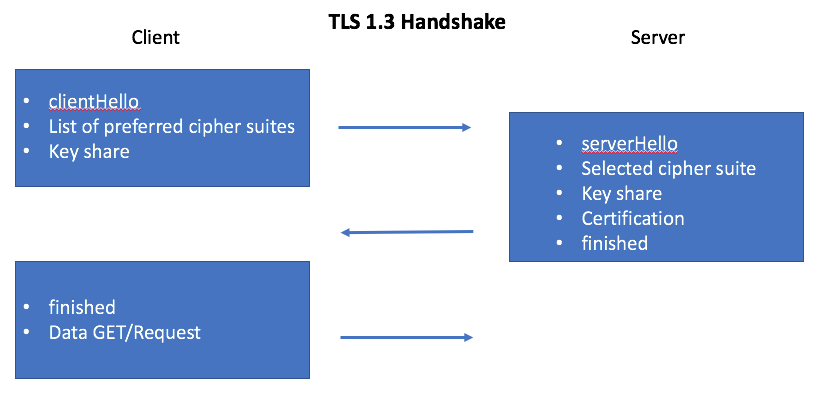
Zero
One
Two
Three
TLS 1.3 completes in a single round trip: hello with key share, server hello with certificate and finished.
What does the cookie attribute HttpOnly do?
Forces HTTPS
Hides the cookie from JavaScript
Limits it to one site
Expires it after the session
It stops scripts reading the cookie, reducing the damage of XSS attacks.
Which mail protocol keeps messages on the server and synchronizes across devices?
SMTP
POP3
IMAP
DNS
IMAP manages mail on the server; POP3 typically downloads and removes it.
What does a switch use to decide where to send a frame?
Destination IP address
Destination MAC address in its address table
TTL
Port number
Switches learn source MAC addresses per port and forward by destination MAC.
A broadcast domain normally ends at:
A switch port
A hub
A router interface
A cable
Routers do not forward layer 2 broadcasts. VLANs also split broadcast domains on switches.
Which protocol exchanges routing information between autonomous systems on the Internet?
RIP
OSPF
BGP
ARP
BGP is the path-vector inter-domain routing protocol.
Which routing algorithm does OSPF run on its link-state database?
Bellman-Ford
Dijkstra's shortest path
Prim's
Floyd-Warshall only
Each OSPF router builds the topology map and computes shortest paths with Dijkstra's algorithm.
What does a stateful firewall do that a stateless one does not?
Reads application data only
Tracks connections and allows return traffic for outbound sessions
Encrypts packets
Assigns IP addresses
It remembers connection state, so replies to internal requests pass but unsolicited inbound packets do not.
A SYN flood attack aims to:
Steal cookies
Exhaust the server's half-open connection resources
Poison DNS caches
Crack Wi-Fi keys
Many SYNs without the final ACK fill the backlog; SYN cookies help defend.
The topology figure shows nodes connected to a central device. Which topology is it?
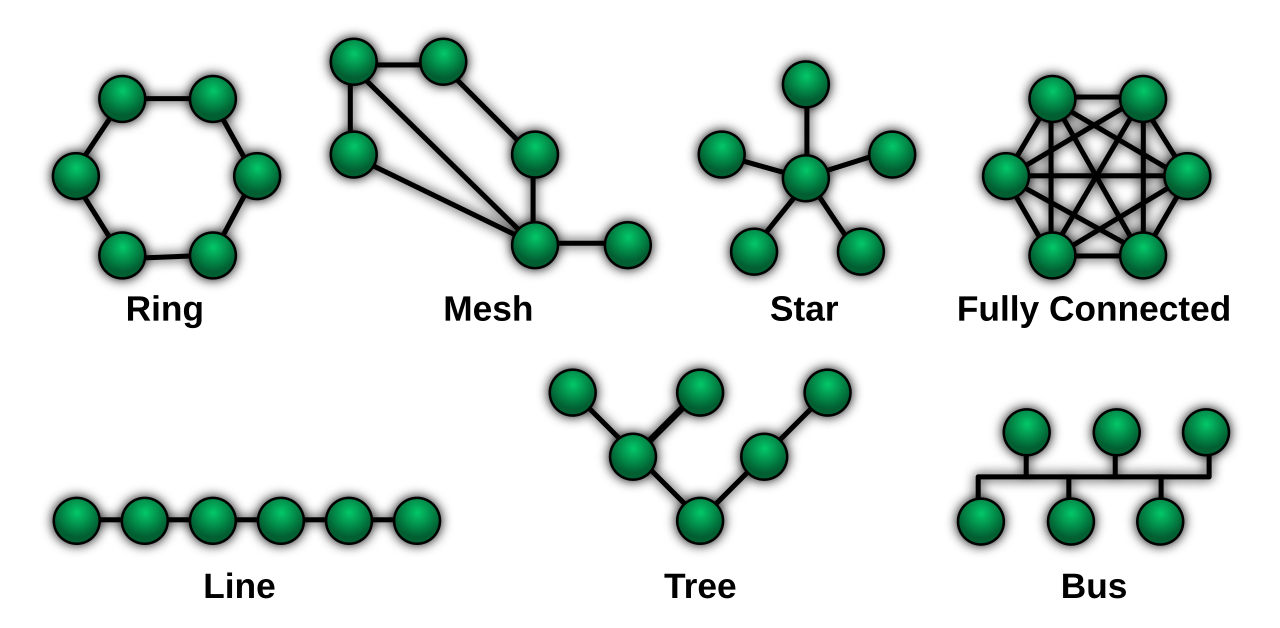
Ring
Bus
Star
Fully connected
All nodes connect to a hub or switch in the middle, as in most modern Ethernet LANs.
What is the bandwidth-delay product of a 100 Mbps link with a 40 ms round-trip time?
500 KB
50 KB
4 KB
5 MB
100 Mbit/s x 0.04 s = 4 Mbit = 500 KB of data in flight.
Which Wi-Fi security protocol uses SAE to resist offline password guessing?
WEP
WPA
WPA2-Personal
WPA3
WPA3 replaces the pre-shared key handshake with Simultaneous Authentication of Equals.
