Quiz · Medium
Phase relationships, soil classification, effective stress, seepage, consolidation, shear strength and foundations.
Water table at the ground surface; saturated clay γsat = 19 kN/m³. Effective stress at 5 m depth is closest to
95 kPa
49 kPa
46 kPa
144 kPa
σ = 95 kPa, u = 49 kPa, σ' = 46 kPa. 95 forgets pore pressure.
A pile in a consolidating clay can experience extra downward load from negative skin friction.
True
False
As the soil settles relative to the pile, drag acts downward on the shaft.
Which relationship is always true for soil phase relationships?
S = wGs e
e = wGs S
Se = wGs
w = Se Gs
Degree of saturation times void ratio equals water content times specific gravity. For saturated soil S = 1, so e = wGs.
A soil has porosity 0.35. Its void ratio is
0.54
0.35
0.65
1.86
e = n/(1 − n) = 0.35/0.65 = 0.538. 1.86 is the inverse, and 0.65 is 1 − n.
Which phase has weight that is normally taken as zero in the phase diagram?
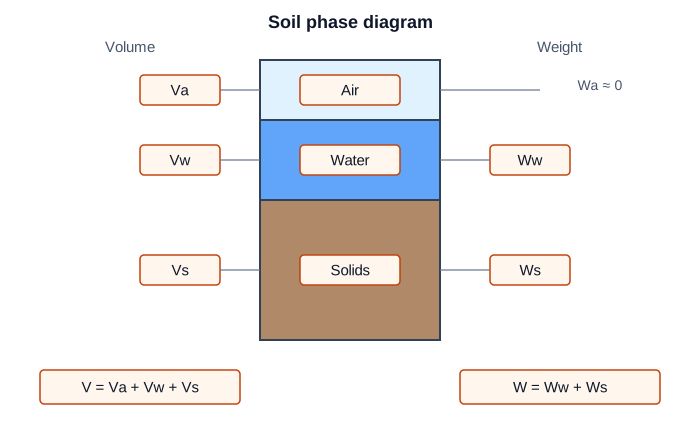
Water
Solids
Voids that are saturated
Air
Air weighs essentially nothing compared with water and solids; this is why dry soil weight equals the weight of solids.
LL = 45, PL = 22 and natural w = 30. The liquidity index is
0.65
0.35
1.30
8
PI = 23 and LI = (w − PL)/PI = 8/23 = 0.35. A value between 0 and 1 means the soil is in the plastic state.
In the diagram, the water content at the boundary between semisolid and plastic states is the
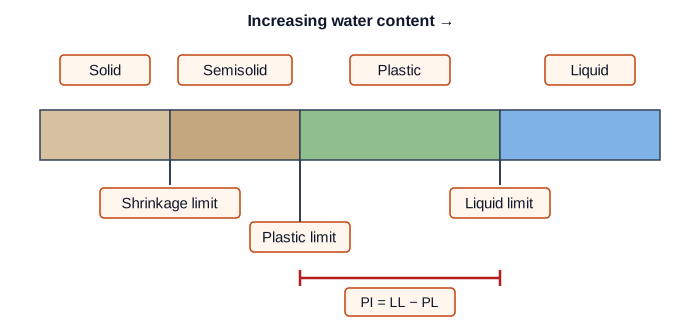
shrinkage limit
plastic limit
liquid limit
optimum moisture content
Shrinkage limit is between solid and semisolid; liquid limit is between plastic and liquid.
A soil has more than 50% passing the No. 200 sieve, LL = 60 and plots above the A-line. The USCS symbol is
CL
MH
SC
CH
Fine-grained with LL over 50 means high plasticity; above the A-line means clay. MH would be silt below the A-line.
A sand has D10 = 0.15, D30 = 0.30 and D60 = 0.60 mm. It is classified as
poorly graded (Cu = 4)
well graded (Cu = 4, Cc = 1)
well graded (Cu = 2)
gap graded with Cc = 3
Sands need Cu ≥ 6 as well as 1 ≤ Cc ≤ 3. Cc = 1 alone is not enough.
Compared with standard Proctor, modified Proctor compaction gives
lower maximum dry density and higher optimum moisture
the same density at a different moisture
higher maximum dry density and lower optimum moisture
a higher optimum moisture and a higher density
More compactive energy packs grains tighter, so less water is needed for lubrication.
Relative compaction in the field is 95% when
field moisture is 95% of optimum
degree of saturation is 95%
the void ratio is 0.95
field dry density is 95% of lab maximum dry density
RC compares dry density only, not moisture.
Effective stress in a saturated soil equals
total stress plus pore pressure
total stress minus pore water pressure
pore pressure minus total stress
total stress times the porosity
Terzaghi: σ' = σ − u. Pore pressure carries no shear and does not hold grains together.
A rising water table in a sand deposit will
reduce effective stress and shear strength
increase effective stress
have no effect on effective stress
increase total stress only
Pore pressure rises while the total stress changes little, so σ' falls and so does frictional strength.
In Darcy's law v = ki, i is
the hydraulic gradient, head loss per length
the pore pressure
the porosity
the total head
i = Δh/L. Seepage velocity through the pores is larger: v/n.
A falling-head permeability test is best suited for
clean gravels
dry sands only
fine-grained soils such as clays and silts
rock cores
Low flow rates in fine soils are measured more accurately by the drop in head in a standpipe. Constant head is for clean sands and gravels.
In a flow net, flow lines and equipotential lines
are parallel
cross at right angles
meet at 45 degrees
never intersect
They form curvilinear squares so that equal head loss and flow occur in each element.
The critical hydraulic gradient for a typical sand is about
0.1
10
0.5 times Gs
1.0
icr = (Gs − 1)/(1 + e). With Gs = 2.65 and e = 0.65 this is exactly 1. At that gradient upward flow can cause a quick condition.
Primary consolidation is controlled by
creep of soil skeleton
elastic compression of grains
dissipation of excess pore water pressure
evaporation
Water must squeeze out of low-permeability clay, which takes time. Creep is secondary compression.
If a clay layer drains on one side only, then doubling its thickness makes consolidation take about
four times as long
twice as long
the same time
eight times as long
t ∝ Hdr², so doubling H gives 4 times.
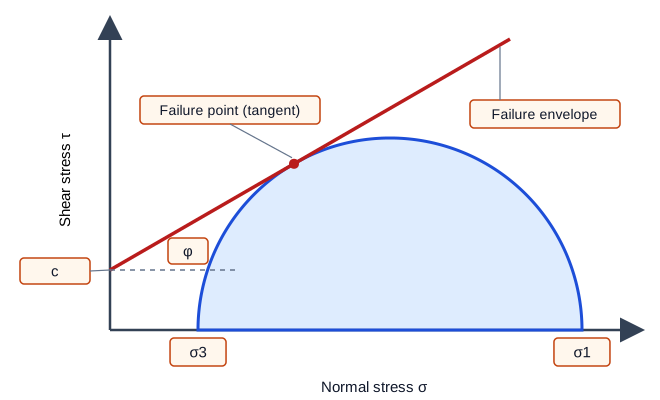
Mohr-Coulomb failure is represented by
τf = c' + σ'/tanφ'
τf = σ' tanφ' − c'
τf = c' tanφ'
τf = c' + σ' tanφ'
Shear strength = cohesion + frictional component proportional to effective normal stress.
For a cohesionless soil with φ = 30°, Ka is
3
1/3
0.5
0.67
Ka = (1 − sin30°)/(1 + sin30°) = 0.5/1.5. Kp = 3 and K0 ≈ 0.5.
In an unconfined compression test, qu = 100 kPa. The undrained shear strength is
100 kPa
50 kPa
200 kPa
25 kPa
cu = qu/2 because the Mohr circle radius is half the compressive strength with φu = 0.
Which test would be used to find the strength of very soft clay in situ?
Proctor test
Sieve analysis
Casagrande limit test
Vane shear test
A vane pushed into the soil and rotated gives su directly.
Terzaghi's equation qult = cNc + qNq + ½γBNγ: the term qNq represents
the effect of surcharge from soil above footing level
cohesion
the soil weight below the footing
the live load on the footing
q = γDf; deeper footings have more surcharge and higher capacity.
The SPT N value is the number of blows required to drive the sampler
the first 150 mm
450 mm in total
the last 300 mm of a 450 mm drive
600 mm in total
The first 150 mm is a seating drive and is not counted.
Which foundation is most appropriate for a heavy building on thick soft clay over rock 20 m below?
Isolated spread footings
Strip footings at 1 m depth
A thin unreinforced slab
Piles or drilled shafts to rock
Shallow foundations would settle excessively in soft clay; deep foundations transfer load to the rock.
Liquefaction mainly affects loose saturated sands during cyclic loading.
True
False
Cyclic loading increases pore pressure until effective stress is near zero, so the sand behaves as a liquid.
RQD of a 1.5 m core run with 1.05 m of intact pieces over 100 mm is
105%
70%
30%
100 mm
RQD = 1.05/1.5 = 70%, which is fair rock quality.
