Quiz · Medium
Core thermodynamics: properties, first and second laws, entropy, cycles and diagrams.
The zeroth law of thermodynamics establishes:
Conservation of energy
Temperature as a measurable property
That entropy never decreases
That heat flows hot to cold only
If A and B are each in equilibrium with C, they are in equilibrium with each other, which is why thermometers work. Energy conservation is the first law; entropy is the second.
Which of these is an intensive property?
Temperature
Volume
Total energy
Mass
Intensive properties do not depend on system size. Volume, energy and mass all scale with the amount of matter.
Raising the compression ratio of an ideal Otto cycle:
Decreases its efficiency
Does not change it
Increases its efficiency
Changes only power
η = 1 − 1/r^(k−1) rises with r. The practical limit is engine knock.
A closed system is one in which:
Neither mass nor energy can cross the boundary
Both mass and energy can cross
Only work can cross
Mass cannot cross the boundary but energy can
Closed systems exchange heat and work but not mass. Neither crossing describes an isolated system.
A gas absorbs 100 kJ of heat and does 40 kJ of work on its surroundings. The change in internal energy is:
+140 kJ
−60 kJ
+60 kJ
−140 kJ
ΔU = Q − W = 100 − 40 = 60 kJ. Adding the work would be the wrong sign convention.
For an ideal gas undergoing an isothermal process, the change in internal energy is:
Equal to Q only
Zero
Equal to W only
Always positive
Internal energy of an ideal gas depends on temperature only, so ΔU = 0 and Q = W.
In the P-V diagram, which of the two curves through the starting point is the adiabatic?
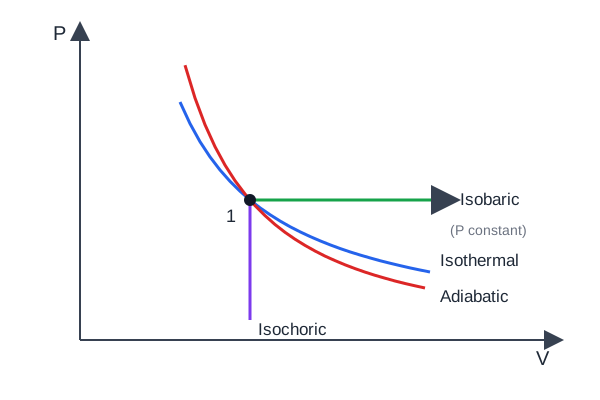
The steeper one (red)
The shallower one (blue)
The horizontal line
The vertical line
Adiabatic compression and expansion change temperature, so P ∝ V^−k with k > 1 gives a steeper curve than the isotherm (P ∝ V^−1).
In the Carnot diagram shown, process 2-3 is:
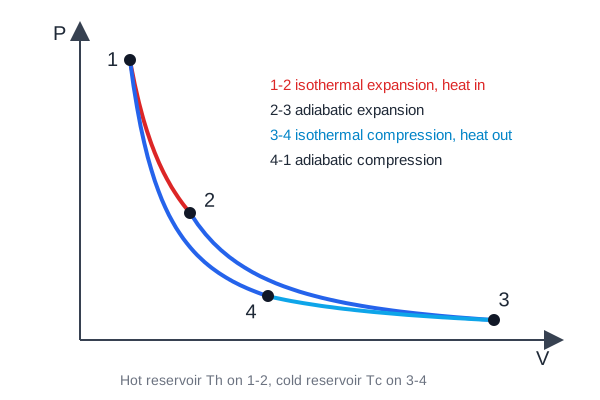
Isothermal expansion
Isothermal compression
Isochoric cooling
Adiabatic expansion
The Carnot cycle has two isothermal and two adiabatic steps. 1-2 is the isothermal expansion; 2-3 is the adiabatic one where T falls.
The efficiency of a Carnot engine depends on:
The working fluid
The mass of working fluid
Only the reservoir temperatures
The cycle speed
η = 1 − TL/TH, independent of the substance. This is a corollary of the second law.
True or False: a heat engine can convert all the heat it receives from a single reservoir into work if it is frictionless.
False
True
The Kelvin-Planck statement forbids it. Even with no friction, some heat must be rejected to a colder reservoir.
Entropy of an isolated system during an irreversible process:
Increases
Decreases
Stays constant
Equals zero
Sgen > 0 for irreversible processes, and an isolated system exchanges no entropy with its surroundings, so its entropy rises.
A reversible adiabatic process is:
Isothermal
Isobaric
Isenthalpic
Isentropic
No heat transfer and no entropy generation means constant entropy. Throttling, by contrast, is isenthalpic and irreversible.
A saturated mixture of water has a quality of 0.25. This means:
25% of the volume is vapor
25% of the mass is liquid
25% of the mass is vapor
The mixture is at 25 °C
x = mass of vapor / total mass. By volume the vapor fraction is usually far larger since vapor is much less dense.
A heat pump has a COP of 3. For each 1 kW of electrical input it delivers:
2 kW of heat
3 kW of heat to the space
1 kW of heat
4 kW of heat
COP_HP = QH/W, so QH = 3 kW. Of that, 2 kW came from the cold source.
An ideal throttling valve operates at constant:
Enthalpy
Entropy
Temperature
Pressure
Steady, adiabatic, no work, negligible kinetic energy change gives h1 = h2. Entropy increases because throttling is irreversible.
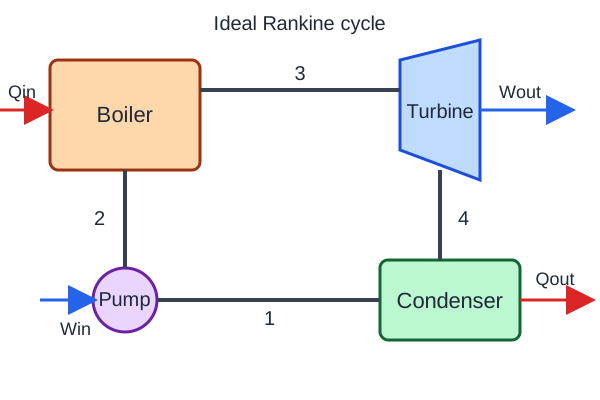
In the Rankine cycle shown, which component raises the liquid's pressure?
Boiler
Turbine
Condenser
Pump
The pump compresses saturated liquid (state 1 to 2) with little work. The turbine and condenser lower pressure or reject heat.
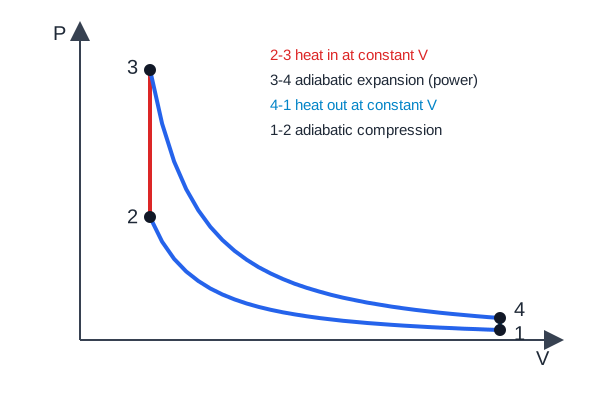
In the Otto cycle diagram, heat is added during:
1-2, at constant pressure
2-3, at constant volume
3-4, adiabatically
4-1, at constant volume
In the ideal Otto cycle the combustion is modeled as constant-volume heat addition. 4-1 is the heat rejection.
For an ideal gas, cp − cv equals:
R
k
1
cv/cp
cp − cv = R, and the ratio cp/cv = k. The two are easy to mix up.
True or False: the Carnot efficiency formula can be used with temperatures in °C.
False
True
Absolute temperatures (kelvin) are required. With °C a 'T = 0' gives nonsense.
A refrigerator removes 6 kW from the cold space using 2 kW of power. Its COP is:
2
4
3
0.33
COP_R = QL/W = 6/2 = 3. A value of 4 would be the heat pump's COP (8/2).
Why can an adiabatic turbine's work be written as h1 − h2?
Because it is isothermal
Q ≈ 0 and kinetic and potential changes are small
Because it is reversible
Because pressure is constant
The steady-flow equation with Q = 0 and negligible ΔKE and ΔPE leaves w = h1 − h2. Reversibility is only needed for the isentropic efficiency.
