Quiz · Medium
Identify fiber connectors, choose cables, and answer questions on Wi-Fi, PoE, VLANs, STP and routing protocols.
Which fiber connector is shown?
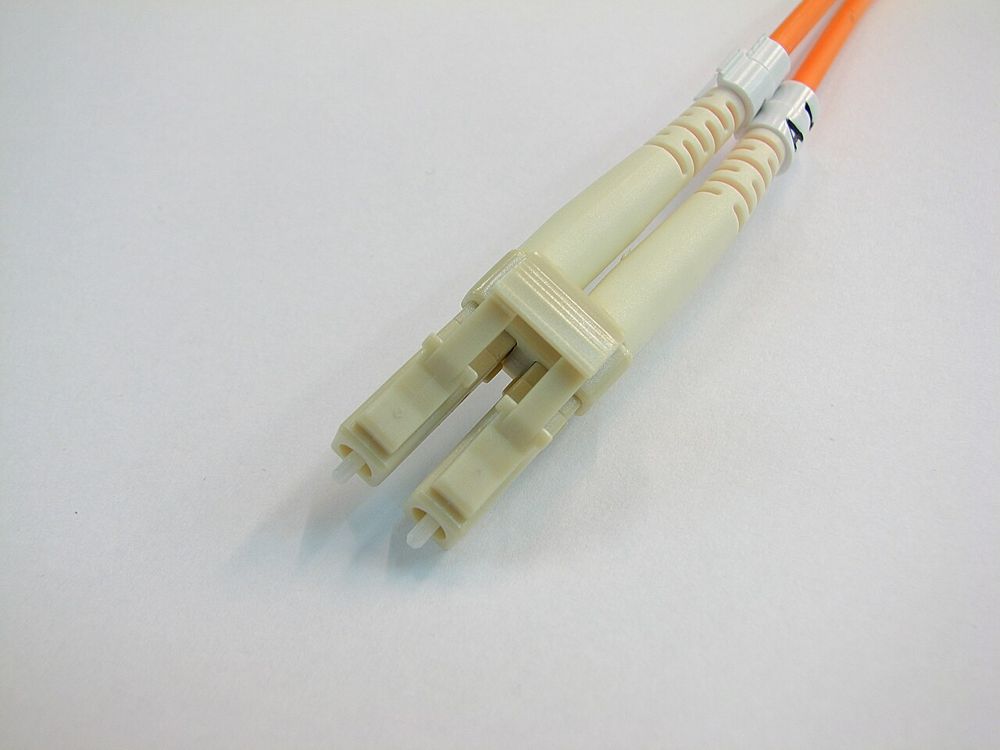
SC
LC
ST
MPO
The small push-pull duplex connector is LC, common on SFP transceivers.
Image: Adamantios, CC BY-SA 3.0, via Wikimedia Commons.
Which fiber connector is shown?
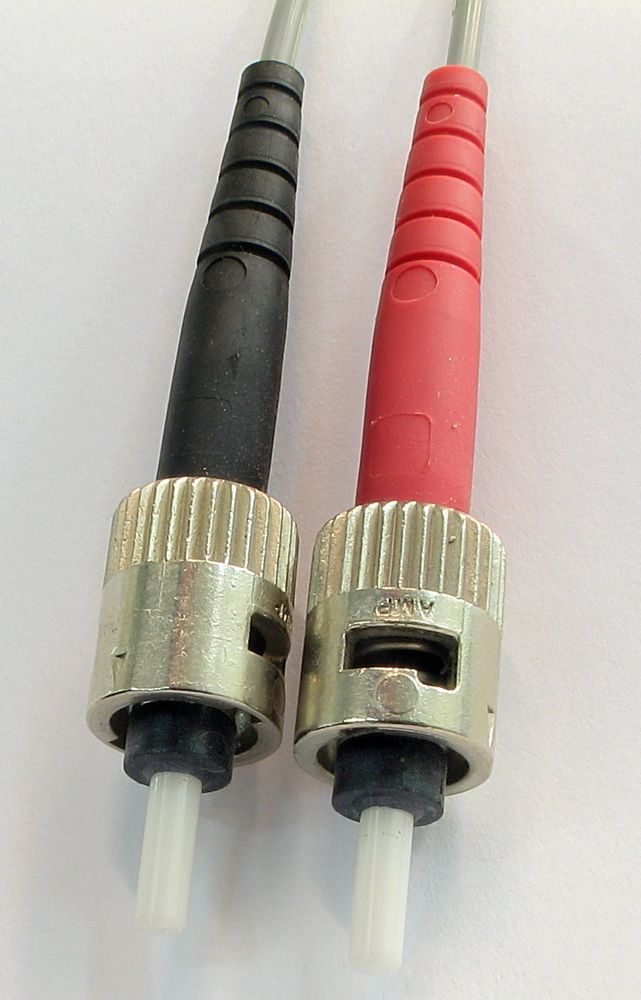
ST
LC
SC
RJ45
The round bayonet-style connector with a metal twist-lock collar is ST (Straight Tip).
Image: Adamantios, CC BY-SA 3.0, via Wikimedia Commons.
Which fiber connector is shown?
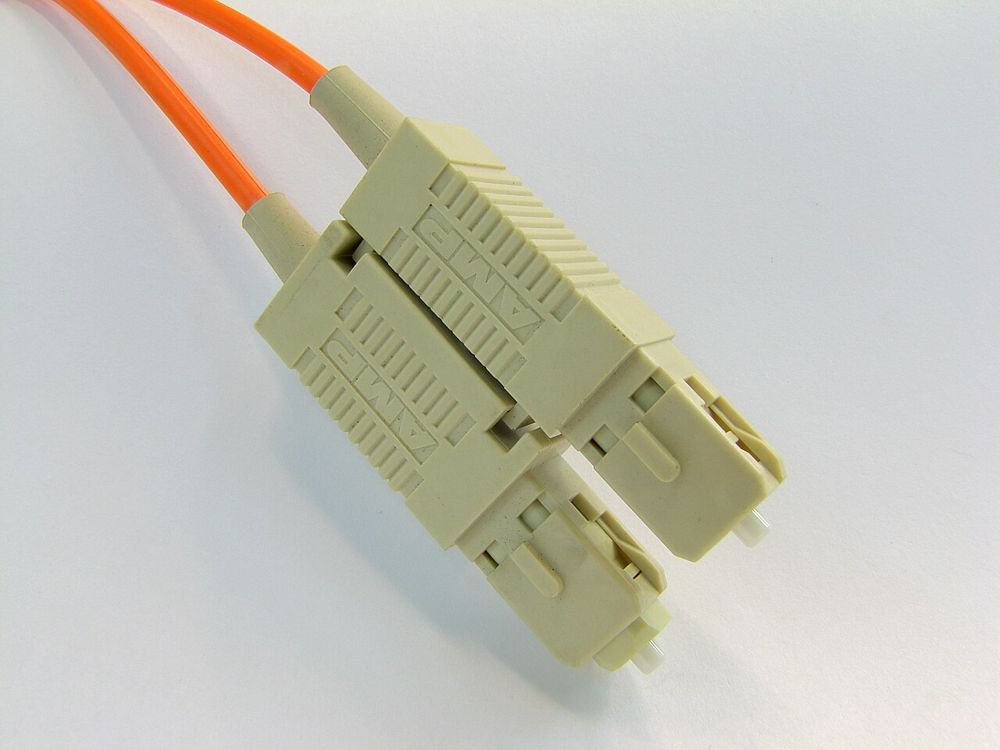
ST
LC
F-type
SC
The square snap-in push-pull body is an SC connector.
Image: Adamantios, CC BY-SA 3.0, via Wikimedia Commons.
What is the maximum recommended length of a twisted-pair Ethernet cable run?
55 meters
185 meters
100 meters
300 meters
Twisted-pair Ethernet segments are limited to 100 m (328 ft). 185 m was thin coax (10BASE2) and 55 m is the 10 Gbps limit on Cat6.
Which cable category supports 10 Gbps over the full 100 meters?
Cat5e
Cat6a
Cat6
Cat3
Cat6a (500 MHz) supports 10GBASE-T to 100 m. Cat6 manages 10 Gbps only up to about 55 m and Cat5e is rated for 1 Gbps.
Which tool in a technician's kit attaches an RJ45 plug to a cable end?
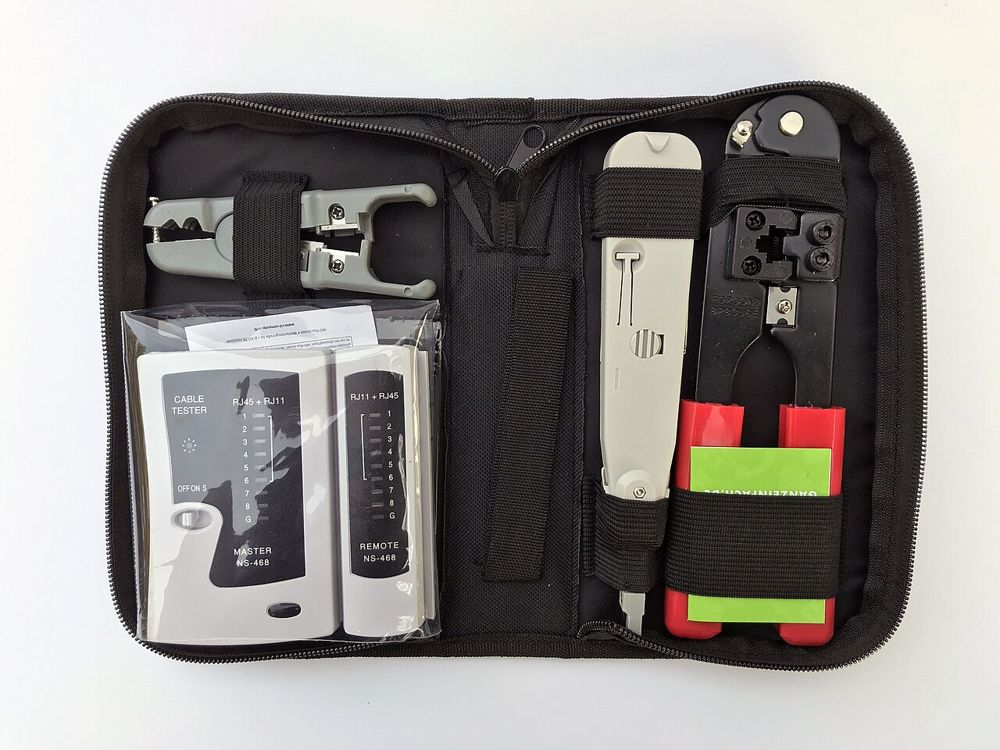
Crimping tool
Punch-down tool
Cable tester
Toner probe
A crimper presses the plug's contacts onto the wires. A punch-down tool terminates wires on patch panel blocks, and a cable tester checks continuity.
Image: www.heimnetzwerke.net, CC BY 4.0, via Wikimedia Commons.
Two switches must be linked with a legacy device that does not support Auto-MDIX. Which cable is needed?
Straight-through
Rollover
Coaxial
Crossover
Like devices on non-Auto-MDIX ports need a crossover (T568A on one end, T568B on the other). A rollover cable is for console access.
Which pin chart change turns a T568B cable end into a T568A one?
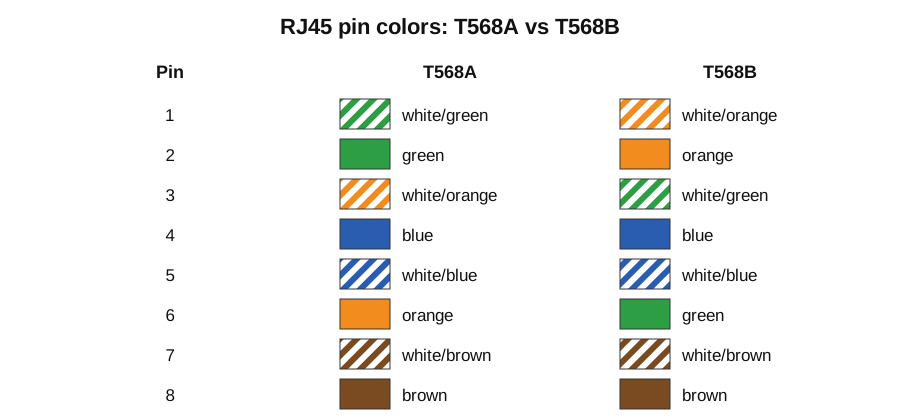
Swap the blue and brown pairs
Reverse all eight wires
Swap the green and orange pairs
Remove the brown pair
T568A and T568B differ only by the green and orange pairs (pins 1,2,3,6). Blue and brown stay on pins 4,5 and 7,8.
Which 2.4 GHz channels are the only non-overlapping set in the US?
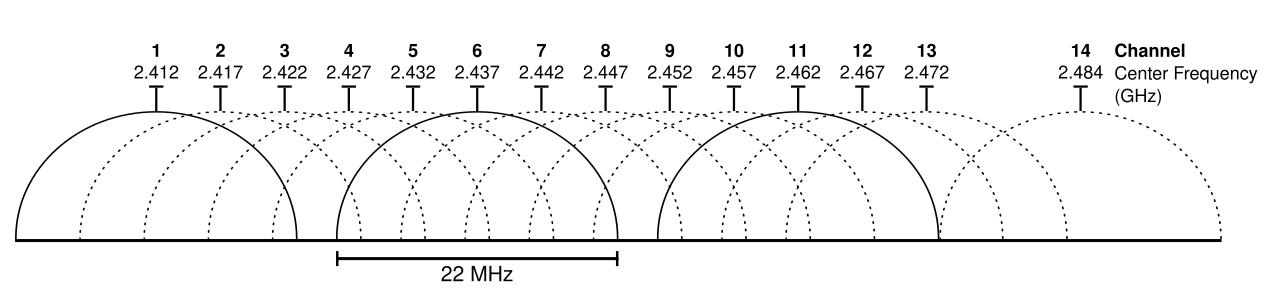
1, 5 and 9
1, 6 and 11
2, 7 and 12
3, 6 and 9
Channels are 22 MHz wide with centers 5 MHz apart, so only 1, 6 and 11 avoid overlap.
Image: Michael Gauthier, CC BY-SA 3.0, via Wikimedia Commons.
Which Wi-Fi standard operates on 5 GHz only?
802.11ac
802.11n
802.11g
802.11b
802.11ac (Wi-Fi 5) is 5 GHz only. 802.11n supports both bands; b and g are 2.4 GHz.
Which Wi-Fi security protocol uses SAE instead of a pre-shared key handshake?
WPA2
WEP
WPA
WPA3
WPA3 uses Simultaneous Authentication of Equals, which resists offline dictionary attacks on captured handshakes.
Which device operates at Layer 3 and separates broadcast domains?
Hub
Unmanaged switch
Router
Repeater
Routers forward by IP and do not pass broadcasts. Hubs and repeaters are Layer 1 and an unmanaged switch is Layer 2.
A single-mode fiber link is usually used for which purpose?
Short desk-to-switch links only
Long distances of many kilometers
Powering devices
Wireless backhaul only
Single-mode fiber with a laser source carries signals for kilometers. Multimode is used for shorter runs inside buildings.
Which PoE standard provides up to 30 W per port?
802.3at (PoE+)
802.3af
802.3bt Type 4
802.3ab
802.3af gives 15.4 W, 802.3at 30 W, and 802.3bt up to 60 or 100 W. 802.3ab is 1000BASE-T and has nothing to do with PoE.
What does a VLAN trunk port carry?
Only untagged traffic for one VLAN
Only management traffic
Only STP BPDUs
Traffic for multiple VLANs, tagged with 802.1Q
Trunks carry several VLANs between switches; each frame is tagged with a VLAN ID. Access ports carry a single untagged VLAN.
Spanning Tree Protocol exists mainly to prevent what?
IP address conflicts
DNS cache poisoning
Layer 2 switching loops
Wireless interference
Redundant switch links cause broadcast storms; STP blocks the redundant paths until needed.
Which routing protocol is used to exchange routes between different autonomous systems on the internet?
OSPF
BGP
RIP
EIGRP
BGP is the exterior gateway protocol that connects autonomous systems. OSPF, RIP and EIGRP are interior gateway protocols.
A hub is replaced with a switch. What changes for collisions?
Each port becomes its own collision domain
Collisions increase
Broadcasts stop
All ports share one collision domain
A switch isolates collision domains per port (full duplex removes collisions entirely). Broadcast traffic is still flooded within the VLAN.
Which type of fiber is typically orange or aqua jacketed with a 50 micron core?
Single-mode
Coaxial
Plenum twisted pair
Multimode
Multimode fiber has a 50 or 62.5 micron core and orange/aqua jackets; single-mode (9 micron) is normally yellow.
