Quiz · Hard
Evidential past, conditionals, participles, -ken and -ince, passive and causative, ability, necessity and reported speech.
What is the difference between 'Ali geldi' and 'Ali gelmiş'?
Future versus past
Positive versus negative
Seen past versus reported or inferred past
Polite versus rude
-di is the witnessed past. -miş is used for something you did not see yourself, were told, or just discovered: Ali gelmiş = Apparently Ali has come.
What does 'Yağmur yağarsa evde kalırım' mean?
If it rains, I will stay at home.
It rained, so I stayed at home.
It is raining and I am at home.
I stay at home when it rained.
-sa/-se is the conditional (if). Yağarsa = if it rains, kalırım = I will stay (aorist).
Which phrase expresses purpose, 'in order to learn Turkish'?
Türkçe öğrenince
Türkçe öğrendiğim
Türkçe öğrenirken
Türkçe öğrenmek için
The infinitive -mek/-mak plus için means in order to: öğrenmek için. -ince is when, -ken is while.
What does 'Hasta olduğum için gelemedim' mean?
I came although I was sick.
I could not come because I was sick.
I was sick so I will come.
If I am sick I cannot come.
-dığım için = because I was. Gelemedim is the negative of ability in the past (gel-e-me-di-m).
What does 'Keşke gelseydin' express?
A threat
A wish about the past
A plan for tomorrow
A question
Keşke + conditional past (-seydin) expresses regret: I wish you had come.
What does 'Kitap okuyan adam' mean?
the book that the man read
the man who reads a book
the man reading a book yesterday
the man who will read a book
-an/-en forms a subject participle: okuyan = who reads. For an object relative (the book I read) you would use -dığım: okuduğum kitap.
How do you say 'the book I read'?
okuyan kitap
okunan
okuyacağım kitap
okuduğum kitap
-dığı marks the past object relative with the possessive of the subject: okuduğum kitap. Okuyan kitap means the book that reads.
What does -ken mean in 'Yürürken müzik dinliyorum'?
while
after
because
before
-ken (while) is attached to the aorist or a noun: yürürken = while walking.
'Eve gelince seni ararım' means:
I called you because I came home.
If I come home I called you.
When I get home I will call you.
I call you before I get home.
-ince/-ınca means when or as soon as. Ararım is the aorist used for a promise.
What does 'Kapı açıldı' show?
Active, the door opened it
Causative, the door made it open
Passive, the door was opened
Ability, the door can open
The passive suffix -ıl- (açmak → açılmak) gives açıldı: the door was opened or opened.
What does 'Ali beni güldürdü' mean?
Ali made me laugh.
Ali laughed at me.
Ali was laughed at.
Ali wants to laugh.
-dir- is the causative: gülmek (to laugh) → güldürmek (to make laugh).
Which means 'I cannot swim'?
Yüzmem
Yüzdüm
Yüzebilirim
Yüzemem
Negative ability is -e/-a plus -me: yüzemem. Yüzmem is I do not swim (a habit), yüzebilirim is I can swim and yüzdüm is I swam.
How do you say 'I have to go'?
Gidebilirim
Gitmem gerekiyor
Giderim
Gitmedim
Gitmem gerek / lazım / gerekiyor: the infinitive with a possessive plus gerek. Gidebilirim is I can go.
How do you say 'before eating'?
yemek yedikten sonra
yemek yemeden önce
yemek yerken
yemek yemek için
-meden önce = before doing. -dikten sonra means after, -erken is while and için expresses purpose.
What does 'ne ... ne de' mean?
both ... and
either ... or
not only ... but also
neither ... nor
Ne çay ne de kahve istiyorum = I want neither tea nor coffee. Both ... and is hem ... hem de.
What does 'evdeki kitap' mean?
the book that is at home
the book that I took home
the home of the book
the book comes home
-ki turns a place or time into an adjective: evdeki = (the one) at home.
Which is 'I should study'?
Çalışabilirim
Çalışıyorum
Çalışmalıyım
Çalıştım
-meli/-malı expresses should or must: çalışmalıyım. Çalışabilirim is I can study.
What does 'hiç gitmedim' mean?
I did not go yesterday.
I will not go.
I have never been.
I went once.
Hiç with a negative verb means never: Türkiye'ye hiç gitmedim = I have never been to Turkey.
What does the sign Sigara içilmez mean?
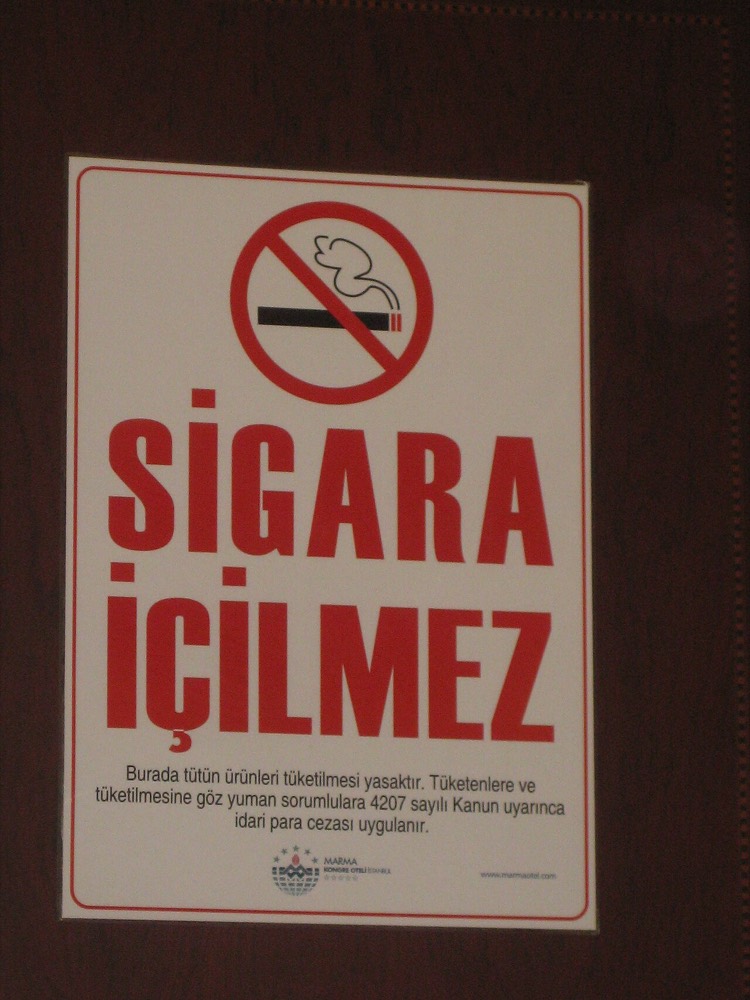
Smoking is not allowed.
Smoke is coming.
Please smoke here.
I am not smoking.
İçilmez is the passive (içilmek) in the negative aorist: it is not smoked. Sigara içilmez is a standard no-smoking sign. Image: Ibrahim Husain Meraj, CC BY-SA 3.0, via Wikimedia Commons.
Which form is used for reported speech, 'He said he won't come'?
Gelmiyor söyledi.
Gelmedi söyledi.
Gelmemek söyledi.
Gelmeyeceğini söyledi.
A reported future is built with the participle -eceğ- plus the possessive and accusative: gelmeyeceğini söyledi.
Which is a polite imperative 'Please sit'?
Lütfen otur.
Lütfen oturun.
Lütfen oturdun.
Lütfen oturur.
The plural/polite imperative adds -(y)In: oturun. Otur is the informal singular.
