Quiz · Medium
Check that you can read the letters, tell look-alikes apart and attach vowel signs correctly.
Which statement about the Devanagari script is correct?
It is a pure alphabet where every vowel is always a separate letter, as in English.
It is an abugida: each consonant carries an inherent a, and vowel signs change it.
It is a syllabary with an unrelated symbol for every syllable.
It is a consonant-only script like Hebrew, with vowels never written.
In an abugida, क is 'ka' and the signs ा ि ी and so on replace that a. Hindi also has independent vowel letters (अ आ इ...), but after a consonant a vowel is shown with a sign.
In which direction is Hindi written?
Right to left, like Urdu
Top to bottom in columns
Left to right
Alternating directions on each line
Hindi in Devanagari runs left to right. The Urdu script, used for the same spoken language, runs right to left.
What is the horizontal line along the top of most Devanagari letters called?
halant
danda
nukta
śirorekhā (headline)
The śirorekhā joins the letters of a word. The halant is a vowel-cancelling mark, the danda (।) a full stop and the nukta a dot under a letter.
What sound does the bare letter क carry by default?
ka, with the inherent a
k with no vowel
kā, a long a
ki
Every consonant letter has an inherent a. To remove it you add a halant (क्); to change it you add a vowel sign.
Which syllable is read kā?
कि
का
के
कु
ा is the vowel sign for ā, written after the consonant. कि is ki, के is ke, कु is ku.
Where is the vowel sign ि (i) written?
To the right of the consonant
Below the consonant
To the left of the consonant, although it is read after it
Above the consonant
In कि you see ि first but say k-i. The long sign ी (ī) goes to the right: की.
In this chart the orange parts are vowel signs added to क. Which of these syllables is written with a sign BELOW the consonant?
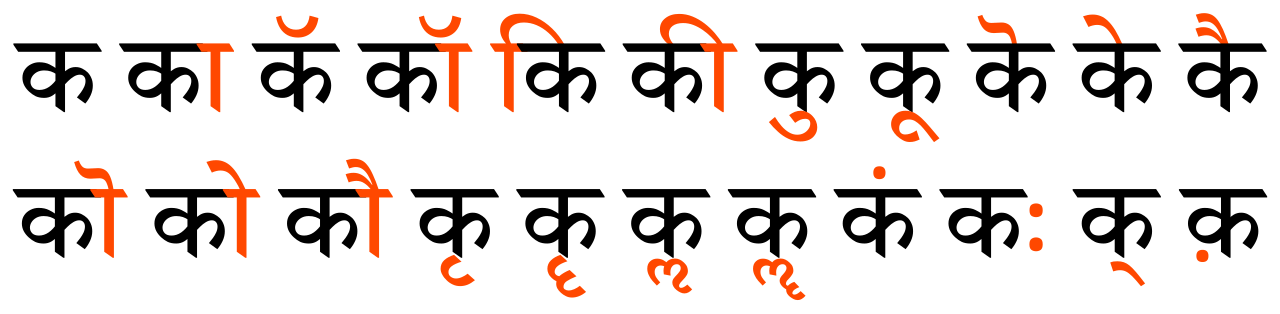
के (ke)
की (kī)
कि (ki)
कु (ku)
ु and ू hang below the consonant. े and ै sit above, ा and ी at the right, and ि at the left.
Image: Saurmandal, CC BY-SA 4.0, via Wikimedia Commons.
What is the difference between कु and कू?
कु has short u, कू has long ū
कू is nasalised and कु is not
They sound identical
कु is written above the consonant and कू below
Short and long vowels are different sounds in Hindi, and the length is shown in the sign. Both signs go under the consonant.
How is को read?
kau, as in 'saw'
ko, as in 'go'
kai, as in 'cat'
ke, as in 'they'
ो is o (the ā bar plus one stroke). ौ with two strokes is au: कौ.
Which sign has two strokes ABOVE the consonant and makes the sound ai?
े (as in के)
ौ (as in कौ)
ै (as in कै)
ं (as in कं)
े has one stroke (e) and ै has two (ai). ौ (au) adds the ā bar plus two strokes, and ं is a nasalising dot.
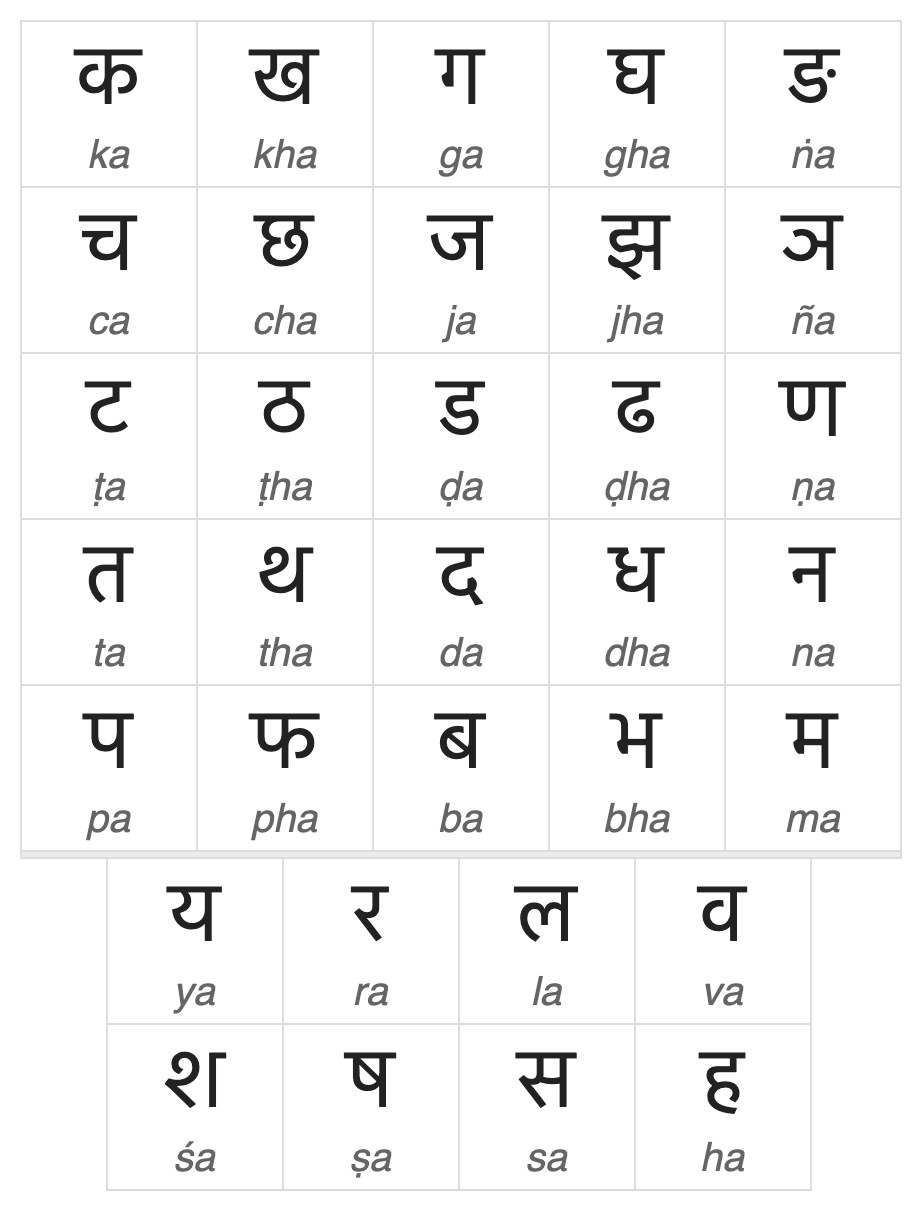
In this chart, which letter is the retroflex t, ṭa?
त
ठ
ढ
ट
ट (ṭa) has a tongue tip curled back. त is the dental ta, ठ is the aspirated ṭha, ढ is ḍha.
Image: Serg!o, public domain, via Wikimedia Commons.
In this chart, which letter is bha?
भ
ध
म
घ
भ (bha) is breathy b. म (ma), ध (dha) and घ (gha) look similar, so learn the shapes together.
Image: Serg!o, public domain, via Wikimedia Commons.
Which letter is va?
ब
व
य
च
व (va) is the sound between v and w; ब (ba) is a clear b. They are easy to mix up, so practise them as a pair. य is ya and च is ca.
Which letter is ma?
भ
स
म
य
म is ma. भ is the breathy bha, and स is sa. Many learners mix up म, भ and स, so check each against the chart.
Which letter is the aspirated partner of त (ta)?
द (da)
ध (dha)
ठ (ṭha)
थ (tha)
थ is त with a puff of air. ध is the breathy partner of द, and ठ is the retroflex aspirate.
Which group is the retroflex (ṭa-varga) row of the consonant chart?
ट ठ ड ढ ण
त थ द ध न
च छ ज झ ञ
प फ ब भ म
त-row is dental, च-row is palatal and प-row is labial. In the retroflex row the tongue tip curls back.
Which consonant is the nasal of the dental (ta) row?
ण
न
ङ
म
न (na) is the nasal of त थ द ध न. ण is retroflex, ङ is velar and म is labial.
Which letter is the flap sound in लड़का (laṛkā)?
ड
ढ़
ड़ (ड with a nukta)
ठ
ड़ has a dot under ड and is pronounced as a quick flap; ढ़ is its aspirated partner (as in पढ़ना).
Which of these is a full vowel LETTER rather than a vowel sign?
ा
ि
ु
आ
आ is the independent letter for ā at the start of a word (आम). ा, ि and ु are signs that attach to consonants.
Which sign looks like a moon with a dot and nasalises the vowel, as in माँ?
ँ (candrabindu)
ः (visarga)
़ (nukta)
् (halant)
ँ and ं both nasalise. ः adds a light h; ़ is a dot below a letter; ् cancels the inherent a.
Which word has the conjunct स्त?
स्वागत
नमस्ते
स्थान
पत्र
नमस्ते = न-म-स्ते. स्वागत has स्व, स्थान has स्थ, and पत्र has त्र.
True or false: in कि the ि is pronounced before the क.
True
False
It is written before but pronounced after: k + i.
True or false: Devanagari has separate capital and small letter forms.
False
True
Devanagari has one set of letter forms. Proper names and sentences begin with ordinary letters.
