Quiz · Easy
Famous Latin sayings, the Latin behind everyday abbreviations, legal terms and mottos, plus basic greetings and replies.
"Festina lente" means...
wait patiently
make haste slowly
time is slow
fast is best
An oxymoron favored by Augustus: act quickly but carefully.
What does "carpe diem" mean?
Beware of the day
Seize the day
Work all day
Time flies
Carpe is the imperative of carpo ("pluck, seize"), diem is the accusative of dies. "Time flies" is tempus fugit.
"Veni, vidi, vici" is by which Roman?
Julius Caesar
Cicero
Augustus
Virgil
Caesar reportedly wrote it to the Senate after defeating Pharnaces at Zela in 47 BC.
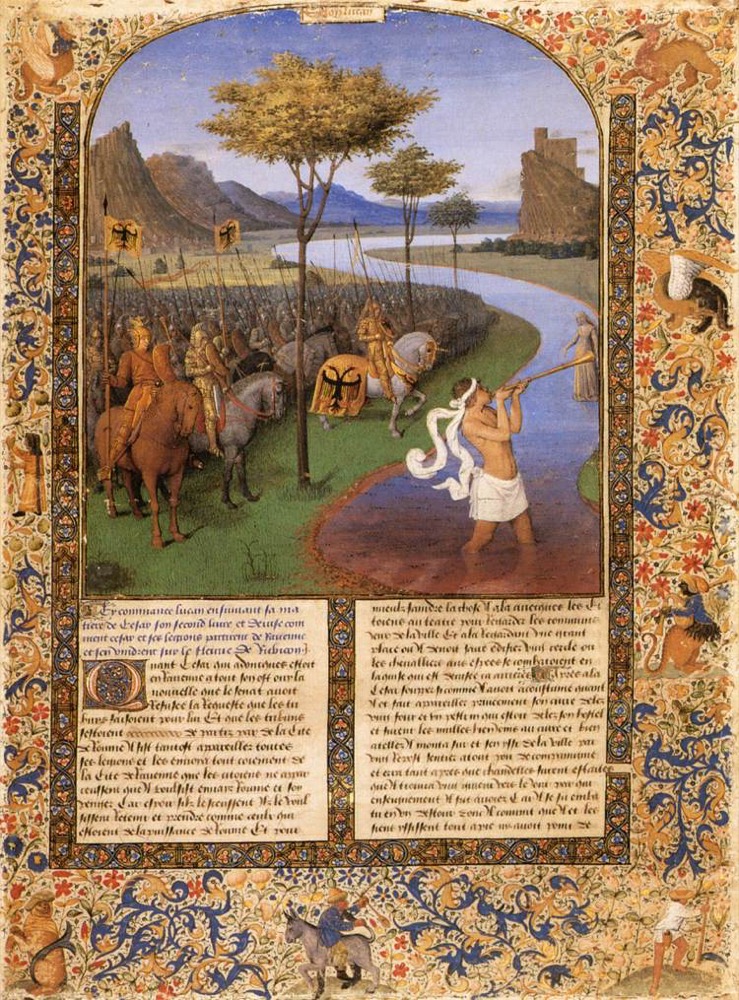
Which phrase is linked to Caesar crossing the Rubicon (shown)?
cave canem
festina lente
tabula rasa
alea iacta est
"The die is cast": Caesar's commitment to civil war in 49 BC. Image: Jean Fouquet, Caesar Crossing the Rubicon, public domain, via Wikimedia Commons.
What does "cogito, ergo sum" mean, and who said it?
I know that I know nothing - Socrates
Man is a wolf to man - Hobbes
I think, therefore I am - Descartes
Seize the day - Horace
Descartes, 1637 (French) and 1644 (Latin). Socrates' saying is not Latin and "homo homini lupus" comes from Plautus.
Which phrase means "a blank slate"?
terra incognita
tabula rasa
magnum opus
annus mirabilis
Tabula rasa: "scraped tablet". Terra incognita = unknown land; magnum opus = great work.
What does "e.g." stand for?
exempli gratia
et cetera
id est
ex gratia
e.g. = for example. i.e. = id est (that is). etc. = et cetera. Ex gratia ("as a favor") is a legal term.
What does "i.e." stand for?
in extremis
ibidem
in excelsis
id est (that is)
Use i.e. to restate something in other words; use e.g. to give examples.
"Et cetera" literally means...
and so forth I say
and I eat
and the other things
and the heads
Et = and, cetera = neuter plural of ceterus ("the remaining things").
What does "a.m." stand for?
anno mundi
ante meridiem (before midday)
annus magnus
ad meridiem
A.m. = before noon. Anno mundi is a different phrase ("in the year of the world").
"Per capita" means...
per head (per person)
per capital city
by the book
for the head of state
Capita is accusative plural of caput, "head". GDP per capita = GDP per person.
What does "in vitro" literally mean?
in life
in truth
in a vein
in glass
Vitrum = glass. Test-tube experiments are in vitro; in a living organism, in vivo.
What does "sine qua non" refer to?
A kind of sauce
A final warning
An indispensable condition
A contract without witness
Literally "without which not": something without which the result cannot occur.
"Caveat emptor" warns the...
seller
buyer
lawyer
judge
Emptor = buyer. "Let the buyer beware."
Which phrase is the motto of the U.S. Marine Corps?
Semper fidelis
Semper paratus
E pluribus unum
Per ardua ad astra
Semper fidelis = always faithful. Semper paratus is the Coast Guard's; per ardua ad astra the RAF's.
Which phrase appears on U.S. coins and the Great Seal and means "out of many, one"?
novus ordo seclorum
annuit coeptis
ad astra per aspera
e pluribus unum
Novus ordo seclorum = a new order of the ages, annuit coeptis = he favors our undertakings: both also on the Great Seal but different meanings.
What does "mens sana in corpore sano" mean?
a healthy mind is a rare body
the mind is the body of the wise
a healthy mind in a healthy body
mind over body
Juvenal, Satires 10.356. Ablatives of place (in corpore sano).
"Homo homini lupus" is best translated...
man is a wolf to man
man is a hunter of wolves
a wolf is a man's friend
mankind is born from wolves
Dative homini = "to man". Plautus, quoted by Hobbes.
What does "persona non grata" mean?
a person without a name
a non-citizen
a thankful person
an unwelcome person
Grata = pleasing, welcome. Used in diplomacy when a person is expelled.
What is the correct reply to "Quid agis?"
Gratias tibi ago.
Salvete!
Bene valeo.
Valete!
Quid agis? = How are you? Bene valeo = I am well. Gratias tibi ago is thanks; salvete/valete are plural greetings.
Which greeting do you use for more than one person?
Salve!
Salvete!
Vale!
Ave, domine!
Salve is for one person, salvete for several. Vale (one) and valete (many) are for goodbye.
What does "Latine loquor" mean?
I speak Latin.
I read Latin.
I write Latin.
I hear Latin.
Latine = "in Latin" (adverb). Loquor is a deponent verb meaning "I speak".
"Quota hora est?" means...
Which hour is best?
How many hours?
Where is the hour?
What time is it?
Quota (feminine, hora is feminine) = "which (in order)". The answer is e.g. "Hora tertia est".
What does "ad nauseam" describe?
Something done in an emergency
Something added at the end
Something repeated until sickening
Something done at sea
Ad = to, nauseam = nausea: "to the point of disgust".
Which statement about "stet" is true?
It means "stop".
It tells an editor to leave the text as it is.
It is an abbreviation of statim.
It is a legal term for a fine.
Stet = "let it stand" (present subjunctive of sto). It cancels a proofreader's correction.
