Quiz · Easy
24 questions on useful phrases for eating out, prices, directions, emergencies and social situations, plus common idioms.
You want to get a waiter's attention. What do you say?
여기요!
괜찮아요!
잘 먹었습니다!
안녕히 계세요!
여기요 ("here!") is the standard way to call staff in a Korean restaurant.
You are about to start eating at someone's table. What do you say?
맛없어요
잘 먹겠습니다
계산해 주세요
잘 먹었습니다
잘 먹겠습니다 ("I will eat well") before the meal. 잘 먹었습니다 is for after.
The meal is over and you thank the person who paid. Which phrase fits?
잘 가요
잘 먹었습니다
잘 먹겠습니다
수고하세요
잘 먹었습니다 = "I ate well", said after the meal.
What is the price of 비빔밥 on the menu board?
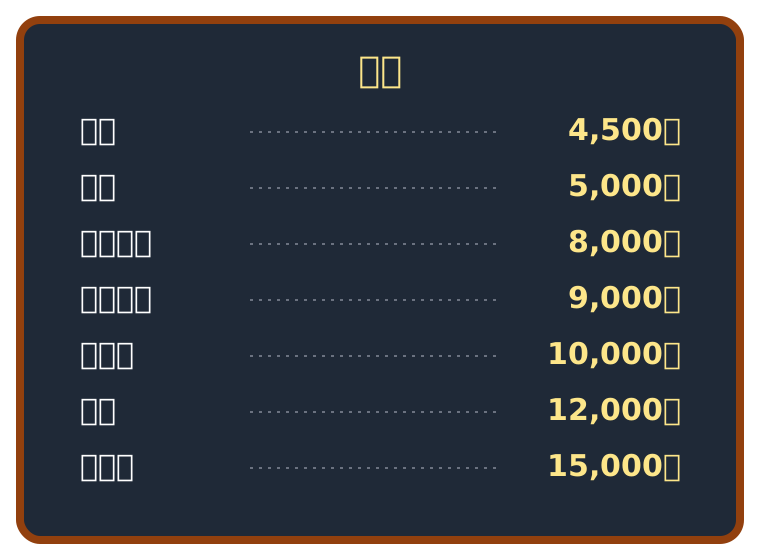
만 이천 원
구천 원
일천 원
만 원
10,000 won is 만 원. Korean never says 일만 원 for 10,000.
How do you read the price of 냉면 on the menu board?
이천 원
만 이천 원
십이천 원
이만 원
12,000 = 만 (10,000) + 이천 (2,000).
What is the price of 김밥 on the menu board?
사십오 원
사천오백 원
오천사백 원
사만오천 원
4,500 = 사천 (4,000) + 오백 (500).
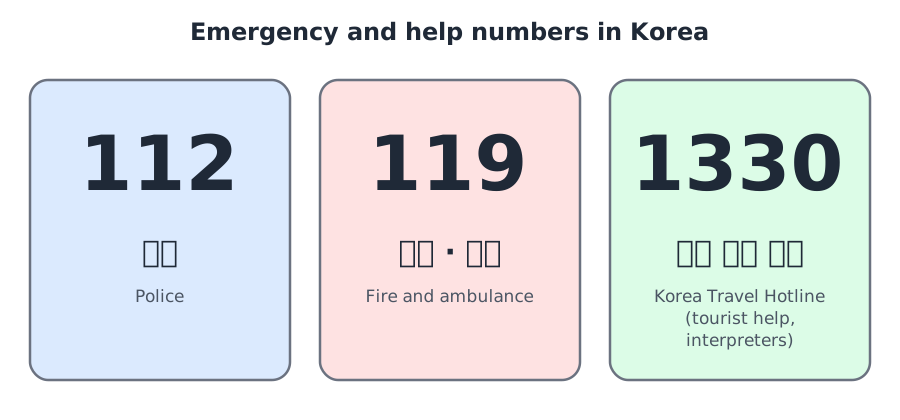
Which number do you call for the police in Korea?
119
911
112
1330
112 is the police. 119 is fire and ambulance.
You need an ambulance in Korea. Which number do you dial?
112
114
1330
119
119 is for fire and ambulance, and 112 is the police. 1330 is the tourist hotline.
In the diagram, which Korean word means "left"?
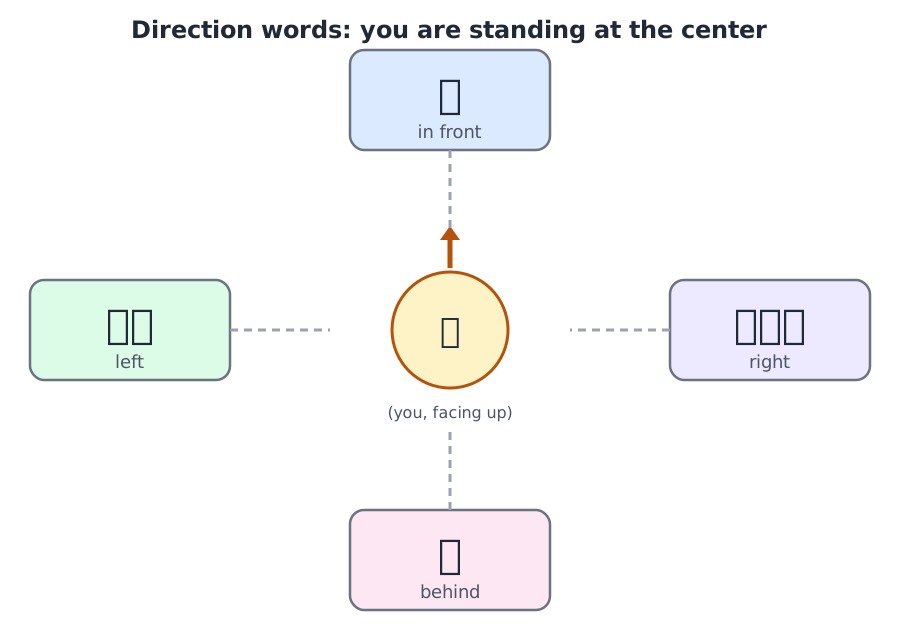
왼쪽
앞
뒤
오른쪽
왼쪽 = left, 오른쪽 = right. 앞 is in front and 뒤 is behind.
A taxi driver asks where to go. You show an address and say:
이 주소가 아니에요
이 주소를 사 주세요
이 주소에서 왔어요
이 주소로 가 주세요
-(으)로 가 주세요 = please take me to. The other options mean buy, not, and came from.
You are lost. What do you say?
길을 가르쳐요
길을 잃어버렸어요
길을 안 좋아해요
길이 맛있어요
잃어버리다 = to lose. 가르치다 means to teach.
Someone compliments your Korean: 한국어 잘하시네요. What is the natural humble reply?
맞아요, 정말요?
네, 저는 잘해요
천만에요, 감사합니다
아니에요, 아직 멀었어요
Korean etiquette is to deflect compliments: "No, I still have a long way to go." Accepting directly can sound boastful.
What does 발이 넓다 mean?
to know many people
to have wide feet
to walk fast
to be very tall
Literally "feet are wide"; the idiom means you have a wide network of connections.
Which idiom describes something very easy?
소귀에 경 읽기
식은 죽 먹기
우물 안 개구리
하늘의 별 따기
식은 죽 먹기 (eating cold porridge) = a piece of cake. 하늘의 별 따기 is the opposite: nearly impossible.
What does 우물 안 개구리 describe?
A lucky person
Someone with a narrow view of the world
A very quiet person
A person who loves swimming
A frog in a well only sees a patch of sky: someone ignorant of the wider world.
A friend says 배가 아파요 when another friend wins the lottery. What does she mean?
She has a stomachache from joy
She is surprised
She is hungry
She is jealous
배가 아프다 is an idiom for jealousy (from the proverb about a cousin buying land).
You say 바가지를 썼어요 after shopping. What happened?
You were overcharged
You got a great deal
You bought a bowl
You got lost
바가지를 쓰다 = to be ripped off. It has nothing to do with buying a bowl.
Which means "Thank you for your hard work"?
처음 뵙겠습니다
수고하셨습니다
다녀오겠습니다
죄송합니다
수고하셨습니다 (or 고생하셨습니다) is said after someone has worked hard.
You leave home in the morning. What do you say to your family?
다녀오겠습니다
잘 먹겠습니다
다녀왔습니다
안녕히 계세요
다녀오겠습니다 = I'll go and come back. 다녀왔습니다 is what you say when you return.
Which sentence asks "How long does it take?"
어디예요?
몇 시예요?
얼마나 걸려요?
얼마예요?
걸리다 = to take (time). 얼마예요 asks about price.
In a cafe the staff asks 드시고 가세요, 가져가세요? What are they asking?
For here or to go?
Hot or iced?
Cash or card?
What size?
드시고 가다 = eat and go (for here), 가져가다 = take along (to go).
What does 괜찮아요 mean when someone offers you more food?
I'm OK, no thanks
It's delicious
I'm sorry
Please give me more
괜찮아요 is "it's fine", which is also the polite way to refuse an offer.
True or false: you use the native numbers (하나, 둘, 셋) to say prices in won.
True
False
False. Prices use Sino-Korean numbers: 삼천 원, 만 원.
Which phrase means "Could you speak slowly, please?"
조용히 하세요
빨리 말씀해 주세요
다시 오세요
천천히 말씀해 주세요
천천히 = slowly, 말씀하다 = honorific "to speak". 빨리 means quickly.
