Quiz · Medium
Twenty sentences to translate into English, testing cases, tenses and word order at beginner level.
What does the warning 'Cave canem' mean?
Beware of the dog.
Take the dog.
The dog is afraid.
Hold the dog.
cave is the imperative of caveo (beware); canem is its accusative object.
Translate: Quid facis?
Who is doing it?
What are you doing?
Why are you doing it?
What did you do?
quid = what? facis = you (singular) do, present tense.
Translate: Puella agricolam amat.
The girl loves the farmer.
The farmer loves the girl.
The girls love the farmer.
The girl loved the farmers.
puella is nominative (subject) and agricolam accusative (object). Reading by word order alone would give the wrong answer.
Translate: Servi dominum timent.
The slave fears the masters.
The slaves fear the master.
The master fears the slaves.
The slaves are afraid of the masters.
servi (nominative plural) is the subject; dominum (accusative singular) is the object; timent is third person plural.
Which is the correct Latin for 'The farmers see the dogs'?
Agricola canem videt.
Agricolam canes vident.
Agricolae canes vident.
Agricolae canis videt.
Plural subject agricolae, plural object canes, plural verb vident. Agricolam would be accusative singular.
Translate: Pueri a magistro laudantur.
The boys praise the teacher.
The teacher is praised by the boys.
The boys were praised by the teachers.
The boys are praised by the teacher.
laudantur is present passive, and the agent is a magistro (a/ab + ablative).
Translate: Milites in urbem veniunt.
The soldiers come into the city.
The soldiers are in the city.
The soldiers leave the city.
The city comes to the soldiers.
in + accusative (urbem) shows motion into; in + ablative (urbe) would mean 'in the city'.
Translate: Milites in urbe manent.
The soldiers march into the city.
The soldiers remain in the city.
The soldiers come out of the city.
The city remains for the soldiers.
urbe is ablative after in = location, no motion. manent = they remain.
Translate: Romulus urbem condidit.
Romulus is founding the city.
Romulus will found the city.
Romulus founded the city.
The city founded Romulus.
condidit is perfect tense (-it ending of the perfect, 3rd conjugation). The accusative urbem is the object.
Translate: Mater filiae donum dat.
The mother gives her daughter's gift.
The daughter gives a gift to the mother.
The mother takes a gift from her daughter.
The mother gives a gift to her daughter.
filiae is dative singular (to the daughter); donum is the accusative object. The genitive 'of the daughter' has the same form, but dat needs an indirect object.
Translate: Canis puellam non mordet.
The girl does not bite the dog.
The dog bites the girl.
The dog does not bite the girl.
The dogs do not bite the girls.
non negates the verb. canis is nominative, puellam accusative.
Translate: Caesar Galliam vicit.
Caesar sees Gaul.
Gaul conquered Caesar.
Caesar is conquering Gaul.
Caesar conquered Gaul.
vicit is the perfect of vinco (conquer). Do not mistake it for the perfect of video (vidit).
Translate: Nauta aquam portabat.
The sailor was carrying water.
The sailor carried the waters.
The sailor will carry water.
The sailors were carrying water.
-bat is the imperfect: ongoing or repeated past action, 'was carrying'.
Translate: Rex magnam urbem aedificat.
The large king builds a city.
The king builds a large city.
The king builds the cities.
The great city builds the king.
magnam agrees with urbem (feminine accusative singular), not with rex.
Translate: Liber Marci est bonus.
The book gives Marcus a good thing.
Marcus is a good book.
Marcus's book is good.
The books of Marcus are good.
Marci is genitive singular (of Marcus). liber is singular, with est.
'Marcum Iulia amat' means 'Marcus loves Julia'.
True
False
Marcum is accusative (object), Iulia nominative (subject): Julia loves Marcus. Ending beats word order.
Translate: Dux militibus signum dedit.
The leader gave the soldiers a signal.
The leader gave the signal to the soldier.
The soldiers gave the leader a signal.
The leader takes the soldiers' signal.
militibus is dative plural (to the soldiers). signum is the object. dedit is the perfect of do.
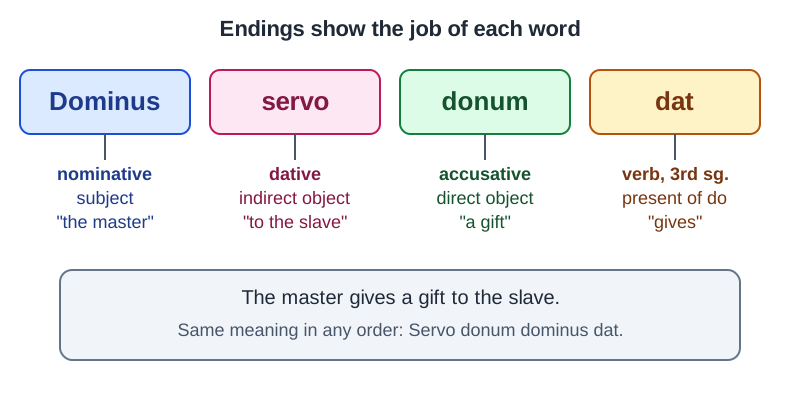
Look at the picture. In 'Dominus servo donum dat', which word is the indirect object?
Dominus
donum
servo
dat
servo is dative (to the slave). Dominus is the nominative subject, donum the accusative direct object, and dat the verb.
Translate: Cur ridetis?
Why is he laughing?
Why are you (plural) laughing?
When will you laugh?
Who is laughing?
cur = why. -tis is the 2nd person plural ending.
Translate: Vir et femina in horto ambulant.
The man and the woman walk into the garden.
The men and the women walk in the garden.
The man and the woman walk in the garden.
The man walks in the woman's garden.
in horto: ablative, location. ambulant is plural because there are two subjects.
Translate: Non est mortale quod opto.
I do not desire the mortals.
It is not what I desire to die.
What I desire is mortal.
What I desire is not mortal.
quod opto is a relative clause (what I desire), subject of est. non negates est. (Ovid, Metamorphoses.)
