Quiz · Medium
Test your pinyin: initials, finals, aspiration, tone marks, spelling rules and the four tones, including image questions on the tone chart.
In this pitch chart, which tone is the purple line that falls from the top to the bottom?
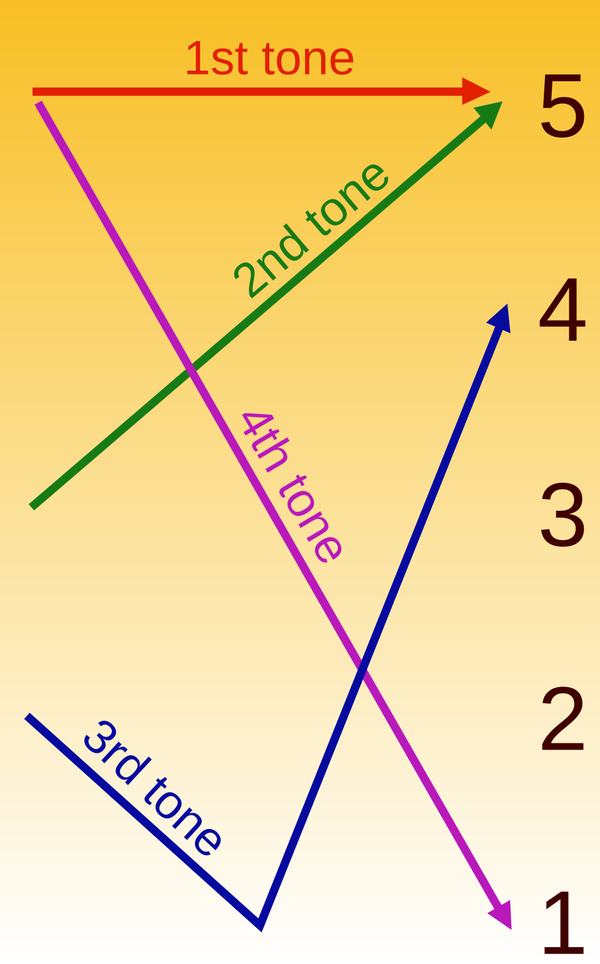
1st tone
2nd tone
4th tone
3rd tone
The 4th tone falls sharply from pitch 5 to 1 (Chao 51). The 1st tone is the flat line at the top; the 2nd rises; the 3rd dips low and then rises. Image: Wereon, CC BY-SA 3.0, via Wikimedia Commons.
Which tone is shown by the blue line that falls to the bottom and then rises?
3rd tone
2nd tone
4th tone
1st tone
The 3rd tone is the dipping tone (Chao 214). The 2nd tone only rises, and it starts higher than where the 3rd tone bottoms out. Image: Wereon, CC BY-SA 3.0, via Wikimedia Commons.
Which initial is pronounced with a strong puff of air (aspirated)?
d, as in 大 dà
g, as in 个 gè
b, as in 爸 bà
t, as in 天 tiān
The aspirated initials are p, t, k, q, ch and c. b, d, g (and j, zh, z) are unaspirated. Hold a tissue in front of your mouth: it moves for tiān but barely for dà.
Which pinyin syllable is 吃 (to eat)?
qī
chī
shī
zī
吃 has the retroflex initial ch and the 'buzzing' final i. qī is 七 (seven), spoken with lips spread and the tongue behind the lower teeth. shī is 诗 (poem), and zī is a different syllable.
How is the final in 天 tiān pronounced?
Like 'tee-ahn', with the a of 'father'
Like 'tyen', with the a sounding like the e in 'bed'
Like English 'teen'
Like English 'tan' with no i sound
In -ian and -üan the a is pronounced like the e in 'bed' because it sits between two high sounds. This is why 天 sounds like 'tyen'.
What is the correct pinyin for 去 (to go)?
qǜ
kù
chù
qù
After j, q, x (and y) the ü is written u without dots, so 去 is qù, although it is pronounced with ü. q cannot be replaced by k or ch without changing the word.
Where does the tone mark go in 'hao3'?
On the a: hǎo
On the o: haǒ
On neither letter; add the mark after the word
On both vowels: hǎǒ
When a syllable has an a, the tone mark goes on it. Priority: a, then o or e, then the last vowel of i/u/ü.
Where does the tone mark go in 'gui4'?
On the u: gùi
On the g: gùi
On the i: guì
There is no mark; the 4th tone is not marked in ui
In the finals iu and ui the mark goes on the second vowel: liú, guì. The same placement applies to all four tones.
How is 你好 pronounced in normal speech?
nǐ hào
nī hǎo
nǐ hǎo with two full dipping tones
ní hǎo
When two 3rd tones are next to each other, the first becomes a 2nd tone (3rd-tone sandhi). The spelling is still nǐ hǎo; only the pronunciation changes.
How is 不是 pronounced?
bù shì
bú shì
bǔ shì
bū shì
不 is bù normally but changes to bú before a 4th tone (是 shì is 4th tone). Compare 不吃 bù chī, 不来 bù lái, 不好 bù hǎo.
How is 不好 pronounced?
bú hǎo
bǔ hǎo
bù hǎo
bū hǎo
不 changes to bú only before a 4th tone. 好 is 3rd tone, so 不 stays bù.
How is 一个 pronounced in normal speech?
yí ge
yī ge
yì ge
yǐ ge
一 becomes yí before a 4th tone (个 gè is 4th tone, usually spoken light). Before 1st, 2nd and 3rd tones it becomes yì: 一天 yì tiān.
How is 一天 (one day) pronounced?
yī tiān
yí tiān
yì tiān
yǐ tiān
一 becomes yì before 1st, 2nd and 3rd tones (一天, 一年, 一起). It becomes yí before a 4th tone.
In 北京 Běijīng, how is 北 pronounced?
As a low half-third tone, without the final rise
With the full dip and rise
As a 2nd tone
As a high level tone
A 3rd tone before 1st, 2nd, 4th or neutral tone is said only as the low part (half-third tone). The full dip-and-rise appears when the syllable stands alone or ends a phrase.
In 我买东西 (I'm shopping), 东西 means 'things' and is pronounced:
dōngxī (1st tone on both)
dóngxi
dǒngxi
dōngxi (neutral second syllable)
The neutral tone changes the meaning: dōngxi = thing(s); dōngxī = east and west.
True or false: Mandarin b, d and g are voiced like English b, d and g.
True
False
False. Mandarin b, d, g are voiceless and unaspirated (like the p, t, k in English 'spin', 'stop', 'sky'). The contrast with p, t, k is aspiration, not voicing.
Which pair differs only in aspiration?
四 sì / 十 shí
爸 bà / 怕 pà
买 mǎi / 卖 mài
新 xīn / 星 xīng
b is unaspirated and p is aspirated. 四/十 differ in the initial (s vs sh), 买/卖 differ in tone and 新/星 differ in the final (in vs ing).
If you say 'wǒ mǎi shuǐguǒ', what are you doing?
Selling fruit
Buying fruit
Eating fruit
Washing fruit
买 mǎi (3rd tone) means buy; 卖 mài (4th tone) means sell. Only the tone distinguishes them.
How is the final iou written after an initial, as in 六 'six'?
iou: lioù
io: lió
yu: lyù
iu: liù
After an initial, iou is shortened to iu, uei to ui and uen to un, but all three sounds are still pronounced. With no initial they are spelled you, wei and wen.
How is the syllable üan spelled with no initial, as in 远 'far'?
yuan
wuan
üan
yüan
With no initial, ü-finals take y- and lose their dots: yu, yue, yuan, yun. The same is true for j, q, x: juan, quan, xuan.
Which spelling correctly shows the city name 西安?
Xiān
Xīān
Xī'ān
Xī An
The apostrophe shows that a new syllable begins at an: Xī + ān. Without it, 'xian' would read as the single syllable xiān (先).
Which initial is retroflex (tongue tip curled back)?
s
x
c
sh
The retroflex initials are zh, ch, sh and r. s, c, z are made with the tongue flat behind the teeth, and j, q, x with the tongue behind the lower teeth.
Which word means 'star'?
新 xīn
星 xīng
心 xīn
行 xíng
星 ends in -ing (tongue back, ng). 新 and 心 end in -in (tongue tip, n). 行 xíng is 2nd tone.
Which of these is NOT a valid pinyin syllable?
qu
qiu
qo
qian
j, q and x never combine with a, o or e on their own, only with finals beginning with i or ü. So 'qo' is impossible, while qu (qü), qiu and qian are all fine.
What are the Chao tone numbers for the 4th tone?
51
55
35
214
55 = 1st (high level), 35 = 2nd (rising), 214 = 3rd (dipping), 51 = 4th (falling from top to bottom).
Which tone mark is shaped like a small v (háček)?
The 2nd tone: á
The 4th tone: à
The 3rd tone: ǎ
The 1st tone: ā
1st = macron (flat line), 2nd = acute (rising), 3rd = caron (v-shaped dip), 4th = grave (falling).
