Quiz · Medium
23 questions with real images: radicals and their meaning, character building, strokes and stroke counts, similar-looking characters, simplified forms and the history of the script.
How many strokes does 好 have?
6
5
7
8
女 has 3 strokes and 子 has 3: 3 + 3 = 6.
How many strokes does 国 have?
6
7
9
8
囗 has 3 strokes and 玉 has 5: 3 + 5 = 8.
Which radical appears in 河, 海 and 湖?
氵 (water)
艹 (grass)
木 (tree)
火 (fire)
All three words relate to water: river, sea, lake. 氵 is the 'three-dot water' radical.
Which radical do 说, 话 and 语 share?
讠 (speech)
口 (mouth)
亻 (person)
辶 (walking)
讠 comes from 言 (speech). 口 is mouth and appears in 吃, 喝.
The radical 饣 appears in which group?
河, 湖, 洗
饭, 饿, 馆
打, 找, 拿
跑, 跳, 路
饣 is the food radical (from 食): meal, hungry, restaurant. 打, 找, 拿 have 扌 (hand); 跑, 跳, 路 have 足 (foot).
In 妈 (mā), what does the 马 part contribute?
The meaning 'horse'
The meaning 'mother'
The sound
Nothing: it is decoration
妈 is a phono-semantic compound: 女 (woman) gives the meaning, 马 mǎ hints at the sound.
Which character means 'sunny'?
情
清
睛
晴
晴 has 日 (sun). 情 is feeling (heart), 清 is clear (water), 睛 is eyeball (eye): all share 青.
Which character means 'to run'?
跑
饱
抱
炮
跑 pǎo has the foot component. 饱 means full, 抱 to hug, 炮 cannon; all share 包.
Which character means 'already'?
己
已
巳
乙
已 yǐ is half-closed. 己 jǐ (self) is open; 巳 sì is closed.
What is the difference between 买 and 卖?
卖 has an extra 十 on top and means 'to sell'
买 means sell and 卖 means buy
They are the same character in two fonts
卖 means 'to shop'
买 mǎi (3rd tone) is to buy. 卖 mài (4th tone) is to sell.
Which character means 'to ask'?
间
闻
问
门
问 has 口 (mouth) inside 门. 间 (between) has 日; 闻 (to hear/smell) has 耳; 门 is door.
What is the correct first stroke of 十?
The vertical stroke 竖
The horizontal stroke 横
The dot 点
Either one
Horizontal first when horizontal and vertical cross.
In 国, when do you write the bottom stroke that closes the box?
Last
First
After the left frame
Never: it is a different character
Close the box last: frame (left and top-right), then the inside, then the bottom.
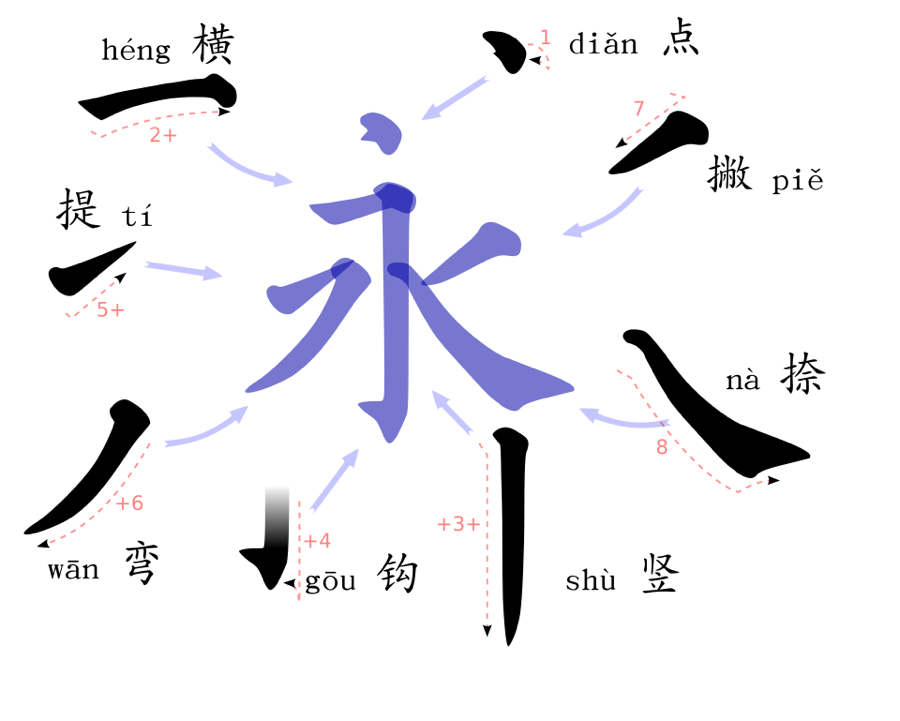
What is shown in this diagram?
The evolution of the character 虎
A map of Chinese dialects
Eight strokes of the character 永 with their names
An oracle bone inscription
This is the traditional diagram of the Eight Principles of Yong. Image: Yug / Rhynyx, CC BY 4.0, via Wikimedia Commons.
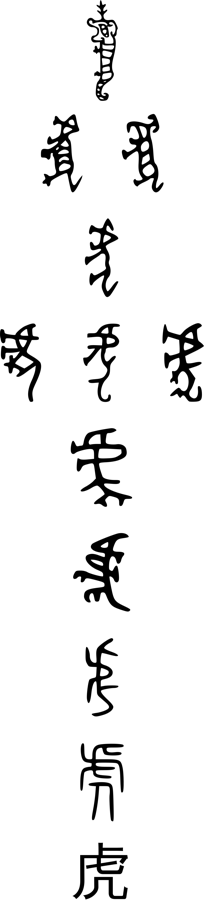
This image shows the character 虎 over time. Which statement is true?
It began as a phonetic character with no picture
It began as a picture of a tiger and became more abstract
It shows how traditional became simplified
It shows how pinyin was created
Pictographic origins are visible in the top forms (oracle bone and bronze). Image: Tomchen1989, public domain, via Wikimedia Commons.
What is this object?
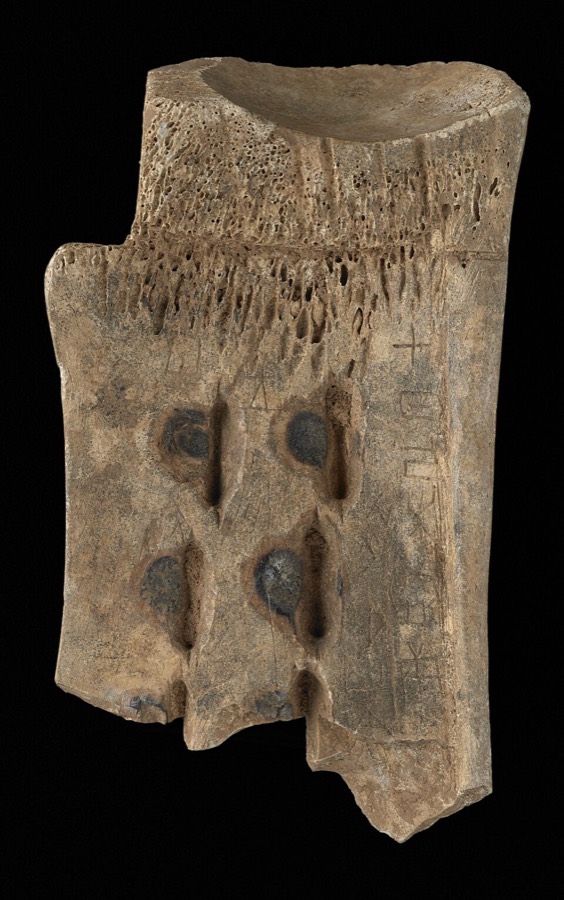
An oracle bone used for divination in the Shang dynasty
A Han dynasty bamboo book
A bronze mirror
A piece of a jade seal
Oracle bones (甲骨) were heated until they cracked; the cracks were interpreted and the divination was recorded in early Chinese writing. Image: anonymous, CC0, via Wikimedia Commons.
What is the simplified form of 愛?
受
爰
爲
爱
The simplified 爱 dropped the 心 (heart) in the middle. 受 means to receive.
Where is traditional Chinese mainly used today?
Taiwan, Hong Kong and Macau
Mainland China only
Singapore only
Nowhere (it is obsolete)
Mainland China, Singapore and Malaysia use simplified characters.
Which radical is simplified from 金 and found in 钱 and 银?
饣
钅
纟
讠
钅 is the metal radical. 饣 is from 食 (food), 纟 from 糸 (silk), 讠 from 言 (speech).
How many radicals does the traditional Kangxi dictionary system use?
108
540
214
1,000
The Kangxi Dictionary (1716) has 214 radicals. 540 radicals were used in the earlier Shuowen Jiezi.
About how many characters does a person need to read a newspaper?
About 3,000 to 4,000
About 500
About 20,000
About 50,000
A learner can read basic texts with around 1,500 to 2,000, but newspaper literacy is usually cited as 3,000 to 4,000.
What is the most common type of character by formation?
Pictograph (象形)
Ideograph (指事)
Compound ideograph (会意)
Phono-semantic compound (形声字)
The vast majority of characters combine a meaning part and a sound part.
True or False: In Chinese characters, the sound component always gives the exact modern pronunciation.
True
False
Pronunciation has changed since characters were formed, so 可 kě in 河 hé only hints at the sound.
