Quiz · Medium
Twenty-two questions on punctuation, parallelism, wordiness, register and email conventions.
Which sentence is punctuated correctly?
The experiment failed, however the team learned a lot.
The experiment failed however, the team learned a lot.
The experiment failed; however, the team learned a lot.
The experiment failed; however the team, learned a lot.
However is a linking adverb, not a conjunction. It needs a semicolon or full stop before it and a comma after it. A comma alone before it creates a comma splice.
Choose the sentence with correct parallel structure.
She enjoys hiking, cycling and swimming.
She enjoys hiking, to cycle and swimming.
She enjoys to hike, cycling and swim.
She enjoys hiking, cycling and to swim.
Items in a list should share the same grammatical form. Here all three are -ing forms. The other options mix -ing forms with infinitives.
Which is the best replacement for the wordy phrase: *Due to the fact that it was raining, the match was postponed*?
Owing to the fact of the rain, the match was postponed.
In view of the fact that it rained, the match was postponed.
As a consequence of the fact it rained, the match was postponed.
Because it was raining, the match was postponed.
Because replaces due to the fact that without changing the meaning. The other options keep or even add wordiness.
Which sentence is a comma splice?
I missed the bus, so I was late for school.
I missed the bus, I was late for school.
I missed the bus; I was late for school.
Because I missed the bus, I was late for school.
Two independent clauses joined by only a comma form a comma splice. Adding the conjunction so, using a semicolon, or making one clause subordinate fixes it.
Which sentence is the most formal?
Can you tell us the date?
We would be grateful if you could confirm the date.
Let us know the date, OK?
We wanna know the date.
Would be grateful if you could is a formal, polite request. The other options are casual or use slang.
Which of these is a redundant phrase?
The final score
The main result
The overall outcome
The end result
A result is already at the end of a process, so end result says the same thing twice. Free gift, future plans and return back are similar.
You are writing an email to a person you do not know by name. Which greeting and sign-off pair is the conventional British formal match?
Dear Sir or Madam, ... Yours faithfully
Dear Sir or Madam, ... Yours sincerely
Dear Ms. Patel, ... Yours faithfully
Hi there, ... Yours truly
Yours faithfully goes with Dear Sir or Madam. Yours sincerely goes with a named recipient. American English usually uses Sincerely or Best regards for both.
Which sentence is a fragment?
The experiment was repeated twice.
Repeat the experiment twice.
Although the experiment was repeated twice.
We repeated the experiment twice because the first result was unusual.
The first option begins with although, so it leaves the reader waiting for the main clause. It cannot stand alone as a sentence.
Which sentence uses the active voice?
The proposal was rejected by the committee.
The proposal has been rejected.
The committee rejected the proposal.
Rejection of the proposal was decided.
In an active sentence the doer (the committee) is the subject. The other options are passive or use a noun form, which is less direct.
Which topic sentence is best for a paragraph about the benefits of cycling to work?
Cycling to work improves both health and finances.
Bicycles were invented in the nineteenth century.
Many people own bikes.
I am going to write about cycling.
A good topic sentence states one controlling idea the rest of the paragraph can support. The others give an unrelated fact, an obvious statement or an announcement.
Which sentence does NOT belong in a paragraph about the benefits of regular exercise?
Exercise lowers the risk of heart disease.
It improves sleep quality.
It can reduce stress.
Chocolate is made from cocoa beans.
The cocoa sentence breaks the unity of the paragraph because it is not about exercise. Every sentence should support the topic sentence.
Which word is correct? *The new rules apply ____ all students.*
at
to
by
with
Apply to means to be relevant for. Check the preposition that goes with the verb: apply to someone, apply for a job.
Which sentence is correct?
Despite of the rain, we enjoyed the trip.
Despite the rain, we enjoyed the trip.
Despite it rained, we enjoyed the trip.
In spite the rain, we enjoyed the trip.
Despite takes no of and is followed by a noun phrase. The full phrase in spite of also needs of. Despite it rained is wrong because despite cannot be followed by a clause.
Which sentence has a clear, arguable thesis?
Plastic bags exist.
This essay is about plastic bags.
Some people use plastic bags and some do not.
Governments should ban single-use plastic bags because they harm marine life.
A thesis takes a position that someone could disagree with, and it gives a reason. The other options are a fact, an announcement and a vague observation.
Which word best completes the sentence? *The film was long; ____, it was never boring.*
nevertheless
therefore
moreover
similarly
Nevertheless shows contrast: long would suggest boring, but it was not. Therefore shows result, moreover adds, and similarly compares.
What is the main problem with this sentence? *Everyone should bring their own lunch, a pencil, and to wear comfortable shoes.*
It is a run-on sentence.
It uses the wrong tense.
The list items are not parallel.
It lacks a subject.
Lunch and pencil are nouns, but to wear comfortable shoes is an infinitive phrase. Fix: bring a lunch, a pencil and comfortable shoes.
Which sentence is written in the most appropriate style for an academic essay?
The results kinda show sleep messes with memory.
Sleep totally ruins your memory, as everyone knows.
The results suggest that sleep affects memory.
I reckon sleep matters for memory, you know?
Academic writing is formal, precise and carefully hedged (suggest). The others use slang, exaggeration or a chatty tone.
Which pair uses *its* and *it's* correctly?
It's clear that the company has lost its way.
Its clear that the company has lost it's way.
It's clear that the company has lost it's way.
Its clear that the company has lost its way.
It's = it is. Its (no apostrophe) is possessive. Here it's clear = it is clear, and its way = the company's way.
The email says: *Please find attached my CV.* What is the purpose of this sentence?
To ask the reader to find a lost document.
To say the writer is leaving.
To begin the formal greeting.
To tell the reader a document is included.
Please find attached is a standard business phrase meaning 'I have attached it to this message'. It is not a request to search for anything.
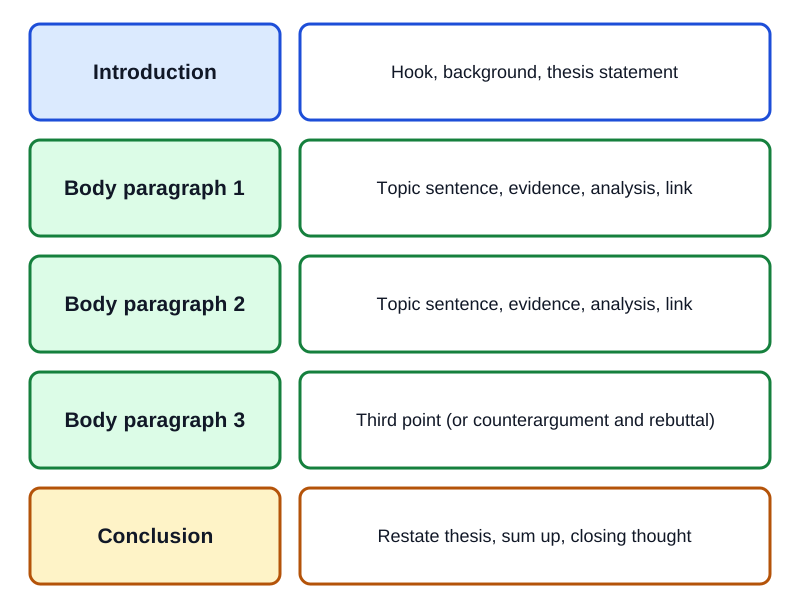
According to the diagram, which element belongs in a body paragraph?
Hook, background, thesis
Topic sentence, evidence, analysis, link
Restate the thesis and give a closing thought
Title page and bibliography
The diagram shows each body paragraph with a topic sentence, evidence, analysis and a link. The hook and thesis belong in the introduction; the restated thesis belongs in the conclusion.
Which is the best subject line for an email asking a teacher about a deadline?
Hi
Question about Friday's essay deadline
Urgent!!! Please read now!!!
Question
A good subject line is short and specific so the reader knows the topic before opening it. One word, a greeting or lots of exclamation marks are all unhelpful.
Which version avoids wordiness?
We should make a decision at this point in time.
We should come to a decision at the present moment in time.
We are in a position where we should decide now.
We should decide now.
Now replaces at this point in time and at the present moment. Cut empty phrases that add words but no meaning.
