Quiz · Medium
Twenty-eight questions on reflection and refraction, lenses, color, the electromagnetic spectrum, wave properties, pitch and loudness, echoes and the Doppler effect.
What is the approximate speed of light in a vacuum?
3.0 × 10⁸ m/s
3.4 × 10² m/s
3.0 × 10⁶ m/s
1.5 × 10⁸ m/s
Light travels at about 300 million m/s in a vacuum. 340 m/s is the speed of sound in air, and 1.5 × 10⁸ m/s is roughly the speed in glass.
A ray of light hits a plane mirror at an angle of incidence of 35° to the normal. What is the angle of reflection?
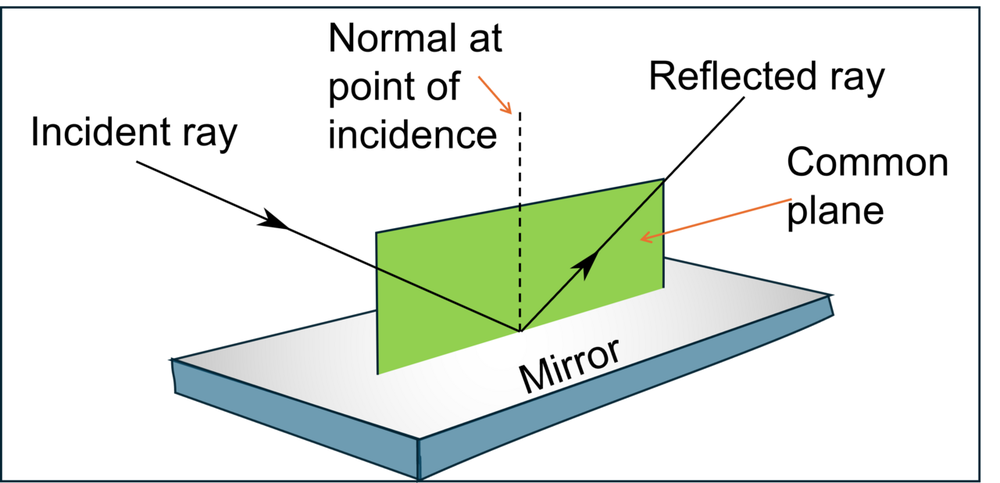
55°
70°
0°
35°
The angle of reflection equals the angle of incidence, both measured from the normal: 35°. 55° is the angle between the ray and the mirror surface, which is not what the law uses.
Which statement about the image in a plane mirror is correct?
It is real, inverted and smaller
It is virtual, upright and the same size as the object
It is virtual, inverted and magnified
It can be projected onto a screen
Plane mirrors make virtual images (the rays only appear to come from behind the mirror), so it cannot be caught on a screen. It is upright, the same size and as far behind the mirror as the object is in front.
Why does the pencil in a glass of water look bent at the surface?

Water softens the pencil
Light is refracted as it passes from water to air
Light is reflected off the glass
Light travels faster in water than in air
Light changes speed and direction at the boundary between water and air, so the submerged part appears displaced. Light travels slower, not faster, in water.
Image: Meganbeckett27, CC BY-SA 3.0, via Wikimedia Commons.
A ray of light passes from air into glass at an angle. How does it bend?
Away from the normal, because it slows down
Toward the normal, because it speeds up
It does not bend
Toward the normal, because it slows down
Light slows down in the denser medium (glass), bending toward the normal. When it leaves the glass it speeds up and bends away from the normal.
What condition is needed for total internal reflection?
Light goes from a denser to a less dense medium at an angle above the critical angle
Light goes from air into glass at a large angle
Light hits a rough surface
Light goes through a lens at its focal point
TIR only occurs when light tries to leave a medium with a higher refractive index and the angle of incidence exceeds the critical angle. It is the principle behind optical fibers.
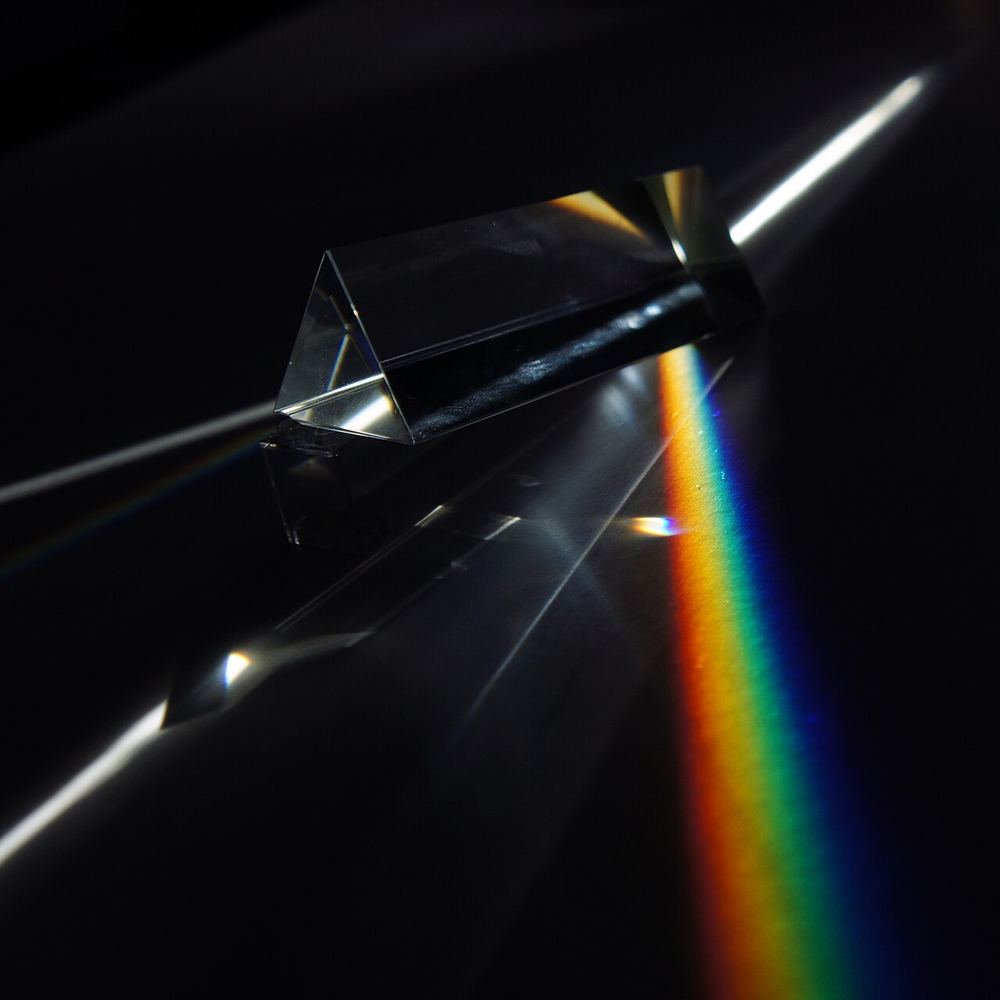
White light passes through a glass prism. Which color is bent the most?
Red
Green
Violet
Yellow
Violet has the shortest visible wavelength and the highest refractive index in glass, so it is refracted most; red is refracted least.
Why does a blue shirt look blue in white light?
It emits blue light
It absorbs blue light and reflects the others
It reflects blue light and absorbs the other colors
It transmits all colors
An object's color is the color it reflects. A blue shirt absorbs most red, green and yellow light.
What color do you see when red light and green light overlap on a white screen?
Yellow
Brown
Blue
White
Additive mixing of red and green light makes yellow. Red, green and blue together make white; brown comes from mixing pigments.
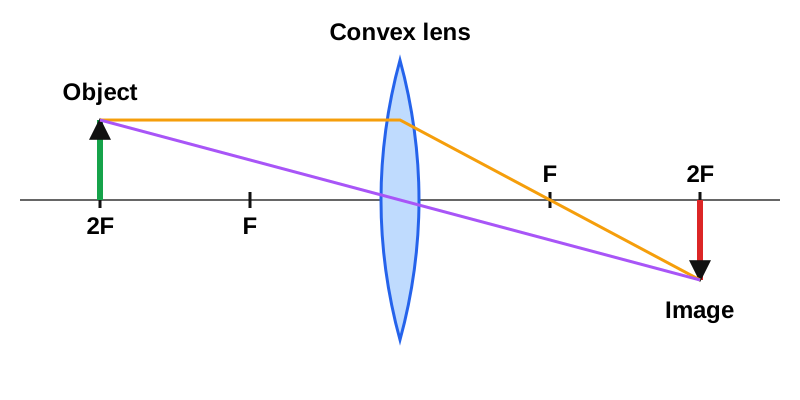
An object stands at 2F in front of a convex lens (see the diagram). What is the image?
Virtual, upright, magnified
Real, upright, smaller
No image forms
Real, inverted, the same size, at 2F on the other side
At 2F the rays from the object tip meet at 2F on the other side, forming a real, inverted image the same size as the object. A virtual upright magnified image needs the object inside F.
An object is placed 15 cm from a convex lens with focal length 10 cm. Where is the image?
6 cm on the same side
30 cm from the lens on the opposite side
25 cm on the opposite side
5 cm on the same side
1/dᵢ = 1/f − 1/dₒ = 1/10 − 1/15 = 1/30, so dᵢ = 30 cm. A positive distance means a real image on the far side, magnified 2× and inverted.
A magnifying glass is a convex lens. Where must the object be placed for it to give an enlarged upright image?
Beyond 2F
Closer to the lens than the focal point
Exactly at 2F
Between F and 2F
Only objects inside the focal length give a virtual, upright, magnified image. At other positions the image is real and inverted.
Which frequency is ultrasound?
15 Hz
300 Hz
30 kHz
3 kHz
Ultrasound is above the human hearing limit of about 20 kHz. 15 Hz is infrasound, and 300 Hz and 3 kHz are audible.
Which type of lens is used to correct short-sightedness (myopia)?
Convex (converging) lens
Plane glass
Cylindrical mirror
Concave (diverging) lens
In short-sightedness the eye focuses distant objects in front of the retina; a concave lens spreads the rays slightly so they focus on the retina. Long-sightedness uses a convex lens.
According to the electromagnetic spectrum chart, which radiation has wavelengths of about 10⁻¹⁰ m, similar to the size of atoms?
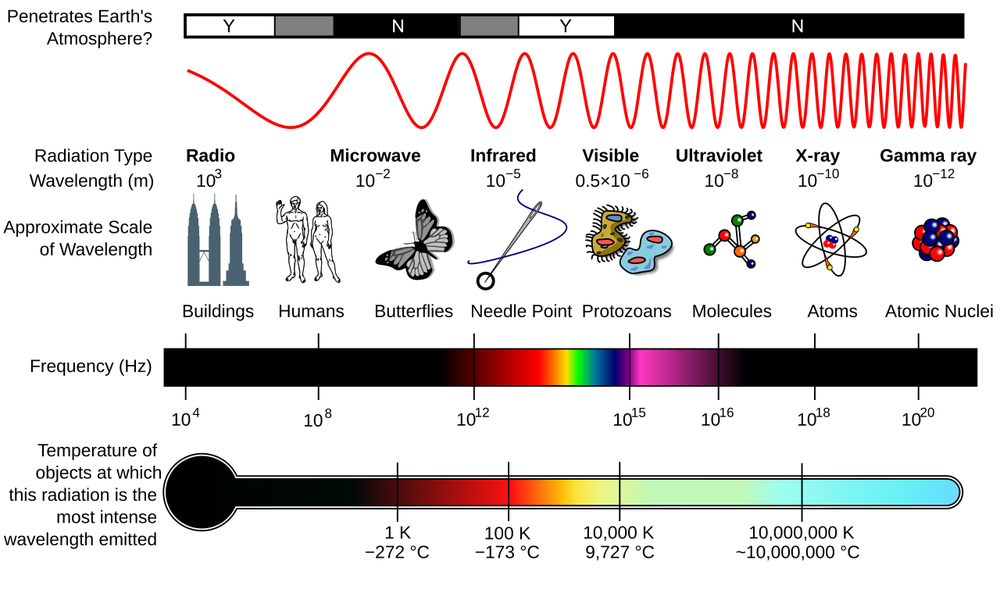
X-rays
Radio waves
Infrared
Ultraviolet
On the chart X-rays are listed at about 10⁻¹⁰ m, matched with atoms. Ultraviolet is about 10⁻⁸ m and infrared 10⁻⁵ m.
Image: Inductiveload; NASA, CC BY-SA 3.0, via Wikimedia Commons.
A radio station broadcasts at 100 MHz (1 × 10⁸ Hz). What is the wavelength of its waves? (c = 3 × 10⁸ m/s)
0.33 m
30 m
3 m
3 × 10¹⁶ m
λ = c/f = 3 × 10⁸ / 1 × 10⁸ = 3 m. Multiplying instead of dividing gives the nonsense 3 × 10¹⁶ m.
Which of these types of radiation is ionizing?
Microwaves
Visible light
X-rays
Infrared
X-rays and gamma rays have enough energy per photon to remove electrons from atoms and damage DNA. Radio, microwave, infrared and visible light are non-ionizing.
Which type of wave is sound in air?
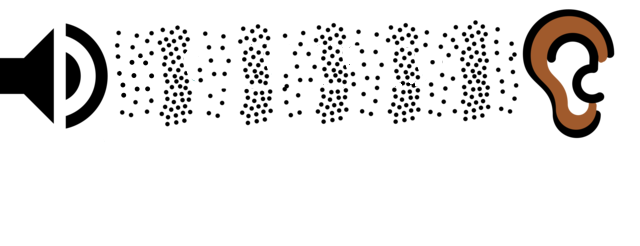
A longitudinal mechanical wave
A transverse electromagnetic wave
A transverse mechanical wave
A longitudinal electromagnetic wave
Sound is a pressure wave: air particles vibrate parallel to the direction of travel. It needs a medium, so it is mechanical.
Image: School Science Shed, CC BY 4.0, via Wikimedia Commons.
What does the labeled vertical arrow on the right-hand side of the wave diagram show?
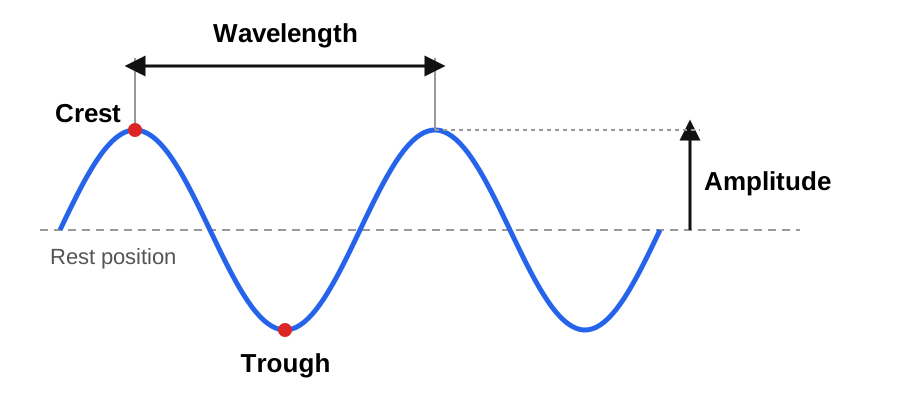
Wavelength
Frequency
Period
Amplitude
Amplitude is the maximum displacement of the wave from its rest position. Wavelength is the horizontal distance between crests.
A note of frequency 686 Hz travels through air at 343 m/s. What is its wavelength?
2 m
0.5 m
2.4 × 10⁵ m
0.2 m
λ = v/f = 343/686 = 0.5 m. Doubling the frequency halves the wavelength.
Which property of a sound wave determines its pitch?
Amplitude
Frequency
Speed
Speed of the wave in air
Higher frequency means higher pitch. Amplitude determines loudness. The speed depends on the medium, not on the pitch.
You see lightning and hear the thunder 6 seconds later. About how far away is the strike?
6 km
200 m
20 km
2 km
Light arrives almost instantly. Sound travels about 343 m/s, so 6 s × 343 ≈ 2060 m ≈ 2 km. A rule of thumb is 3 seconds per kilometer.
A ship's sonar sends a pulse and receives the echo from the seabed 0.4 s later. Sound travels at 1500 m/s in water. What is the depth?
300 m
600 m
150 m
3750 m
The pulse travels down and back, so d = vt/2 = 1500 × 0.4 / 2 = 300 m. 600 m forgets that the 0.4 s covers a round trip.
In the picture of waves from a moving source, what does an observer on the side where the wavefronts are closest together hear?
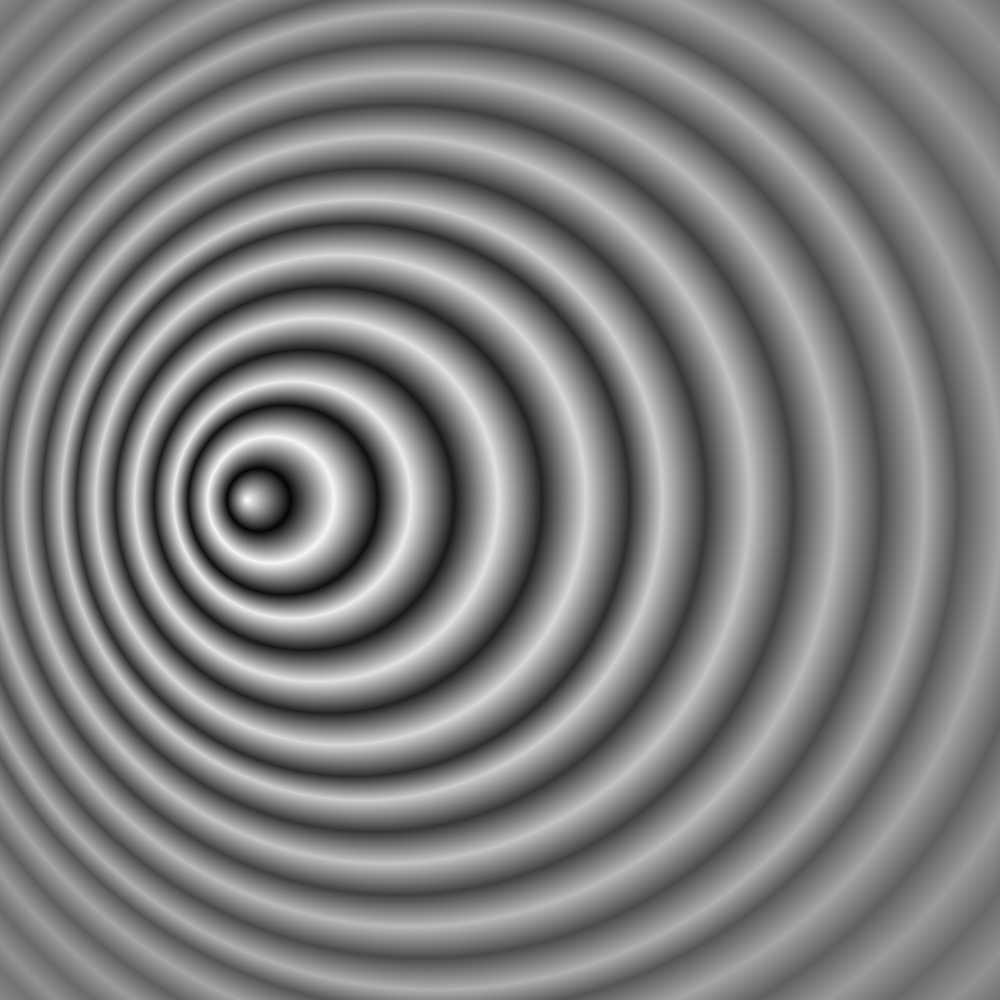
A lower pitch
The same pitch
A higher pitch than the source's true pitch
A quieter sound with the same pitch
The Doppler effect compresses the waves ahead of a moving source, so more wavefronts reach the ear per second: a higher frequency.
Sound can travel through a vacuum if it is loud enough.
True
False
Sound is a mechanical wave and needs particles to vibrate. A vacuum has none, so no sound, however loud the source.
A tuning fork vibrating 440 times each second is struck. What is the frequency and what is the period?
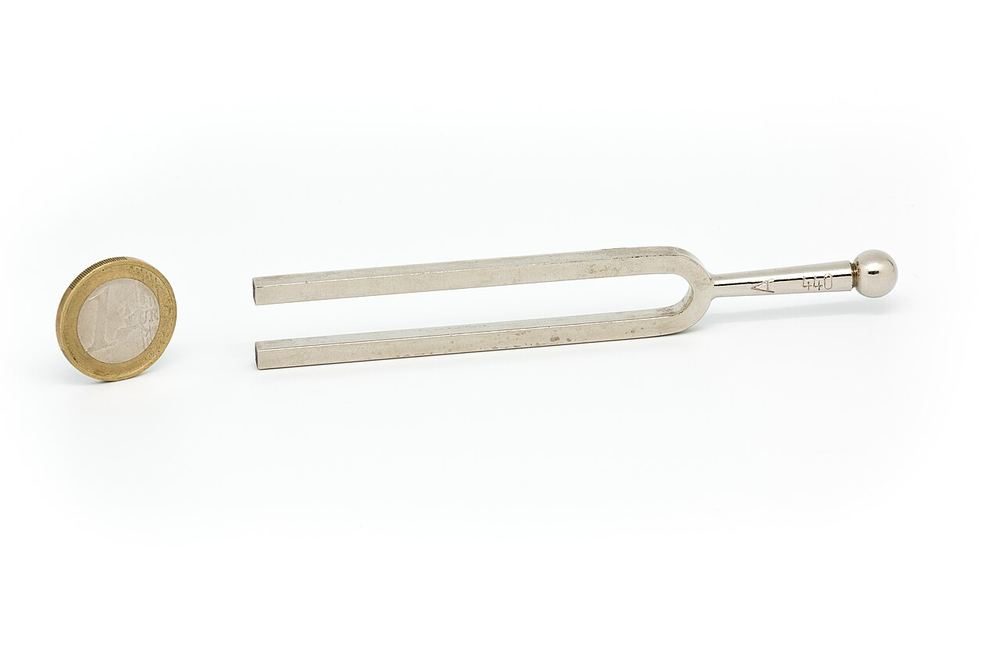
440 Hz and about 0.0023 s
440 s and 0.0023 Hz
220 Hz and 0.0045 s
440 Hz and 440 s
Frequency is 440 per second = 440 Hz. Period = 1/f = 1/440 ≈ 0.0023 s. Frequency and period are reciprocals.
Image: Édouard Hue, CC BY-SA 3.0, via Wikimedia Commons.
Which change makes a sound louder without changing its pitch?
Increasing the frequency
Decreasing the wavelength
Increasing the temperature of the air
Increasing the amplitude
Loudness depends on amplitude (the energy of the wave). Changing the frequency or wavelength alters the pitch.
Two tuning forks of 440 Hz and 446 Hz sound together. How many beats per second are heard?
3
6
886
440
Beat frequency is the difference between the two frequencies: 446 − 440 = 6 beats per second.
