Quiz · Medium
Twenty-eight questions on static electricity, current and voltage, series and parallel circuit calculations, power, magnets, electromagnets, motors and induction.
A balloon rubbed on a student's hair attracts the hair. What has happened?
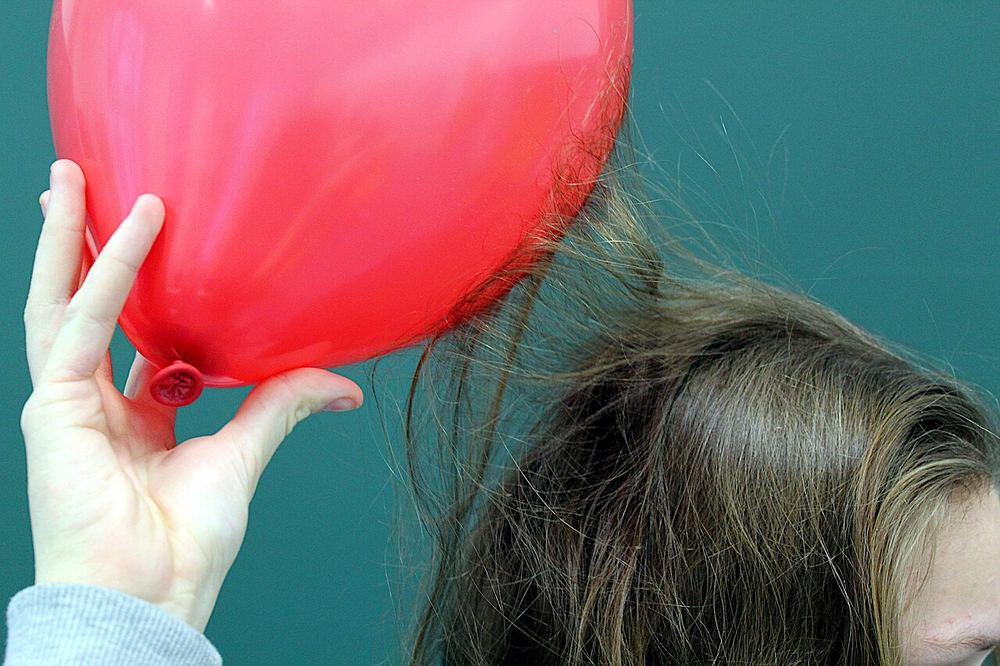
Electrons moved from the hair to the balloon, so they have opposite charges
Protons moved from the hair to the balloon
The balloon and hair both became negative
The balloon became magnetic
Friction transfers electrons: the balloon becomes negative and the hair positive. Opposite charges attract. Protons are fixed in nuclei and do not move, and both being negative would make them repel.
Image: MikeRun, CC BY-SA 4.0, via Wikimedia Commons.
Two small spheres both carry negative charge. What happens when they are brought close?
They attract each other
Nothing happens
They exchange protons
They repel each other
Like charges repel. Only oppositely charged objects, or a charged and a neutral object, attract.
Which of these materials is the best electrical insulator?
Copper
Rubber
Graphite
Salt water
Rubber has no free charge carriers. Copper and graphite have free electrons and salt water has free ions.
A current carries 30 C of charge past a point in 6 s. What is the current?
180 A
5 A
0.2 A
24 A
I = Q/t = 30/6 = 5 A. Multiplying (180) gives the charge unit, not current.
A battery transfers 60 J of energy to 20 C of charge. What is the voltage?
1200 V
0.33 V
80 V
3 V
V = W/Q = 60/20 = 3 V (3 joules per coulomb).
A copper wire's length is doubled with the same thickness. What happens to its resistance?
It doubles
It halves
It quadruples
It stays the same
R = ρL/A: resistance is proportional to length, so doubling L doubles R (the electrons travel through twice as much material).
A 4 Ω resistor is connected across a 12 V battery. What current flows?
48 A
0.33 A
3 A
8 A
I = V/R = 12/4 = 3 A. Multiplying (48) mixes up the formula.
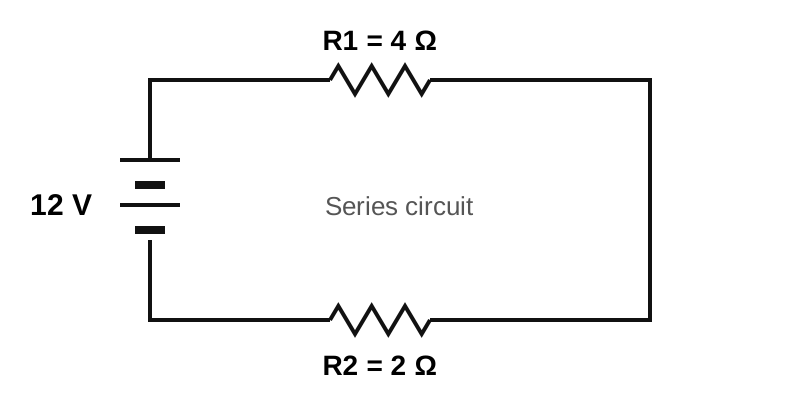
In the series circuit (12 V battery, 4 Ω and 2 Ω resistors), what is the current?
3 A
6 A
2 A
8 A
Total resistance is 4 + 2 = 6 Ω, so I = 12/6 = 2 A. The same 2 A flows through both resistors.
In the same series circuit, what is the voltage across the 2 Ω resistor?
4 V
2 V
6 V
12 V
V = IR = 2 A × 2 Ω = 4 V. The 4 Ω resistor takes 8 V and the two voltages add up to 12 V.
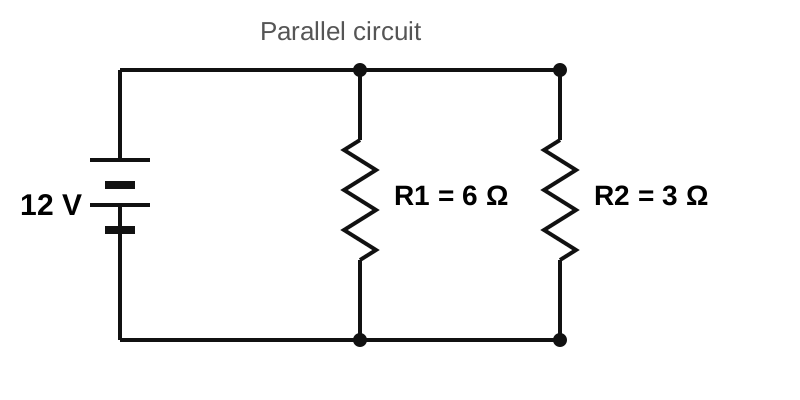
In the parallel circuit (12 V battery, 6 Ω and 3 Ω resistors), what is the total current drawn from the battery?
2 A
4 A
1.3 A
6 A
Branch currents are 12/6 = 2 A and 12/3 = 4 A. In parallel the currents add: 2 + 4 = 6 A.
What is the equivalent resistance of the parallel circuit (6 Ω and 3 Ω)?
9 Ω
2 Ω
4.5 Ω
3 Ω
R = V/I = 12/6 = 2 Ω, or 1/R = 1/6 + 1/3 = 1/2. The parallel total is always lower than the smallest resistor; 9 Ω would be the series value.
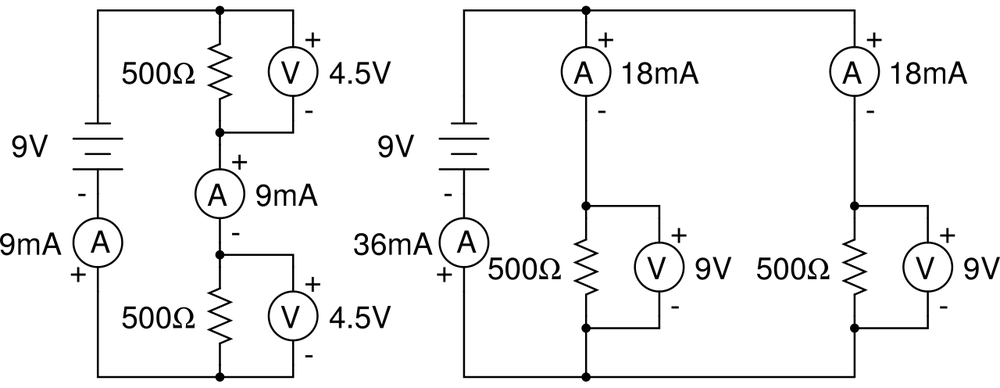
In the pair of circuits, each resistor is 500 Ω and the battery is 9 V. How much current does the battery supply in the parallel circuit?
9 mA
36 mA
18 mA
4.5 mA
Each branch has 9 V across 500 Ω, so 18 mA each; the two branches add up to 36 mA. The series circuit draws only 9 mA.
Image: Xyzzy n (SVG version), CC BY-SA 3.0, via Wikimedia Commons.
Two identical bulbs are connected in series to a battery. One bulb breaks (its filament snaps). What happens to the other?
It gets brighter
It stays the same brightness
It gets dimmer but stays lit
It goes out, because the circuit is broken
In a series circuit there is only one path, so a break stops the current through all components.
Where should an ammeter be connected to measure the current through a lamp?
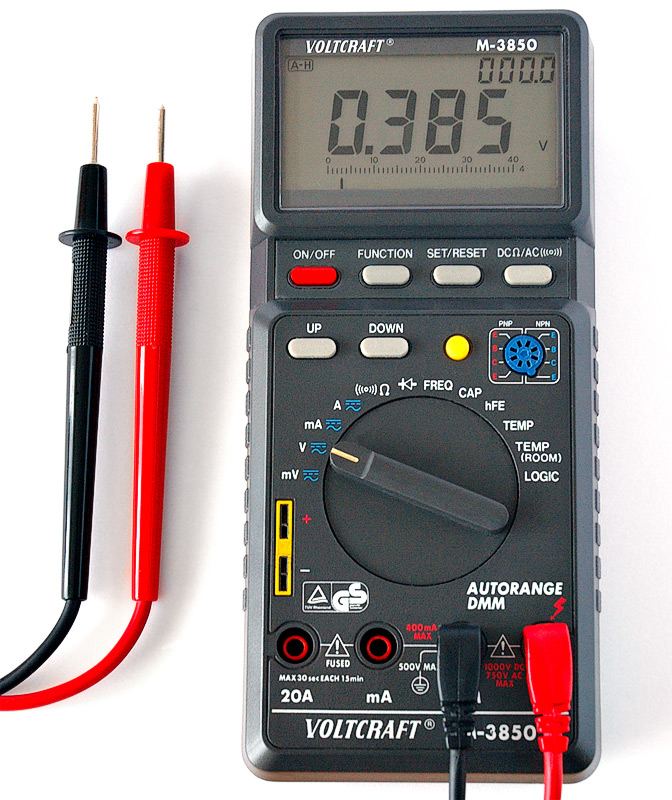
In series with the lamp
In parallel with the lamp
Across the battery only
Anywhere, it does not matter
An ammeter must carry the same current as the component, so it goes in series. A voltmeter goes in parallel.
Image: André Karwath aka Aka, CC BY-SA 2.5, via Wikimedia Commons.
A 12 V car lamp draws 5 A. What is its power?
2.4 W
17 W
60 W
0.42 W
P = IV = 5 × 12 = 60 W.
A 100 W lamp is used for 5 hours. How much energy is this?
500 kWh
20 kWh
0.5 kWh
0.02 kWh
E = Pt = 0.1 kW × 5 h = 0.5 kWh. Mixing W and kW gives the 500 error.
A 10 Ω heating element carries 3 A. What is its power?
90 W
30 W
300 W
13 W
P = I²R = 9 × 10 = 90 W. Using I × R = 30 gives a voltage (30 V), not power.
Why is electricity transmitted over long distances at very high voltage?
High voltage makes the wires cooler by itself
Electrons move faster at high voltage
It is cheaper to make high-voltage cables thinner for safety
A higher voltage means a smaller current for the same power, so less energy is lost as heat in the cables
Power lost in a cable is I²R. For fixed power (P = IV), raising V lowers I, so the loss drops dramatically.
A step-down transformer has 2000 turns on the primary coil and 100 turns on the secondary. If the input is 240 V AC, what is the output?
4800 V
12 V
120 V
2.4 V
Vs/Vp = Ns/Np, so Vs = 240 × 100/2000 = 12 V. A transformer cannot work with steady DC.
What direction do the magnetic field lines point outside a bar magnet?
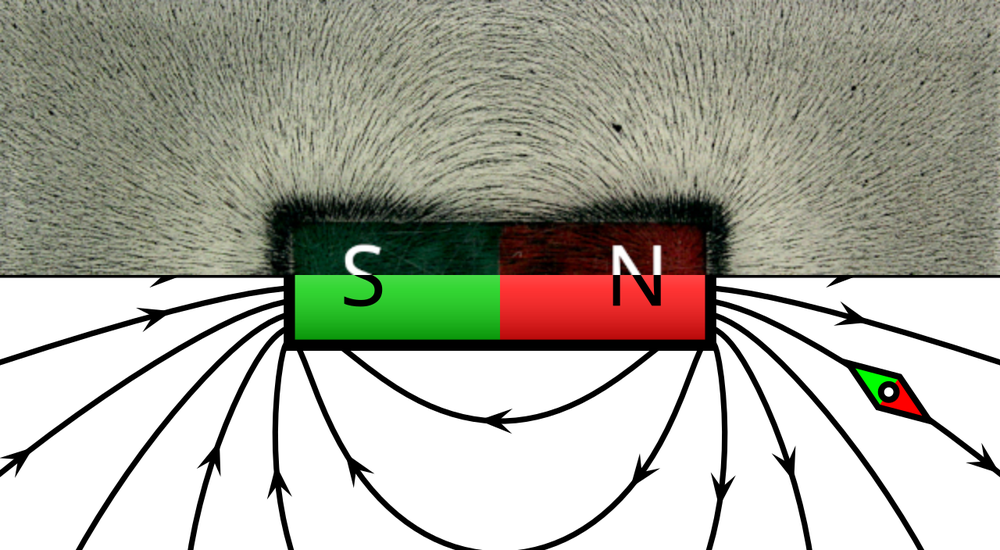
From the south pole to the north pole
From the north pole to the south pole
Around the magnet in circles only
Directly away from both poles
By convention the field lines leave the north pole and enter the south pole outside the magnet. They are closer together where the field is stronger.
Image: Geek3; derivative work by MikeRun, CC BY-SA 3.0, via Wikimedia Commons.
Which change would make the electromagnet (nail wrapped in a coil) stronger?
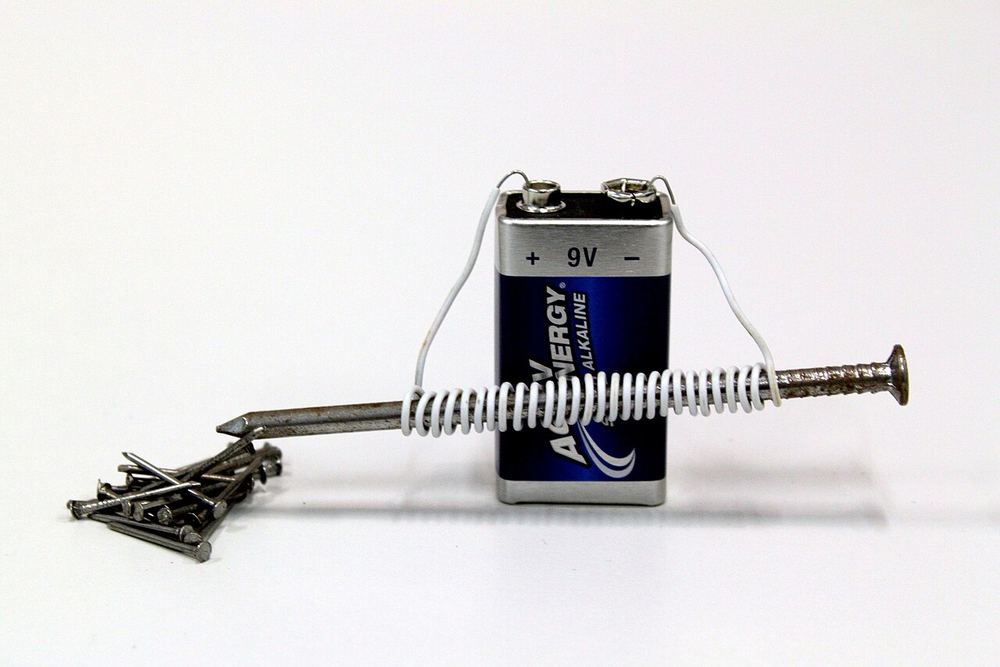
Using a plastic rod instead of an iron nail
Reversing the battery
Removing the coil
Adding more turns of wire and increasing the current
The field strength increases with the number of turns and the current, and an iron core strengthens it. Reversing the battery swaps the poles but does not change strength.
Image: MikeRun, CC BY-SA 4.0, via Wikimedia Commons.
A wire carrying a current is placed in a magnetic field and experiences a force. What is this effect used in?
An electric motor
An electric generator
A transformer
A battery
The motor effect turns electrical energy into motion. A generator uses the opposite effect (induction) to turn motion into electrical energy.
Which of these will induce a current in a coil of wire?
Holding a magnet still inside the coil
Placing the coil near a battery
Pushing a bar magnet into the coil
Heating the coil
A current is induced only when the magnetic flux through the coil changes, for example by moving the magnet. A stationary magnet gives no emf.
A resistor has bands blue, grey, red and gold. What are its resistance and tolerance?
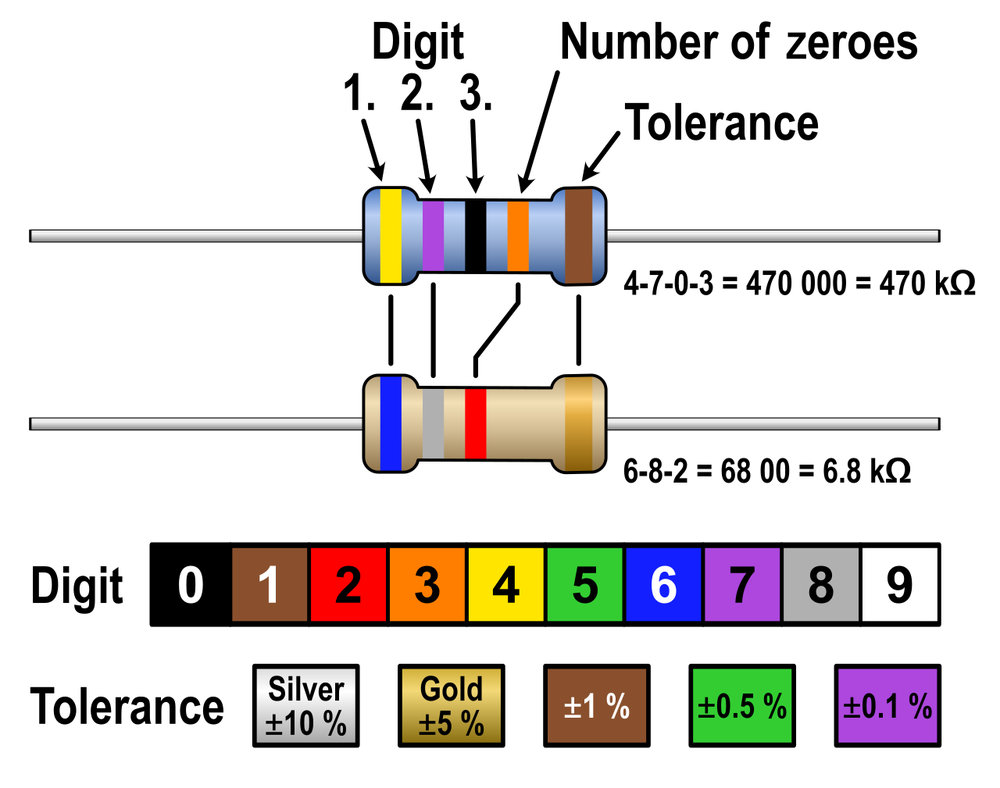
68 Ω, ±5%
682 Ω, ±10%
6.8 kΩ, ±5%
8.6 kΩ, ±5%
Blue = 6, grey = 8, red = ×10² so 6800 Ω = 6.8 kΩ; gold means ±5%.
Outside the battery, electrons flow from the negative terminal to the positive terminal, opposite to the direction of conventional current.
True
False
Conventional current is drawn from positive to negative, but the charge carriers in a metal wire are electrons, which move the other way.
Adding a second identical resistor in parallel increases the total resistance of a circuit.
True
False
Adding a parallel path gives the current an extra route, so the total resistance decreases. In series it would increase.
The photograph shows lightning. What is lightning?
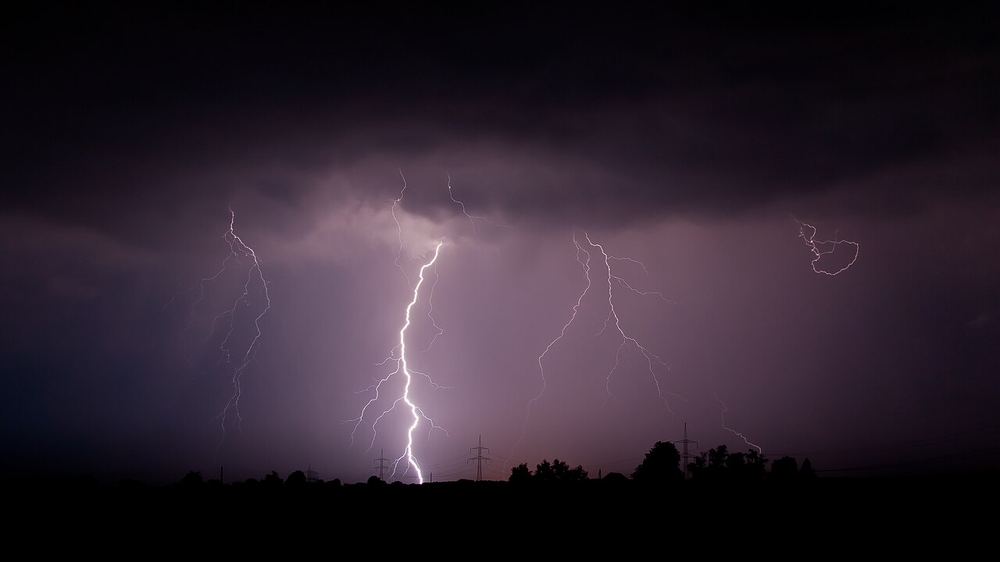
A large electrostatic discharge between a charged cloud and the ground or another cloud
A burst of magnetic energy
The reflection of sunlight off clouds
A current flowing in a closed loop through the cloud
Charge separation in a storm cloud builds up an enormous voltage until the air breaks down and charge surges through it as a spark.
Image: Mathias Krumbholz, CC BY-SA 3.0, via Wikimedia Commons.
The person in the photo has hair that stands on end while touching a Van de Graaff generator. Why?
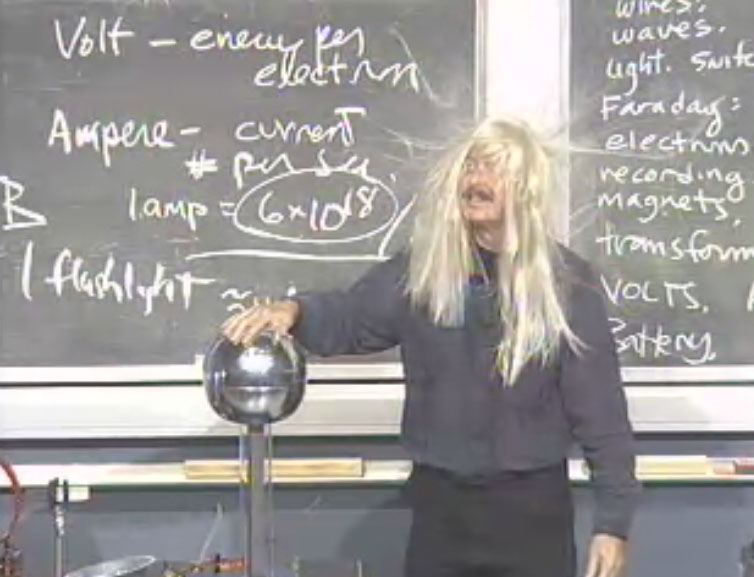
The generator makes the hair magnetic
Opposite charges on the hairs attract
The hair is lighter than air
Each hair has the same charge and the like charges repel
The generator charges the person and every hair equally. Like charges repel, so the hairs spread out as far apart as they can.
