Quiz · Medium
Foundational questions on STRs, PCR, body fluid tests, blood groups and hair.
What are STRs?
Long segments of mitochondrial DNA
Short sequences repeated head to tail, with the repeat number varying between people
Variants of single nucleotides
Proteins in the blood plasma
STRs are short tandem repeats. Single nucleotide variants are SNPs, and mtDNA is a separate genome.
What is the role of Taq polymerase in PCR?
It builds copies of DNA and survives the high temperature of denaturation
It separates fragments by size
It cuts DNA at specific sites
It dyes the DNA fragments
Taq is heat stable. Restriction enzymes cut DNA; dyes label primers; electrophoresis separates.
In capillary electrophoresis, which STR fragments reach the detector first?
The largest fragments
The ones with the most repeats
Those labeled with blue dye
The smallest fragments
Small fragments migrate through the polymer faster. More repeats means a longer, slower fragment.
A locus shows one peak. What is the most likely genotype?
Stutter
Homozygous
A mixture of exactly two people
Heterozygous
A single allele peak usually means two copies of the same allele. Drop-out in a low-level sample can look the same, so peak height matters.
Which of these is the best description of stutter?
A contaminating allele from another person
Signal from the wrong dye channel
The DNA ladder
A small peak one repeat smaller than an allele peak, caused by polymerase slippage
Stutter is a PCR artifact. Drop-in is contamination and pull-up is dye cross-talk.
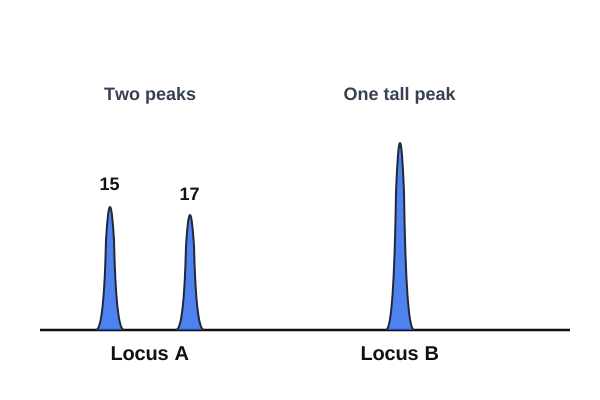
The STR image shows Locus A with 15 and 17 and Locus B with one tall peak. Which statement fits?
A mixture of three people
Heterozygous at A and homozygous at B
Heterozygous at both
Homozygous at A and heterozygous at B
Two peaks mean two different alleles. One tall peak means two copies of the same allele.
Which sample type is best for mitochondrial DNA analysis?
A shed hair shaft without a root
Fresh liquid blood
A large semen stain
A buccal swab from a suspect only
Hair shafts have almost no nuclear DNA, but mtDNA is abundant. Fresh blood and semen give plenty of nuclear DNA.
Why is Y-STR typing useful in a sexual assault case with little sperm and lots of victim DNA?
It identifies the victim
It detects only male DNA in the mixture
It works only on female DNA
It is more discriminating than autosomal STRs
Y-STRs are on the Y chromosome, so female DNA does not interfere. But they are shared by paternal relatives and so are less discriminating.
A pink color is obtained with phenolphthalin and peroxide. What can be concluded?
Blood may be present, but the test is presumptive
The stain is not blood
The stain is human blood
The blood is from a male
The Kastle-Meyer test is presumptive and also reacts to plant peroxidases. Confirmatory tests are needed to show it is blood and human.
Why is luminol not used as proof of blood?
It destroys DNA completely
Bleach and some metals also make it glow
It only works on fresh blood
It never reacts with blood
Oxidants like bleach and copper compounds also catalyze luminol. Luminol finds, it does not confirm.
Which test is confirmatory for semen?
Ultraviolet fluorescence
Acid phosphatase
Finding sperm cells or PSA
Kastle-Meyer
Acid phosphatase and fluorescence are presumptive. Sperm cells or PSA (p30) are specific.
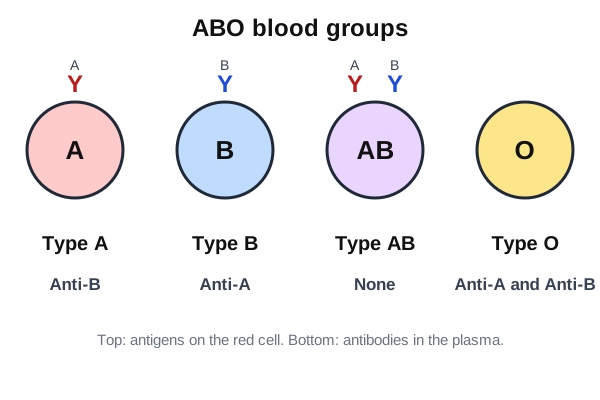
A person whose red cells carry both A and B antigens (the AB cell in the picture) has which plasma antibodies?
None
Anti-A only
Anti-A and anti-B
Anti-B only
A person does not make antibodies against antigens they have, so type AB has neither anti-A nor anti-B.
Which statement about ABO blood type is correct?
Type O red cells carry neither A nor B antigen
Type B has A antigens
Type A has anti-A antibodies
Type AB has both anti-A and anti-B antibodies
Antibodies are made against antigens the person lacks. AB has none, A has anti-B, B has anti-A.
What is a secretor?
A person who has no blood group
A person with two Y chromosomes
A person with Rh-negative blood
A person who secretes ABO antigens into body fluids
About 80 percent of people are secretors and their saliva or semen can be ABO typed.
Which tube is used for blood collected for DNA?
Gray-top (sodium fluoride)
Red-top with no additive only
Green-top with lithium heparin only
Lavender-top (EDTA)
EDTA prevents clotting and preserves DNA. Gray-top tubes are standard for alcohol.
Which layer of a hair is the outermost?
Medulla
Root
Cuticle
Cortex
Cuticle (scales), then cortex, then the medulla in the center.
Which phase of the hair cycle yields a root with tissue useful for nuclear DNA?
Telogen
None
Catagen only
Anagen
Anagen (growing) hairs pulled out often keep follicular tissue. Telogen roots are club-shaped and have little.
What does the 2015 FBI hair review reveal about microscopic hair comparison testimony?
Many statements overstated the weight of a match
It showed mtDNA never matches
It proved microscopic comparison is unique
Hair comparison has no error
Examiners had said hairs could be matched with high certainty. Microscopy can only show they are consistent.
A DNA profile has a genotype frequency of 0.02 at each of 4 independent loci. What is the product-rule frequency?
2e-4
8e-2
0.08
1.6e-7
, roughly 1 in 6 million. Multiplying frequencies across independent loci is the product rule.
Which fly group usually reaches a body first?
Mites
Blow flies
House flies only after weeks
Beetles
Blow flies (Calliphoridae) can find a body within minutes to hours. Beetles arrive later.
True or false: A match between a hair found at the scene and a suspect under the microscope proves the hair came from the suspect.
False
True
Microscopic comparison shows only consistency. Individualization needs nuclear DNA from a root.
What does a reagent blank control show?
The size of the fragments
Whether the DNA is degraded
The sex of the donor
Whether the reagents are free of contaminating DNA
A reagent blank contains no sample. Peaks in it signal contamination.
Which is a possible reason for a profile showing a 'ski slope' with the right-hand peaks lower?
Excess template DNA
DNA degradation
Sex chromosome abnormality
A tri-allelic pattern
Long fragments break more often than short ones, so large loci fail first in degraded DNA. Excess DNA gives off-scale peaks and pull-up.
