Quiz · Medium
Foundational ballistics: cartridge parts, rifling, class and individual characteristics, GSR and wounds.
In the cartridge diagram, what is the red component at the base?
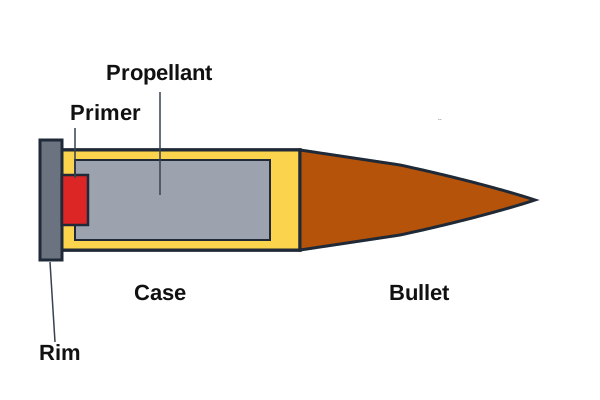
Bullet
Propellant
Primer
Rim
The primer is ignited when struck by the firing pin and ignites the powder.
Which of these is a class characteristic of a firearm?
Wear on the breech face
A scratch left in the barrel by a tool
Number of lands and grooves
A random nick on the firing pin
Class characteristics are shared by a model design. Random marks are individual.
In the image of a barrel cross-section, which part is the raised portion between the grooves?
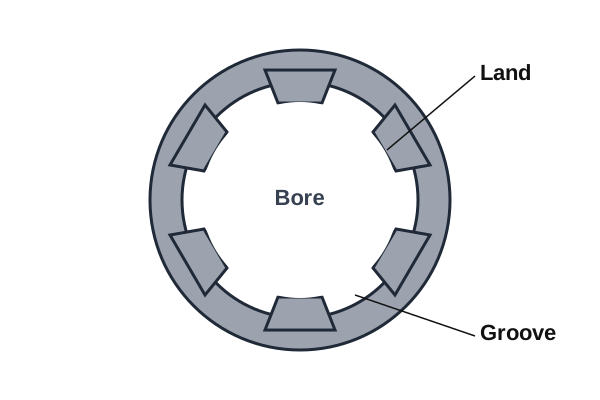
Land
Chamber
Groove
Bore
The land is the raised part. The groove is the cut channel.
What is the purpose of rifling?
To reduce recoil only
To spin the bullet and stabilize it
To slow the bullet
To make the barrel stronger
The spin gives gyroscopic stability so the bullet flies point first and accurately.
Six fired cartridge cases are found on the floor of a room, with no gun present. Which weapon type is more likely?
A semi-automatic pistol
A single-shot muzzleloader
A bolt-action shotgun
A revolver
Semi-automatics eject cases. Revolvers keep them in the cylinder until reloaded, but a shooter can empty a cylinder.
What instrument allows two bullets to be viewed side by side?
Comparison microscope
Spectrophotometer
Scanning electron microscope
Polarizing microscope
The comparison microscope shows two objects in one split field.
What does NIBIN do?
Correlates images of cartridge cases to link crimes
Matches DNA
Traces gun sales
Identifies fingerprints
NIBIN gives leads that examiners must confirm.
Which agency runs NIBIN?
NIST
DEA
ATF
FBI Laboratory only
The Bureau of Alcohol, Tobacco, Firearms and Explosives.
Which particle composition is characteristic of primer residue?
Lead, barium and antimony
Iron, zinc and copper
Gold, silver and tin
Carbon, sulfur and nitrogen
Pb-Ba-Sb together in one particle are highly characteristic of GSR.
Which instrument is standard for analyzing GSR particles?
Polarizing light microscope only
SEM/EDS
GC-FID
UV spectrophotometer only
SEM/EDS provides particle morphology and elemental composition.
The center panel shows dots of powder tattooing around the hole but no soot. What range of fire is this?
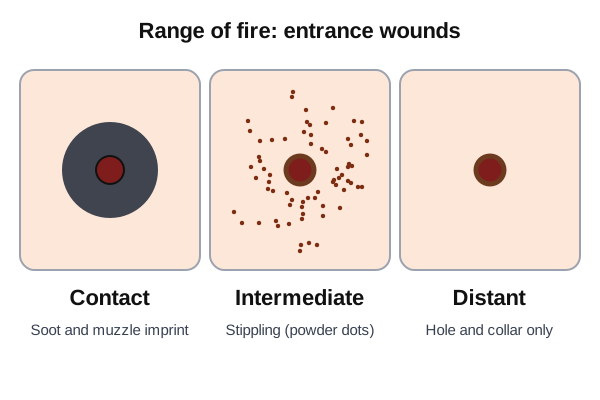
Contact
Distant
Intermediate
A ricochet
Stippling without soot means unburned powder reached the skin but the muzzle was not touching it.
An entrance wound has soot in the wound track and a muzzle imprint. What range is this?
Indeterminate
Contact
Distant
Intermediate
Soot in the track and muzzle imprint indicate the gun was pressed to the skin.
Stippling (tattooing) around an entrance wound indicates:
A ricochet
Contact range
Intermediate range
Distant range
Powder grains reach the skin at a few feet but not at long distance.
How do you tell a skull entrance from an exit?
Both have the same beveling
Exit has an abrasion collar
The bone is beveled inward at the exit
The bone is beveled outward at the exit
The crater widens in the direction the bullet traveled, so the exit side is larger.
In the 3R rule for glass, the radial fractures have Right angles on the:
Concentric ring
Reverse side from the force
Same side as the force
Edge only
The 3R rule: Radial cracks, Right angle edges, Reverse side.
Which statement about GSR is true?
Its absence does not prove that a person did not fire a gun
Its presence proves the person fired a gun
It cannot be transferred
It lasts for weeks on hands
GSR can be lost by washing or activity and can be transferred by contact.
Which of these is the unit of the shotgun bore 'gauge'?
The number of lead balls of bore size that weigh one pound
The number of pellets in the shell
The barrel length in inches
The bore diameter in mm
A 12-gauge has bore size so that 12 balls make a pound.
What is the correct kinetic energy of a 10 g bullet at 300 m/s?
450 J
45 J
900 J
1,500 J
J.
A fired bullet is recovered. It has 6 land impressions with a right twist. This tells the examiner:
Class characteristics that narrow the possible makes of guns
The firing distance
The shooter
The exact gun
Number of lands and twist direction are class characteristics. Identification needs the individual striations.
Why is the water tank used to test-fire a suspect gun?
It increases the bullet's velocity
It stops the bullet with little damage so the marks can be compared
It preserves GSR
It cleans the gun
The water decelerates the bullet gently, preserving the striations.
True or false: A firearm examiner can identify the person who fired a gun from the bullet marks.
False
True
Ballistic examination links bullets and cases to a gun, not to a person.
