Quiz · Medium
Recognize galaxy types from photos, understand spiral and elliptical differences, the Local Group, active nuclei, and evidence for dark matter.
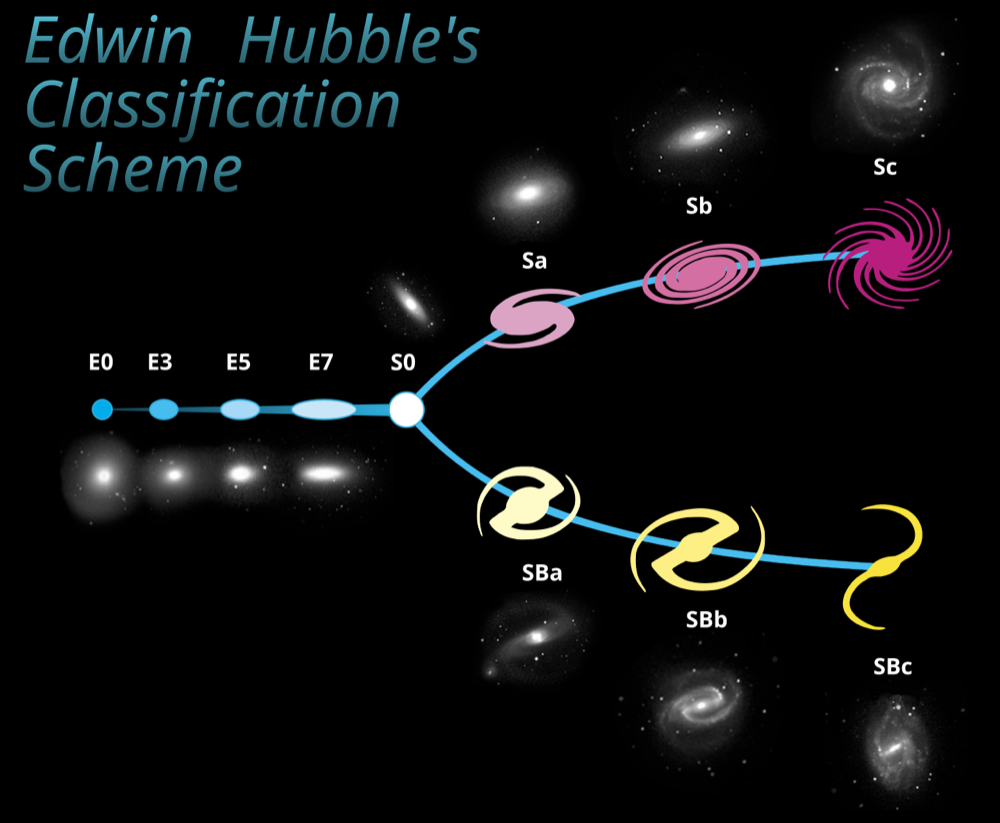
In Hubble's tuning-fork diagram, which galaxy type has a flattened disk with a bulge but no spiral arms?
SBb
E7
S0 (lenticular)
Sc
S0 galaxies are the transition between ellipticals and spirals. E7 is the flattest elliptical but has no disk.
Which feature best distinguishes Sa spirals from Sc spirals?
Sc has a bar and Sa does not
Sa has a larger bulge and tightly wound arms
Sa has no gas
Sa is much older than Sc
Along the sequence Sa to Sc, the bulge shrinks and arms open up. Bars are a separate dimension (SB vs S) and both types contain gas.
The galaxy in this image, with chaotic tails and many bright pink and blue knots, is best explained as
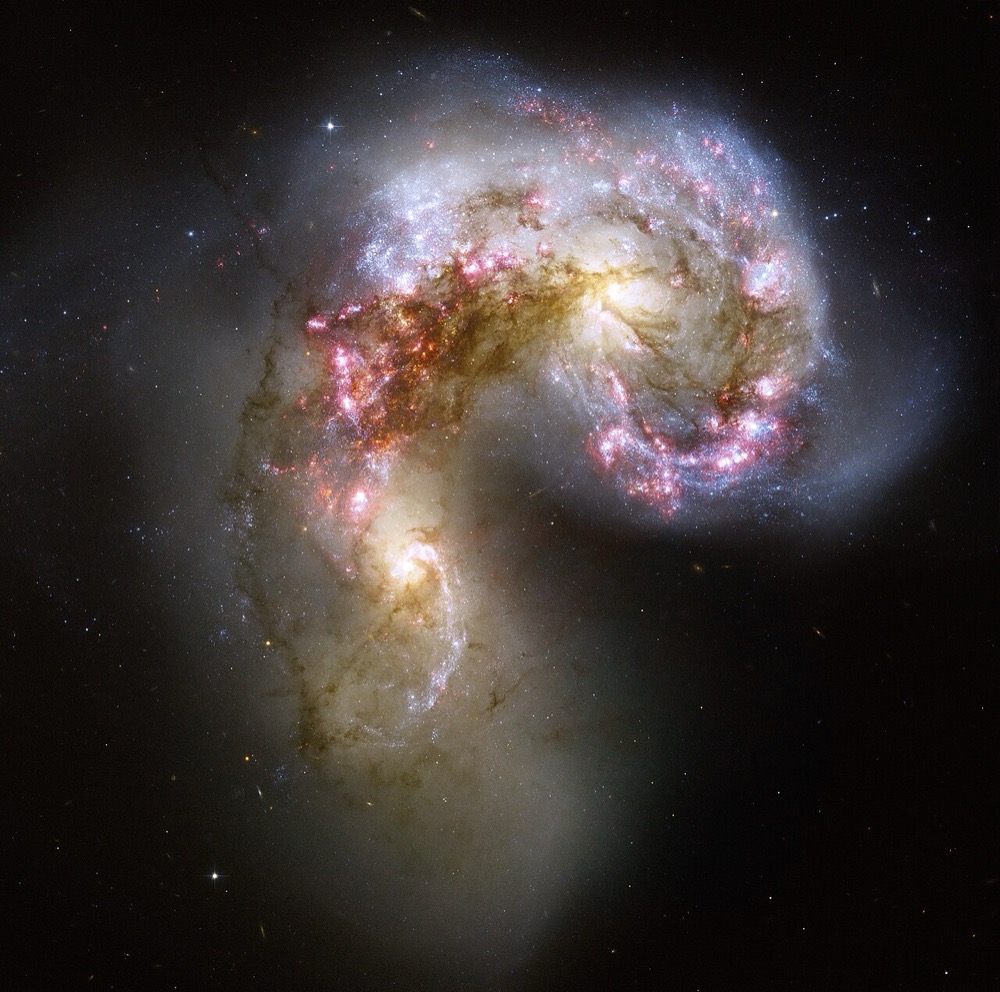
a pair of colliding galaxies with a burst of star formation
a supernova remnant
an isolated spiral galaxy seen edge-on
a young elliptical galaxy forming stars normally
The Antennae are NGC 4038 and NGC 4039. The collision compresses gas, creating many young star clusters.
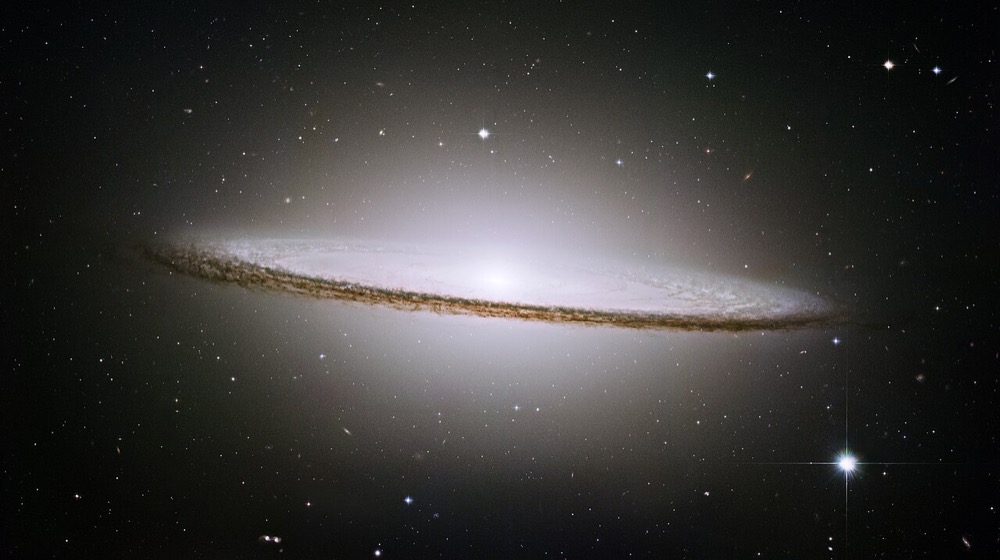
This galaxy, with a bright bulge and a dark lane, is seen edge-on. What is it?
The Andromeda Galaxy
The Whirlpool Galaxy
The Large Magellanic Cloud
The Sombrero Galaxy (M104)
The dark dust lane against the bright bulge gives the Sombrero its hat-brim look. The Whirlpool is seen face-on.
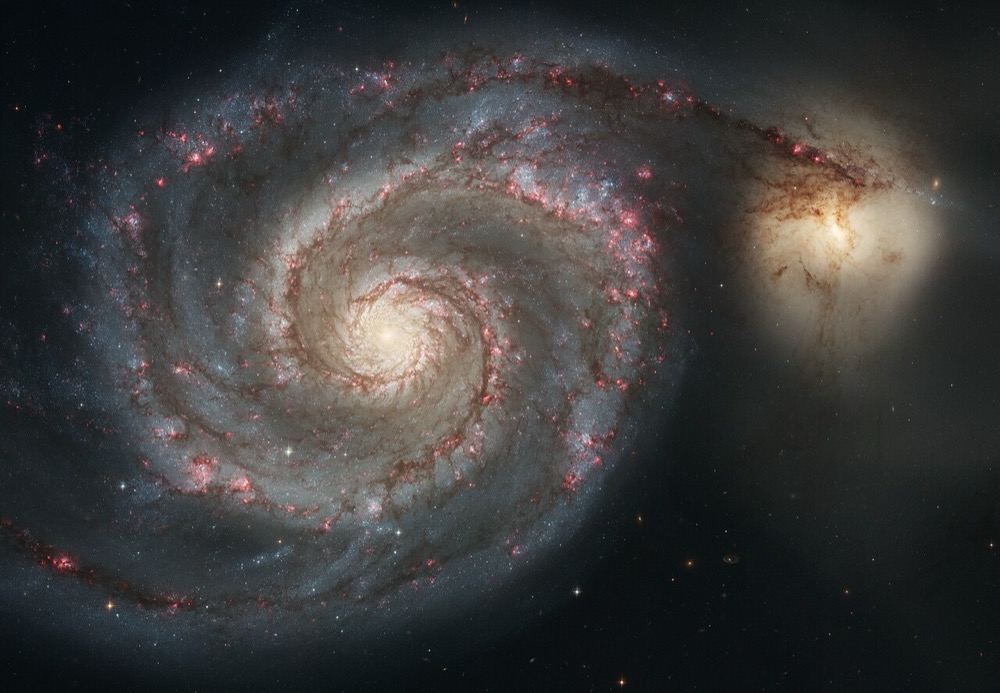
What is the interacting companion of the Whirlpool Galaxy (M51)?
The Triangulum Galaxy
Andromeda
M104
NGC 5195
The small galaxy at the end of one spiral arm is NGC 5195; their encounter helps trigger star formation.
About how far is the Andromeda Galaxy?
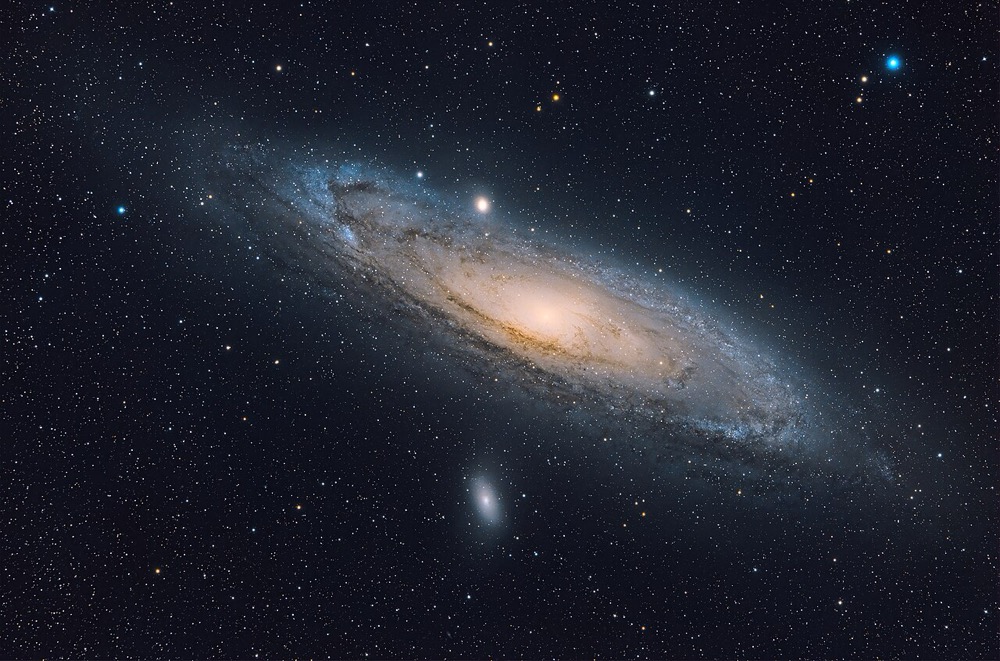
2.5 million light-years
250,000 light-years
25 million light-years
250 million light-years
Andromeda is about 2.5 Mly, the nearest large galaxy. 250,000 would put it inside our own halo region (like the Magellanic Clouds).
Image: Lviatour, CC BY-SA 2.5, via Wikimedia Commons.
Observations of flat galaxy rotation curves imply that
spiral galaxies contain far more mass than the visible matter
stars at the edges are more massive
gravity is weaker at large distances
galaxies contain no dark matter
Without extra unseen mass, speeds should fall with distance. A dark halo explains why they stay constant.
What does the Hubble Ultra Deep Field image demonstrate?

Even a tiny patch of sky holds thousands of galaxies
The universe is 13.8 billion years old
Stars in the Milky Way are all older than the Sun
Our galaxy has thousands of dwarf companions
The image covers a tiny area, yet shows about 10,000 galaxies, implying hundreds of billions in the whole sky.
What does the central bright ring in this image represent?
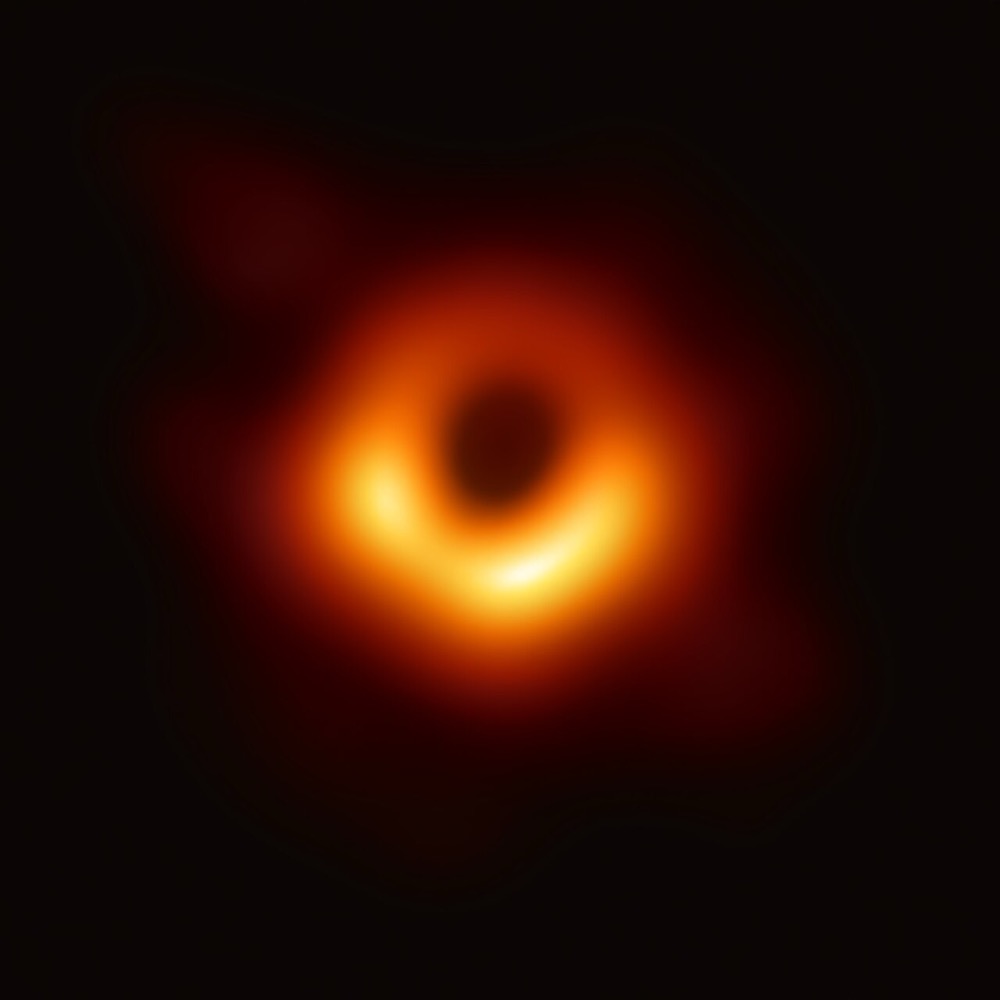
Hot gas around the supermassive black hole at the center of M87
A planetary nebula
The black hole's physical surface
A star orbiting the black hole
The dark center is the black hole's shadow, bounded by the photon ring. A black hole has no solid surface; the bright ring is glowing accretion flow.
Image: Event Horizon Telescope, uploader cropped and converted TIF to JPG, CC BY 4.0, via Wikimedia Commons.
The best evidence that "spiral nebulae" are separate galaxies came from Hubble's use of
Type Ia supernovae in Andromeda
redshifts from the Virgo Cluster
Cepheid variable stars in Andromeda
parallax of Andromeda's stars
Cepheids' period-luminosity relation gave a distance far greater than the size of the Milky Way. Type Ia supernova distances came later.
Where are the oldest stars in the Milky Way mostly found?
In the spiral arms
In the thin disk near the Sun
In the halo and bulge
In the Orion Nebula
Spiral arms and the disk contain gas and young stars; the halo and bulge host old, metal-poor stars and globular clusters.
What drives the luminosity of a quasar?
Fusion in billions of massive stars
Matter falling onto a supermassive black hole
A recent supernova
A collision of two neutron stars
Accretion heats gas to enormous temperatures; a quasar can outshine its host galaxy.
Why do stars rarely collide when two galaxies merge?
Dark matter pushes them apart
Stars repel each other magnetically
The distances between stars are enormous compared with their sizes
The galaxies pass through each other in empty space
If stars were grains of sand, the nearest would be many kilometers away. Gas clouds, being much larger, do collide.
An elliptical galaxy labeled E0 is
a barred spiral
extremely flat
an irregular galaxy
round on the sky
The E-number is 10(1 - b/a), so E0 means a = b and appears circular. It does not mean a spherical true shape necessarily.
About how long does the Sun take to orbit the center of the Milky Way?
About 25 billion years
About 250,000 years
About 2.5 million years
About 225 to 250 million years
At roughly 230 km/s at about 26,000 light-years from the center. The Sun has orbited about 20 times.
Which galaxy cluster is nearest to the Local Group?
The Perseus Cluster
The Bullet Cluster
The Coma Cluster
The Virgo Cluster
Virgo is about 54 million light-years away; Coma is about 320 million, and the others are farther.
Spiral arms are permanent structures made of the same stars that orbit together forever.
True
False
Arms are density waves: stars and gas flow through them. The pattern persists, but individual stars enter and leave.
What fraction of the Milky Way's total mass is thought to be dark matter?
About 50 percent
Roughly 90 percent
Almost none
About 10 percent
The Milky Way's total mass is about a trillion solar masses, but stars and gas are only about 60 to 100 billion solar masses, so dark matter is the large majority.
Why is the Milky Way visible as a band across the night sky?
It is the Sun's halo
We are inside its disk and look edge-on through it
It is the largest cluster in our sky
It is a thin cloud in Earth's atmosphere
Looking along the plane of the disk sees many stars; looking out of the plane sees few. Galileo first resolved the band into stars in 1610.
