Quiz · Hard
Harder applied pollution questions: pH logs, SO2 mass balance, eutrophication scenarios, bioindicators, wastewater treatment choices, toxicology and half-life calculations.
An engine at high temperature emits NO. In sunlight, NO2 reacts with hydrocarbons to make ozone. Which would most reduce afternoon ozone in a city?
Increasing CO2 emissions
Cutting both NOx and VOC emissions from vehicles
Raising the height of smokestacks
Planting more tall trees only
Ozone forms from NOx and VOCs in sunlight, so reducing either precursor helps; reducing both is best. Taller stacks only move pollution downwind, and trees themselves emit some VOCs.
Rain with a pH of 3.6 is how many times more acidic than rain with a pH of 5.6?
2 times
20 times
10,000 times
100 times
A 2-unit pH difference corresponds to -fold change in H+ concentration. Confusing the difference with the factor would give 2.
A power plant burns 1,000 tonnes of coal containing 2 percent sulfur by mass. Assuming all sulfur becomes SO2 (S = 32, SO2 = 64), how many tonnes of SO2 are released?
40 tonnes
20 tonnes
64 tonnes
2 tonnes
Sulfur mass = 20 t. Each 32 g of S gives 64 g of SO2, so mass doubles: 20 x 2 = 40 t. Forgetting the oxygen mass gives 20.
A lake receives runoff from a fertilized farm. In July, dissolved oxygen at the bottom drops to 1 mg/L, while the surface is oxygen-rich. Which explanation is best?
Cold water at the bottom cannot hold oxygen.
Fish release oxygen at the surface only.
Algae at the surface die and sink, and decomposers use up the oxygen at the bottom; stratification stops mixing.
Fertilizer directly consumes oxygen as it dissolves.
Eutrophication: algal bloom, die-off, decomposition (high BOD), plus a thermocline that prevents oxygen from mixing downward. Colder water actually holds more oxygen.
Which management approach is most effective at reducing nutrient pollution of a river from agriculture?
Higher fertilizer rates to increase yields
Building a taller dam
Buffer strips of vegetation, cover crops and timed fertilizer application
Adding chlorine to the river
Practices that keep nutrients on the field and filter runoff address the source (nonpoint). Chlorine disinfects but does not remove nutrients.
A stream sample contains many stonefly and mayfly nymphs and few midge larvae. What can be concluded?
Water quality is probably good, with high dissolved oxygen.
The water is heavily polluted with sewage.
The water is acidic.
Nutrient levels are very high.
Stoneflies and mayflies are intolerant of pollution and need high oxygen. Midges and sludge worms dominate polluted waters.
A wastewater plant releases effluent that meets BOD limits but is still high in nitrogen and phosphorus. Which additional step is needed?
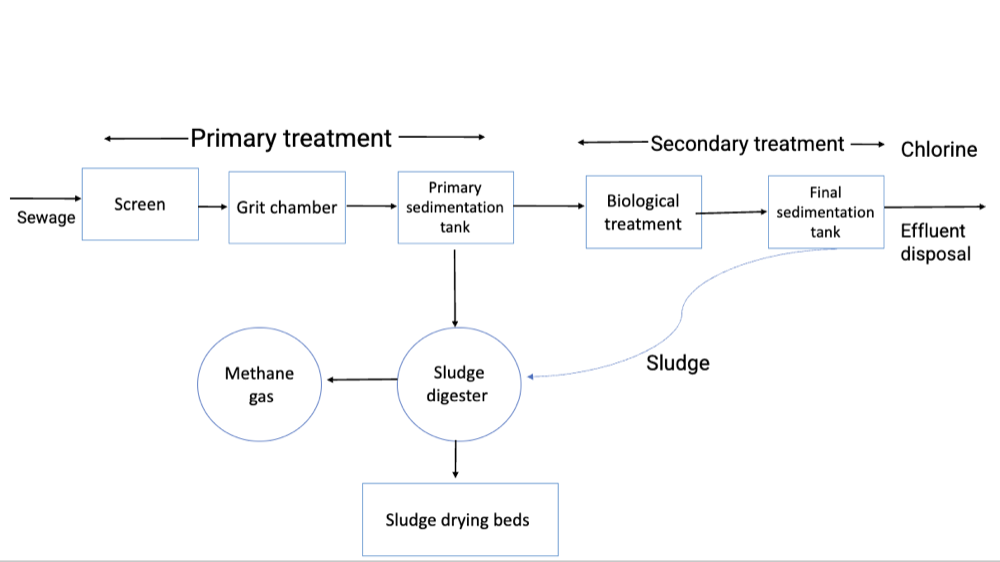
Primary treatment
Longer screening
Sludge drying
Tertiary (advanced) treatment for nutrient removal
Secondary treatment lowers BOD but does not remove most nutrients. Tertiary treatment (biological nutrient removal or chemical precipitation) does.
Which statement about mercury is correct?
Mercury is quickly excreted and does not accumulate.
Mercury is converted to methylmercury by bacteria and biomagnifies in predatory fish.
Mercury only comes from natural volcanic sources.
Mercury is removed by sewage treatment completely.
Coal burning and mining add mercury; bacteria in sediments methylate it, and it accumulates in the tissues of long-lived top predators.
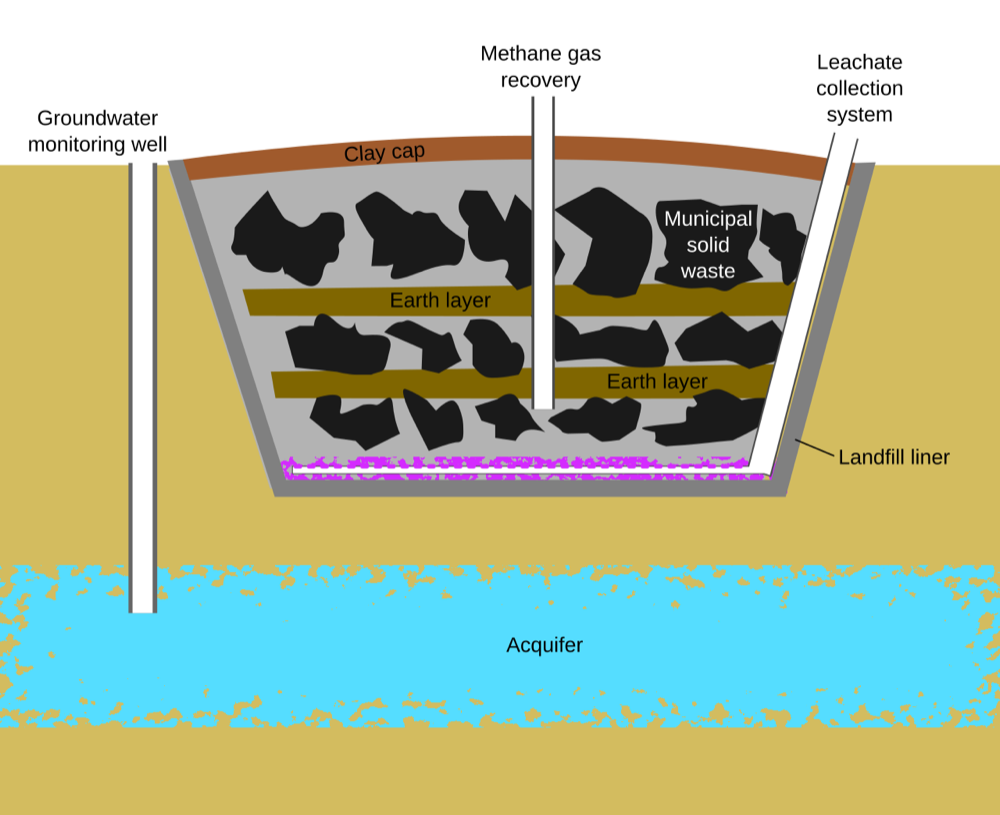
A landfill's methane recovery system captures gas and burns it to make electricity. Which is the primary environmental benefit?
It prevents leachate from forming.
It converts methane, a potent greenhouse gas, to CO2 and generates energy.
It eliminates the need for a clay cap.
It increases the rate of aerobic decomposition.
Methane warms much more than CO2 per molecule, so burning it lowers warming impact and displaces other fuels. It does not stop leachate, and landfill decay is mainly anaerobic.
Image: Belbury, CC BY 4.0, via Wikimedia Commons.
Which solid waste method reduces volume by about 90 percent but creates toxic ash and air emissions that require control?
Sanitary landfilling
Composting
Source reduction
Incineration with energy recovery
Waste-to-energy burns waste and generates power, but needs scrubbers and filters and safe ash disposal. Landfilling does not reduce volume that much; composting handles only organic waste.
A chemical has an LD50 of 5 mg/kg and another has an LD50 of 500 mg/kg. Which statement is correct?
The first is more acutely toxic.
The second is more acutely toxic.
They are equally toxic.
The first is safe at any dose.
A lower LD50 means a smaller dose kills half the test animals, so the chemical is more acutely toxic. LD50 says nothing about chronic effects.
Radioactive waste contains an isotope with a half-life of 30 years. About what fraction remains after 90 years?
One third
One half
One eighth
One ninth
90 years is three half-lives: . A mistake would be dividing by 3.
Which pair correctly matches a law with its focus?
Clean Air Act: cleanup of abandoned dump sites; CERCLA: vehicle emissions
Safe Drinking Water Act: wetlands filling; Oil Pollution Act: ozone
Clean Water Act: discharges to surface water; RCRA: tracking hazardous waste from cradle to grave
TSCA: acid rain trading; NEPA: tap water standards
The Clean Water Act regulates discharges to waters; RCRA manages current hazardous waste. CERCLA (Superfund) handles abandoned sites; the Clean Air Act covers air quality.
An urban area wants to cut summer smog and reduce reliance on cars. Which policy combination is most effective?
Fund public transit, set low-emission zones and tighten fuel and emission standards
Allow more cars but increase smokestack heights
Ban only diesel trucks at night
Increase parking spaces downtown
Policies that cut vehicle use and emissions directly address NOx and VOC sources. More parking increases car use, and tall stacks do not reduce emissions.
Scientists find a persistent pesticide at 0.003 ppm in water, 0.04 ppm in plankton, 0.5 ppm in minnows and 25 ppm in fish-eating birds. This pattern is best explained by
rapid biodegradation by bacteria
dilution in the food chain
photosynthesis in the birds
biomagnification of a fat-soluble, nondegradable chemical
Concentrations increase at each trophic level when a chemical is stored in fat and not broken down. Biodegradation would lower concentrations.
