Quiz · Medium
Foundations of toxicology: dose-response, ADME, ethanol, specimens, antidotes and basic tests.
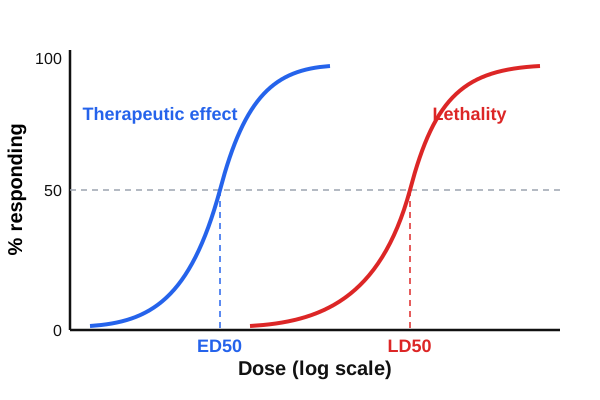
In the dose-response graph, which dose is marked in red on the right?
TD1
ED50
Vd
LD50
The red curve and marker show lethality, so the lethal dose for 50 percent. The blue one to the left is the effective dose.
Drug A has ED50 5 mg and LD50 500 mg. Drug B has ED50 5 mg and LD50 50 mg. Which statement is true?
Drug A has the wider safety margin
They are equally safe
Drug B has the wider safety margin
Drug A is more toxic
TI A = 100 and TI B = 10. A bigger therapeutic index is safer.
Which of these has 100 percent bioavailability?
A subcutaneous dose with first-pass effect
An IV dose
A transdermal patch
An oral dose
IV bypasses absorption. Oral doses are reduced by incomplete absorption and first-pass metabolism.
First-pass metabolism occurs mainly in the:
Kidney
Lungs
Liver
Skin
Drugs absorbed from the gut pass the portal vein to the liver first.
A drug with half-life 4 hours is taken once. About how much is left after 12 hours?
6.25 percent
12.5 percent
50 percent
25 percent
12 h is three half-lives: 100 to 50 to 25 to 12.5 percent.
Why is ethanol elimination called zero-order at ordinary levels?
A constant fraction is removed each hour
It is eliminated only by breath
The liver enzyme becomes saturated, so a constant amount is eliminated per hour
It is not metabolized
Alcohol dehydrogenase is saturated, so elimination is a roughly constant 0.015 g/dL per hour.
A man's blood alcohol is 0.10 g/dL at 11 pm. Assuming an average elimination rate of 0.015 g/dL per hour, about what will it be at 2 am?
About 0.01
About 0.10
About 0.085
About 0.055
3 hours x 0.015 = 0.045. 0.10 - 0.045 = 0.055.
Why are blood alcohol samples collected in gray-top tubes?
They are sterile only
They stop DNA damage
Heparin keeps the sample warm
Sodium fluoride prevents microbial alcohol production and oxalate prevents clotting
Preservatives prevent fermentation by microorganisms.
Which specimen is best for postmortem alcohol when the body is decomposed?
Hair
Vitreous humor
Gastric content only
Heart blood
The vitreous is isolated and less affected by decomposition.
Why are femoral blood samples preferred over heart blood postmortem?
It has the highest drug concentrations
Less affected by postmortem redistribution
It clots less
Cheaper to collect
Drugs diffuse out of organs into central blood after death, raising the concentration in heart blood.
What is the usual confirmatory test after a positive immunoassay screen?
A color test
Visual inspection
A second immunoassay from the same kit
GC-MS or LC-MS/MS
Mass spectrometry identifies compounds by their structure, so cross-reactivity is not an issue.
6-MAM in a urine sample indicates use of:
Hydrocodone
Heroin
Codeine
Poppy seed tea only
6-monoacetylmorphine is formed only from heroin (diacetylmorphine).
Which is the antidote for opioid overdose?
Flumazenil
Naloxone
Atropine
N-acetylcysteine
Naloxone is an opioid antagonist. Flumazenil is for benzodiazepines, NAC for acetaminophen and atropine for organophosphates.
Cherry-red lividity at autopsy suggests poisoning with:
Arsenic
Morphine
Carbon monoxide
Strychnine
Carboxyhemoglobin is bright red.
Cyanide poisons by:
Blocking cytochrome c oxidase
Inhibiting acetylcholinesterase
Blocking glycine receptors
Binding hemoglobin more than oxygen
CO is the one that competes with oxygen on hemoglobin. Cyanide stops cellular respiration.
Which pair is correct?
Organophosphate: pralidoxime
Acetaminophen: naloxone
Cyanide: pralidoxime
Opioids: N-acetylcysteine
Pralidoxime reactivates acetylcholinesterase. NAC is for acetaminophen.
A purple Marquis test most likely suggests:
Marijuana
Cocaine
Methanol
An opiate such as heroin or morphine
Marquis gives purple with opiates and orange-brown with amphetamines. It is presumptive.
Which sample gives the longest history of drug exposure?
Blood
Oral fluid
Breath
Hair
Hair retains drugs as it grows, so segments reflect weeks or months.
What is the effect of drinking alcohol on a person taking a benzodiazepine?
Synergistic CNS and respiratory depression
Cancellation of both effects
No change
Faster metabolism only
Both are CNS depressants acting at the GABA system, so effects are more than additive.
True or false: A positive immunoassay screen is enough to report a drug as present in court.
False
True
Screens cross-react and need confirmation with a more specific method.
Which toxin classically causes Mees' lines on the nails?
Ricin
Carbon monoxide
Strychnine
Arsenic
Mees' lines are white bands on nails seen in arsenic and some other heavy metal poisonings.
