Quiz · Medium
A foundation quiz on the greenhouse effect, the Keeling Curve, ice cores, feedbacks, sea level, ocean acidification, coral bleaching and the main climate policies, with graphs and photos.
Which gases make up most of Earth's atmosphere but are NOT greenhouse gases?
Carbon dioxide and methane
Water vapor and ozone
Nitrogen and oxygen
Argon and nitrous oxide
N2 and O2 are about 99 percent of dry air but do not absorb infrared radiation significantly because they are symmetric diatomic molecules. Water vapor, CO2, CH4, N2O and ozone do absorb infrared; argon is also not a greenhouse gas but is only about 1 percent.
Without the natural greenhouse effect, Earth's average surface temperature would be about
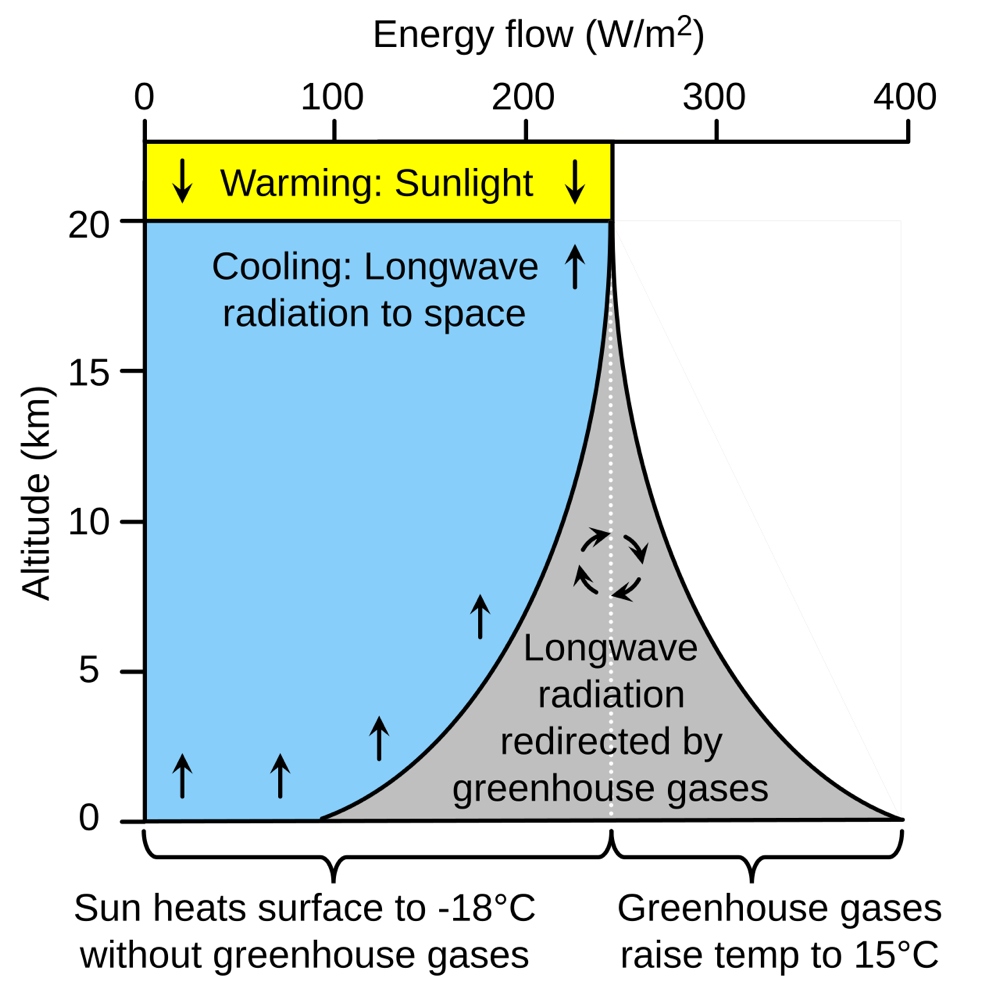
-18 degrees C
15 degrees C
-100 degrees C
0 degrees C exactly
The Sun alone would heat the surface to about -18 degrees C; greenhouse gases raise it to about 15 degrees C, making Earth habitable.
Image: Efbrazil, CC BY-SA 4.0, via Wikimedia Commons.
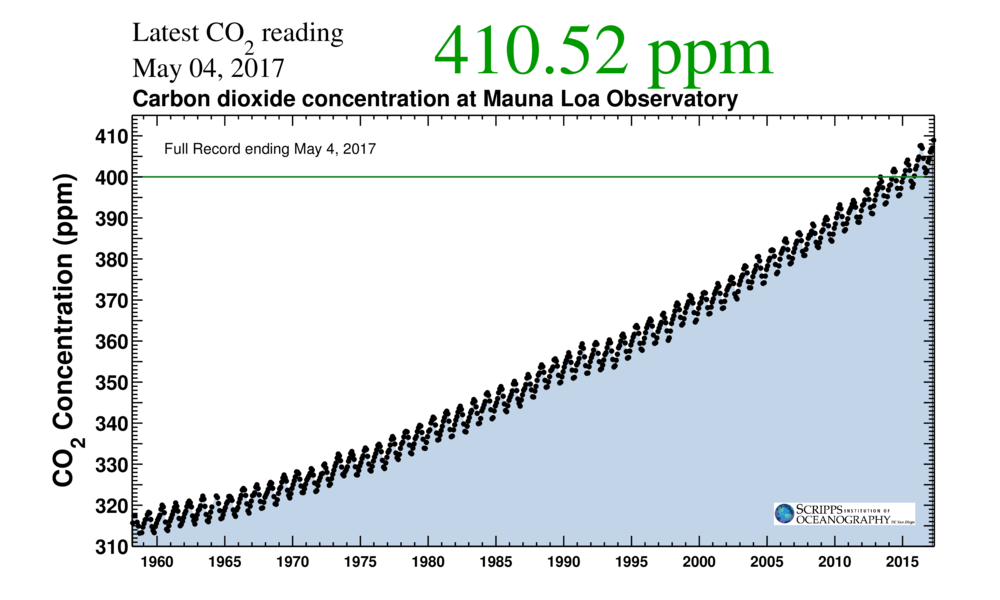
What causes the yearly sawtooth pattern in the Keeling Curve?
Volcanic eruptions each spring
Seasonal changes in the Sun's output
Ocean currents reversing every year
Northern Hemisphere plants take up CO2 in the growing season and release it in winter.
The Northern Hemisphere has more land and vegetation than the Southern, so its seasonal photosynthesis (summer uptake) and decay (winter release) produce a yearly cycle on top of the steady rise from fossil fuels.
Image: Scrippsnews, CC BY-SA 4.0, via Wikimedia Commons.
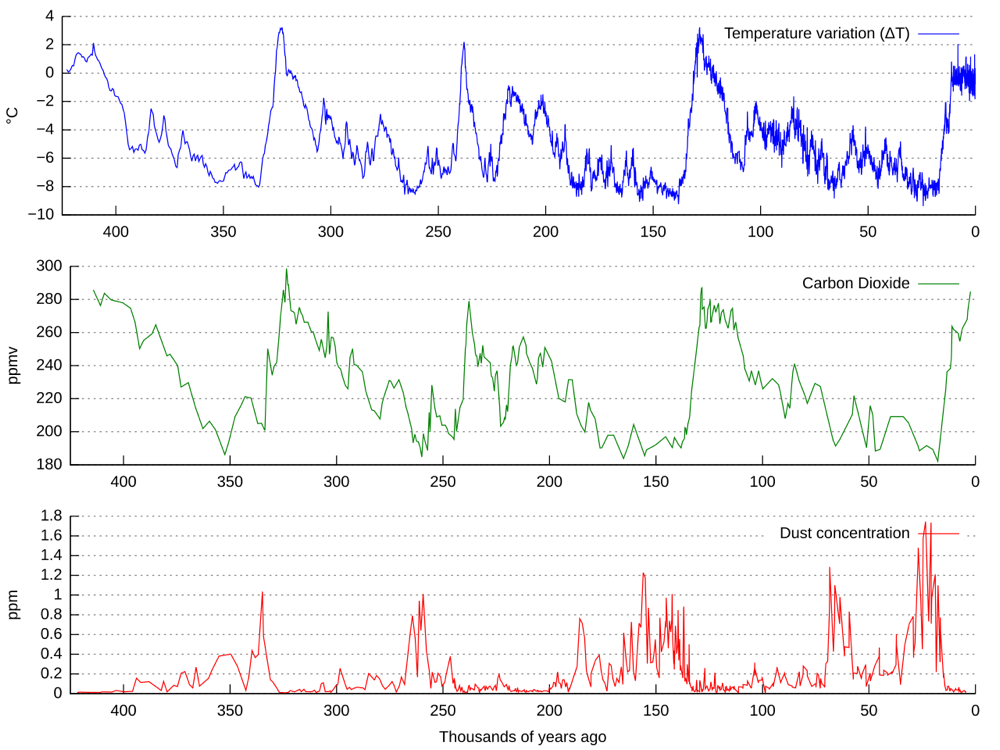
What does the Vostok ice-core record show?
CO2 was always above 400 ppm during warm periods.
CO2 and temperature moved together over glacial cycles, and CO2 never exceeded about 300 ppm.
Temperature changed but CO2 did not.
CO2 was constant at 280 ppm for 400,000 years.
The ice cores show a close link between CO2 and temperature, with CO2 between about 180 and 300 ppm. Today's concentration (above 420 ppm) is well above anything in this record.
Image: Original: Unknown Vector: Autopilot, CC BY-SA 3.0, via Wikimedia Commons.
Which of the following is the best evidence that the recent rise in atmospheric CO2 is from fossil fuels?
The oceans are getting cooler.
The atmosphere's carbon-14 and carbon-13 ratios are falling.
Volcanoes erupt more often than before.
Solar output has increased steadily.
Fossil carbon contains no carbon-14 and is depleted in carbon-13, so adding it changes isotope ratios in a measurable way (Suess effect). Volcanic CO2 is a tiny fraction and solar output has been flat.
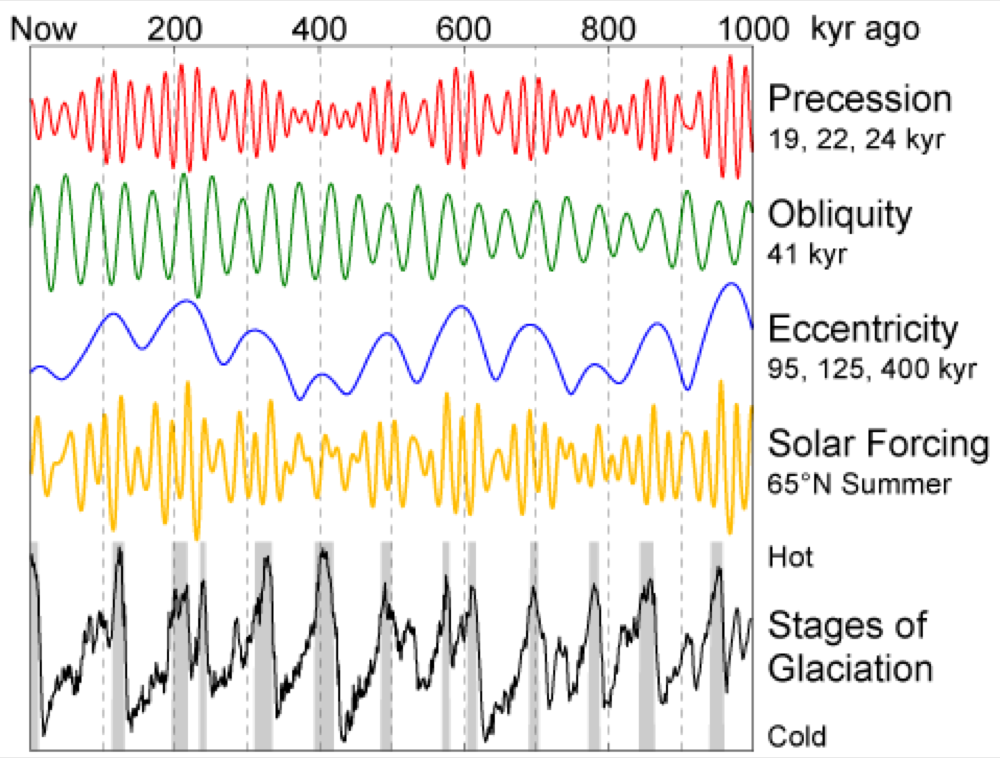
The Milankovitch cycles explain
the rapid warming since 1980
the ozone hole over Antarctica
changes in volcanic emissions
Natural changes in sunlight distribution that paced ice ages over tens of thousands of years
Eccentricity, obliquity and precession alter how sunlight is distributed over thousands of years. They cannot explain the rapid warming of the last 150 years.
Image: Robert A. Rohde (Global Warming Art), CC BY-SA 3.0, via Wikimedia Commons.
Which statement about the energy sector's share of global greenhouse gas emissions is closest to the chart?
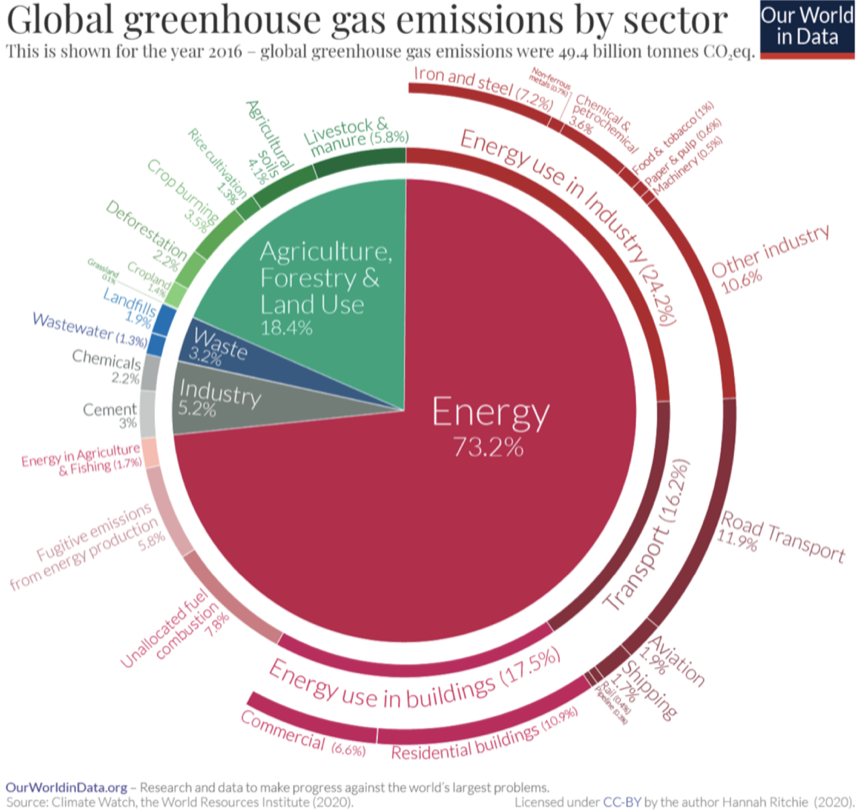
It is about three quarters of total emissions.
It is under 10 percent.
It is about one quarter.
It is about half.
Energy (electricity, heat, transport, buildings, industry energy use, fuel extraction) was about 73 percent of emissions in 2016. Agriculture, forestry and land use was about 18 percent.
Image: Hannah Richie, CC BY-SA 3.0, via Wikimedia Commons.
Which of these is a positive feedback?
Warmer Earth emits more infrared radiation to space.
Volcanic aerosols reflect sunlight.
Melting sea ice exposes dark ocean that absorbs more sunlight.
More CO2 makes plants grow slightly faster and take up more CO2 in some regions.
The ice-albedo feedback amplifies warming. A warmer Earth radiating more heat is a negative (stabilizing) feedback. Volcanic aerosols are a forcing, and CO2 uptake by plants is a modest negative feedback.
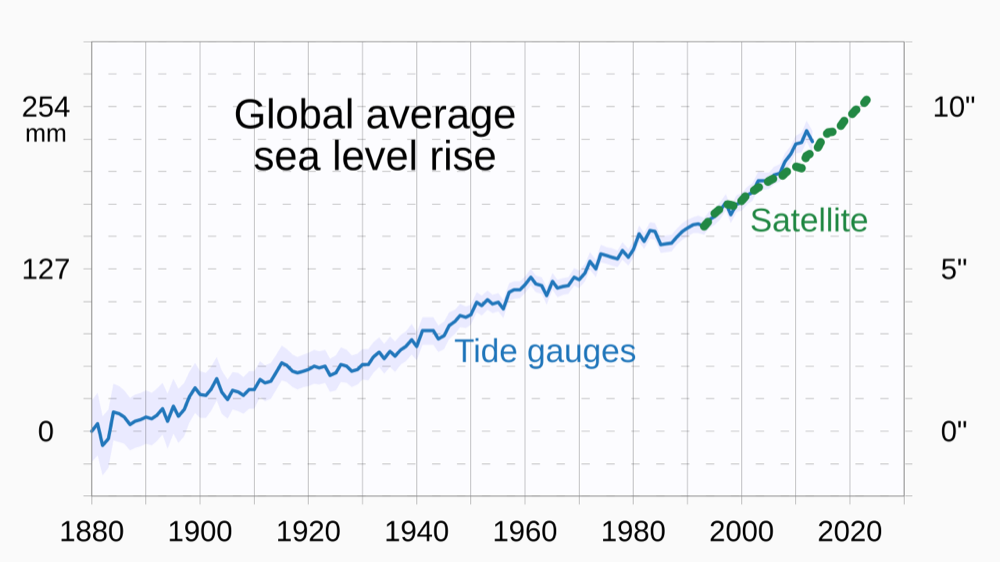
Which two processes cause most sea level rise?
Melting of sea ice and increased rainfall
Thermal contraction and ice formation
Thermal expansion of seawater and melting of land ice
Melting sea ice and groundwater recharge
Warmer water expands, and glaciers and ice sheets add water. Floating sea ice already displaces its own weight, so its melting barely changes sea level.
Image: RCraig09, CC BY-SA 4.0, via Wikimedia Commons.
Why is the Arctic warming faster than the global average?
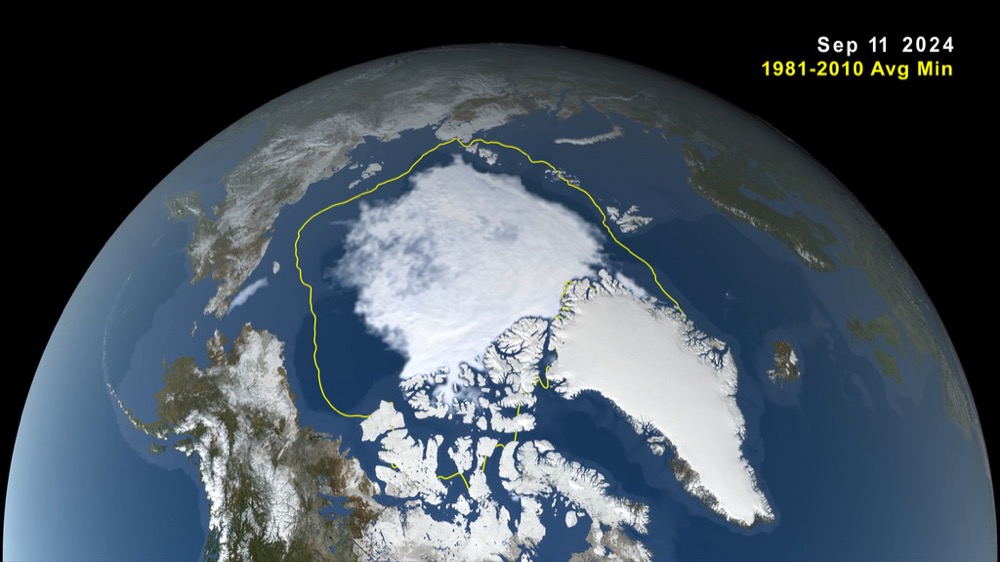
Loss of reflective snow and ice lowers albedo and amplifies warming (Arctic amplification).
It receives more sunlight than the tropics.
Industrial pollution is concentrated there.
Its ozone layer has been destroyed, letting in more UV.
The ice-albedo feedback and other feedbacks mean the Arctic warms 2 to 4 times faster than the global average. The Arctic actually receives less sunlight than the tropics.
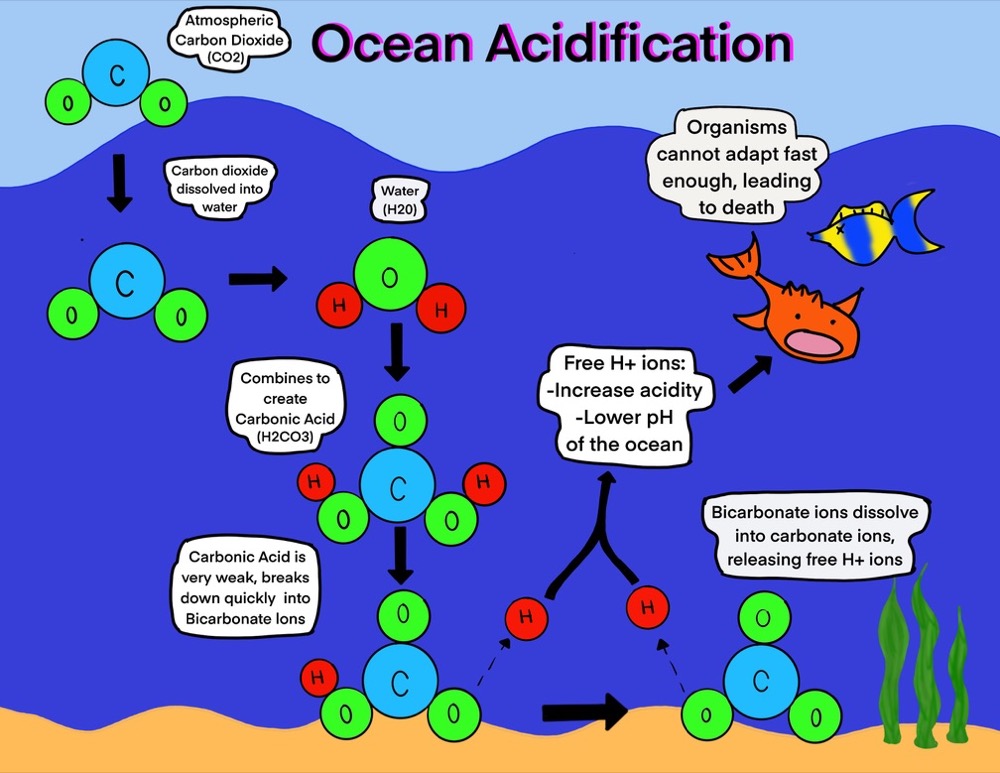
Rising CO2 lowers ocean pH because dissolved CO2
forms calcium hydroxide
removes hydrogen ions from the water
makes the sea warmer, which directly lowers pH
forms carbonic acid, which releases hydrogen ions
CO2 plus water gives H2CO3, which releases H+ and bicarbonate, so pH falls and carbonate ions decline. It is chemical, not caused by temperature.
Image: Jujchin, CC BY-SA 4.0, via Wikimedia Commons.
What is the immediate biological cause of coral bleaching?
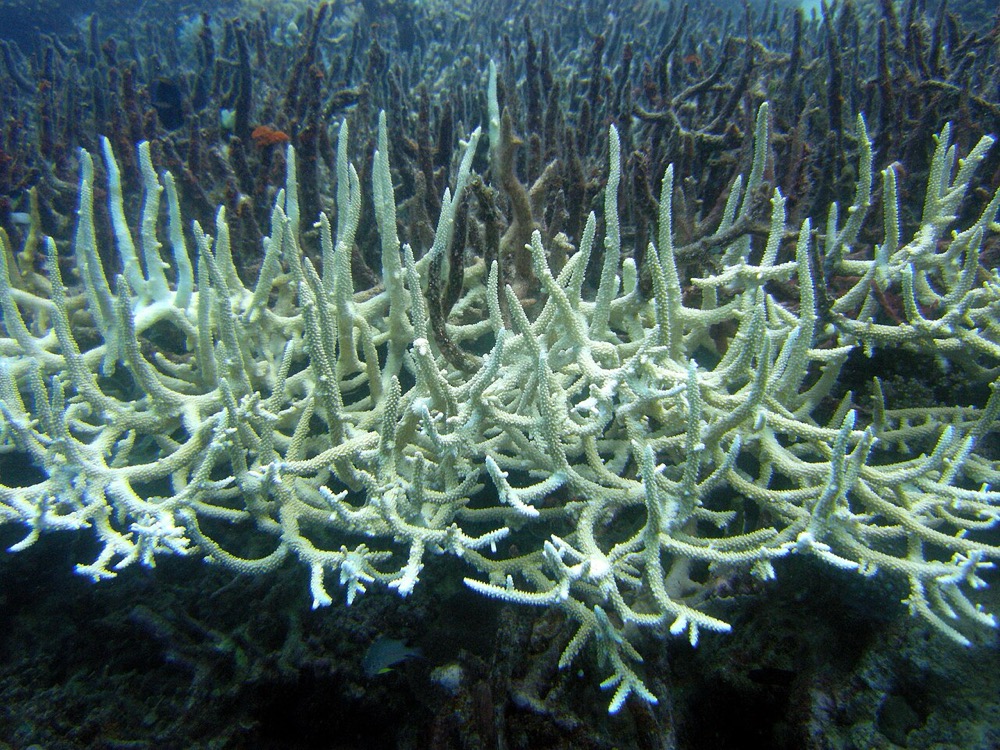
Corals are infected by a virus caused by acid rain.
Corals expel their symbiotic algae under heat stress.
Corals lose calcium from their skeletons within hours.
Corals absorb too much light at night.
Heat stress breaks down the coral-algae mutualism, and the coral expels the zooxanthellae, which provide most of its energy. Without them the coral appears white.
Image: Matt Kieffer, CC BY-SA 2.0, via Wikimedia Commons.
Which statement about hurricanes and climate change is best supported?
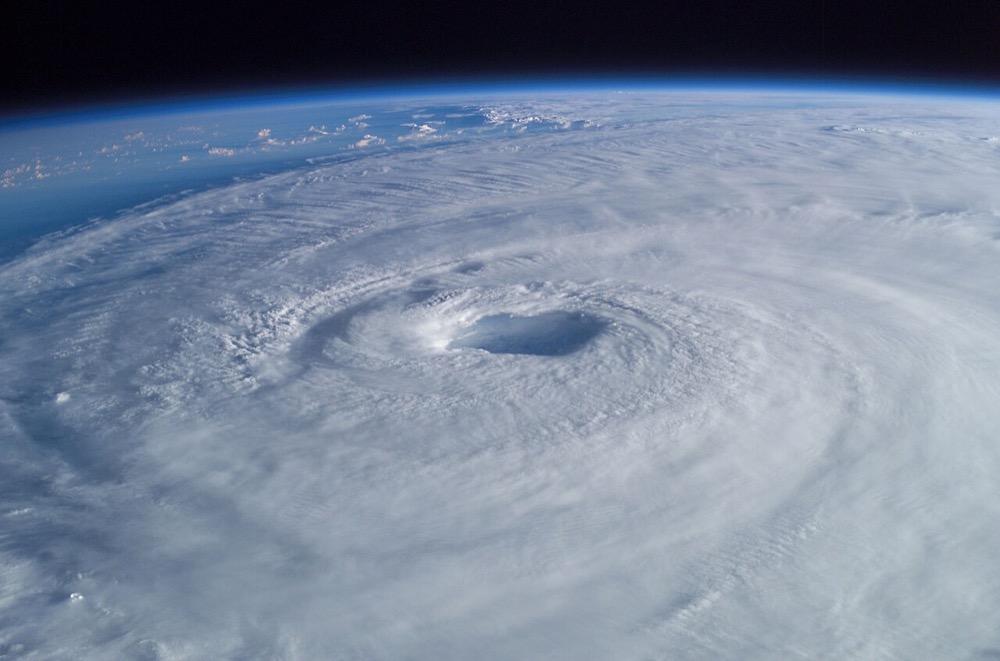
Warming guarantees more hurricanes each year.
Warming increases the share of intense storms and the rainfall they produce.
Warming makes all hurricanes weaker.
Hurricane tracks are unaffected by sea level.
Warm oceans and moister air strengthen storms and raise rainfall. The total number of storms may not rise. Higher sea levels increase storm surge flooding.
Which would be an example of adaptation rather than mitigation?
Replacing coal plants with wind farms
Planting trees to store carbon
Installing heat pumps instead of gas furnaces
Building a sea wall around a coastal city
Adaptation means adjusting to impacts. The others reduce emissions or remove CO2, which is mitigation.
Under the Paris Agreement, countries
set their own national pledges (NDCs) and update them every five years
are legally forced to cut emissions by the same percentage
pay a global carbon tax to the UN
stop all fossil fuel use by 2030
Paris uses bottom-up pledges. The goal is well below 2 degrees C with efforts toward 1.5 degrees C, and ratcheting ambition every five years. It does not impose identical or legally binding national targets.
Which energy source has the lowest median life-cycle emissions per kWh?
Natural gas
Solar PV
Wind
Coal
Median life-cycle emissions (IPCC) are about 11 to 12 g CO2e/kWh for wind, around 12 for nuclear, 40 to 50 for solar PV, 490 for gas and 820 for coal. The differences between the lowest ones are small compared with fossil fuels.
A carbon tax differs from cap-and-trade because a carbon tax
sets a firm limit on total emissions
gives free permits to every emitter
sets the price on emissions and lets the quantity vary
is only used by countries
In a tax, the price per tonne is fixed and emissions respond; in cap-and-trade, the cap is fixed and the allowance price is set by the market.
The Montreal Protocol is connected to climate policy because it
phased out CFCs, which are potent greenhouse gases, and later phased down HFCs
controls CO2 from power stations
was the first binding treaty on methane
created the IPCC
The Montreal Protocol (1987) was about the ozone layer, but CFCs are strong greenhouse gases, so it also avoided warming. The Kigali Amendment (2016) covers HFCs. The IPCC was set up by WMO and UNEP in 1988.
A forest is cleared and burned for pasture. Which statement best describes the carbon effect?
The cleared land absorbs more CO2 than the forest did.
No carbon is released because the wood is organic.
Only oxygen is released into the air.
A carbon sink becomes a source, since stored carbon is released as CO2.
Trees store carbon; burning or decay releases it, and the loss of trees reduces future uptake. Pasture grasses store far less carbon than a forest.
