Quiz · Hard
Exam-style problems: IPAT, doubling time, payback period, energy savings, footprint and biocapacity, externalities and decoupling.
A town of 20,000 people uses 3,000 MWh of electricity per month. An efficiency program cuts use by 15%. How many MWh per year are saved?
450
36,000
5,400
30,600
3,000 x 0.15 = 450 MWh per month; x 12 = 5,400 MWh per year. 30,600 is the remaining annual use.
A rooftop solar array costs $18,000 and reduces electricity bills by $1,500 per year. After a $3,000 one-time rebate, what is the payback period?
12 years
6 years
10 years
8 years
Net cost = 18,000 - 3,000 = 15,000. 15,000 / 1,500 = 10 years. Forgetting the rebate gives 12.
A 100 W incandescent bulb is replaced by a 14 W LED, both used 4 hours per day for a year (365 days). If electricity costs $0.15 per kWh, about how much is saved per year?
$18.83
$0.52
$1.13
$125.56
Savings = (100 - 14) W = 86 W. 86 W x 4 h x 365 d = 125,560 Wh = 125.56 kWh. x $0.15 = $18.83.
A city's population grows at 3.5% per year. In about how many years will it double?
7 years
35 years
2.5 years
20 years
70 / 3.5 = 20 years.
Country X has population 10 million, affluence A and technology T. Population increases by 20% and the technology factor improves 25% (T falls by a quarter) while affluence stays the same. Using IPAT, total impact changes by:
No change
A 10% decrease
A 5% increase
A 45% decrease
I = 1.20 x 1.00 x 0.75 = 0.90, a 10% decrease.
A country's ecological footprint is 5.0 global hectares per person and its biocapacity is 3.2 global hectares per person. Which statement is correct?
It has an ecological reserve of 1.8 global hectares per person
It has an ecological deficit of 1.8 global hectares per person
It is exactly sustainable
Its footprint equals 8.2 global hectares per person
Footprint minus biocapacity = 1.8 gha per person; footprint above biocapacity is a deficit.
Which pair of changes would MOST reduce the ecological footprint of a household?
Using single-use items for convenience
Heating a larger home and flying more often
Buying a larger refrigerator and more clothes
Eating less beef and cutting car travel
Diet and transport are among the largest footprint components; beef and driving are high-impact.
An environmental scientist notes that the fertilizer a farmer applies runs off into a river and causes an algal bloom downstream. She is describing:
A negative externality
A positive externality
Decoupling
A natural capital gain
Costs fall on the downstream community and ecosystem rather than on the farmer.
Which policy would MOST directly internalize the cost of carbon emissions?
A subsidy for coal mining
A voluntary recycling campaign
A tax on each tonne of CO2 emitted
Banning solar panels
A carbon price makes polluters pay for the damage.
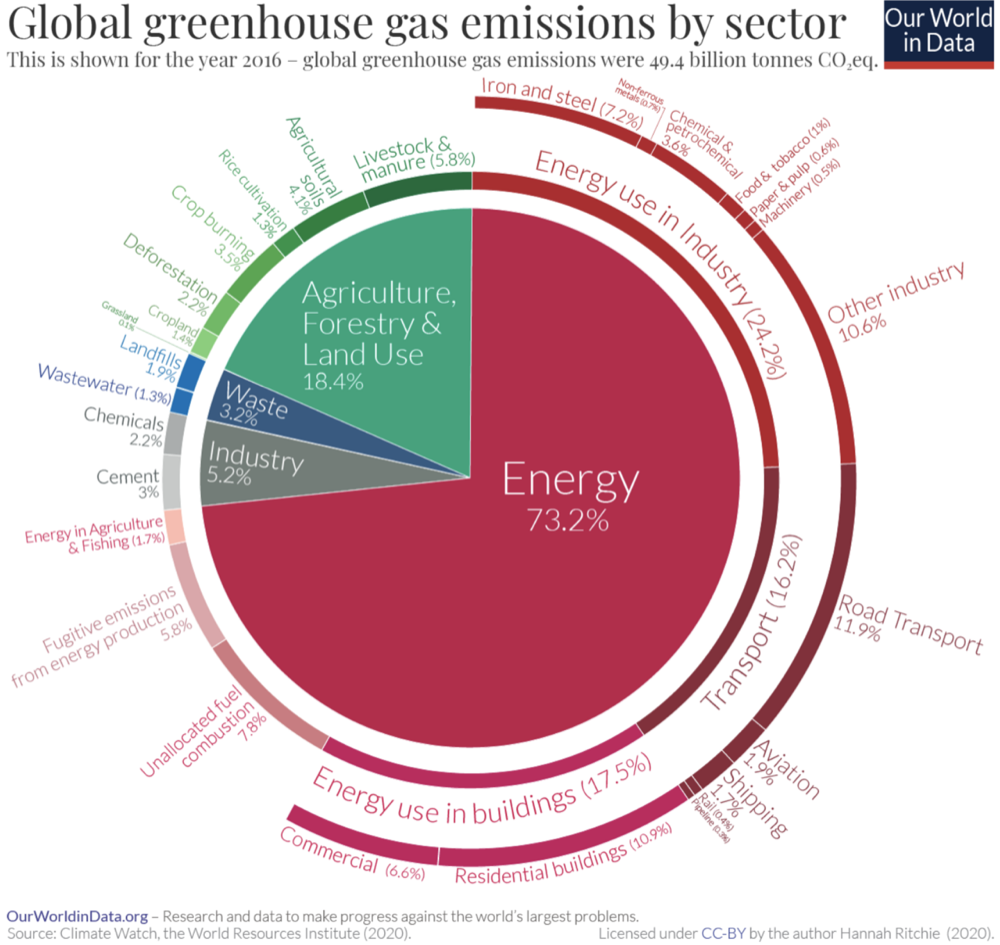
The graph shows the greenhouse gas emissions by sector. A policy that cuts the emissions of the sector with the LARGEST share would mainly target:
Waste only
Agriculture only
Energy use in industry, transport, buildings and power generation
Land use change only
Energy is about 73% of global emissions in this chart, so decarbonizing energy has the largest effect. Image: Hannah Ritchie, Our World in Data, CC BY-SA 3.0.
Which result is the best example of 'absolute decoupling'?
GDP rises while total resource use falls
Resource use rises while GDP falls
GDP and resource use both fall
GDP rises and resource use rises more slowly
In absolute decoupling the impact itself declines while the economy grows. Relative decoupling only slows the growth of the impact.
Why might switching to more efficient light bulbs fail to reduce total electricity use as much as expected?
LEDs cannot run for long
Bulbs do not affect electricity use
Efficient bulbs consume more power
The rebound effect: lower cost leads people to use lights more
The rebound effect (Jevons paradox) offsets some of the savings.
A farmer rotates corn with soybeans and plants winter cover crops. Which combination of benefits is MOST likely?
More synthetic fertilizer needed
Higher soil nitrogen, less erosion and reduced pest cycles
Increased soil compaction
Less biodiversity and more tillage
Soybeans are legumes that fix nitrogen; cover crops protect the soil and break pest cycles.
A product's life-cycle assessment shows that 80% of its emissions occur during the use phase. Where should the designer focus to cut emissions most?
Changing the packaging
Improving its energy efficiency in use
Using a different shipping route
Choosing recycled paper for the manual
Target the largest share. Packaging, shipping and manuals are small components here.
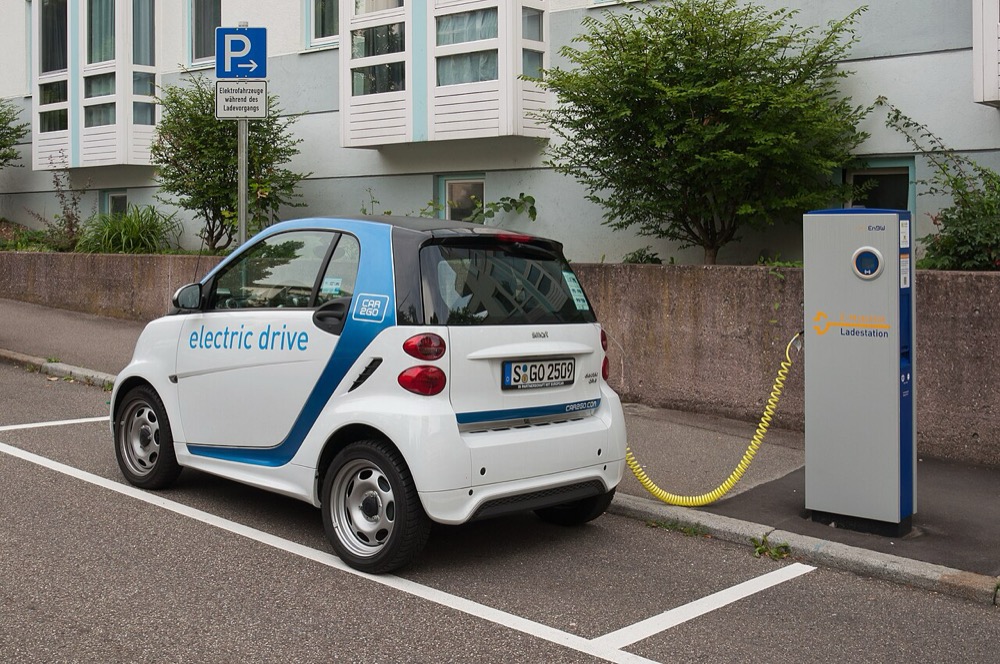
Which statement about an electric vehicle (EV) charged from a grid supplied mostly by coal is correct?
It always emits more than a gasoline car
Charging does not use electricity
It has zero lifetime emissions
Its lifetime emissions may still be significant, depending on the grid mix, but are often lower than a gasoline car
Total emissions depend on the electricity source and battery manufacturing. Image: Julian Herzog, CC BY 4.0.
