Quiz · Medium
Parallax and magnitude calculations, spectral classes, the HR diagram, how stars live and die, and pictures of famous nebulae.
In the HR diagram, a star is cool but extremely luminous. Where does it lie?
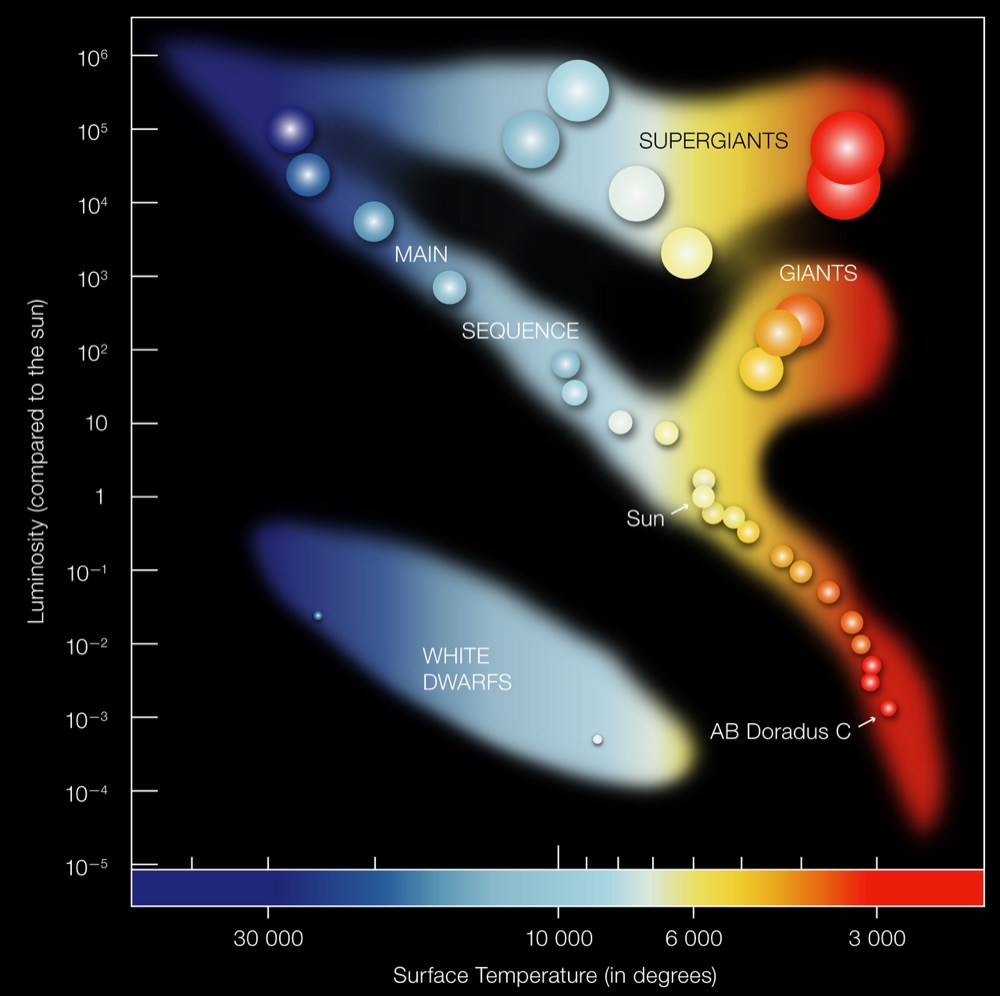
Upper right (supergiant region)
Upper left (hot, luminous)
Lower right (cool, faint main sequence)
Lower left (white dwarf region)
Low temperature gives little energy per unit area, so such a star must have an enormous surface area: a red giant or supergiant. Lower right stars are cool and faint (red dwarfs).
Image: ESO, CC BY 4.0, via Wikimedia Commons.
Which statement correctly describes the temperature axis of an HR diagram?
It is a logarithmic axis showing mass
Temperature decreases from left to right
Temperature increases from left to right
It shows age rather than temperature
Tradition places the hottest (O) stars on the left, so the axis runs backward compared with most graphs.
Image: ESO, CC BY 4.0, via Wikimedia Commons.
A star has a parallax of 0.05 arcseconds. How far away is it?
5 parsecs
20 parsecs
0.05 parsecs
200 parsecs
d = 1/p = 1/0.05 = 20 pc (about 65 light-years). Multiplying instead of dividing gives the tempting wrong answer 0.05.
How many times brighter is a magnitude 2 star than a magnitude 7 star?
2.5 times
25 times
100 times
5 times
Five magnitudes equal a factor of exactly 100. The scale is logarithmic, not linear, so 5 magnitudes is not 5 times.
Which spectral class is the hottest?
G
M
A
O
The sequence from hot to cool is O, B, A, F, G, K, M. M stars are the coolest and reddest.
A star's luminosity is 16 times larger than that of an identical star only because its temperature is higher. By what factor is its temperature greater?
8
16
4
2
L is proportional to T^4, so T ratio = 16^(1/4) = 2. Dividing 16 by 4 (a common slip) would assume L is proportional to T^2.
Why do massive stars live much shorter lives than the Sun?
Their gravity makes them collapse quickly
They are cooler, so fusion is unstable
They contain less hydrogen
They fuse hydrogen at a vastly higher rate, so they exhaust their fuel sooner
Massive stars have more fuel but are far more luminous (L is roughly M^3.5), so lifetime falls roughly as M^-2.5. A 10-solar-mass star lives only tens of millions of years.
What is the Sun's eventual fate?
Gradual fading into a brown dwarf
Red giant, planetary nebula, then a white dwarf
Red giant, then a Type II supernova
Direct collapse into a black hole
The Sun is far below the roughly 8 solar masses needed for a core-collapse supernova. It will end as a carbon-oxygen white dwarf, supported by electron degeneracy pressure.
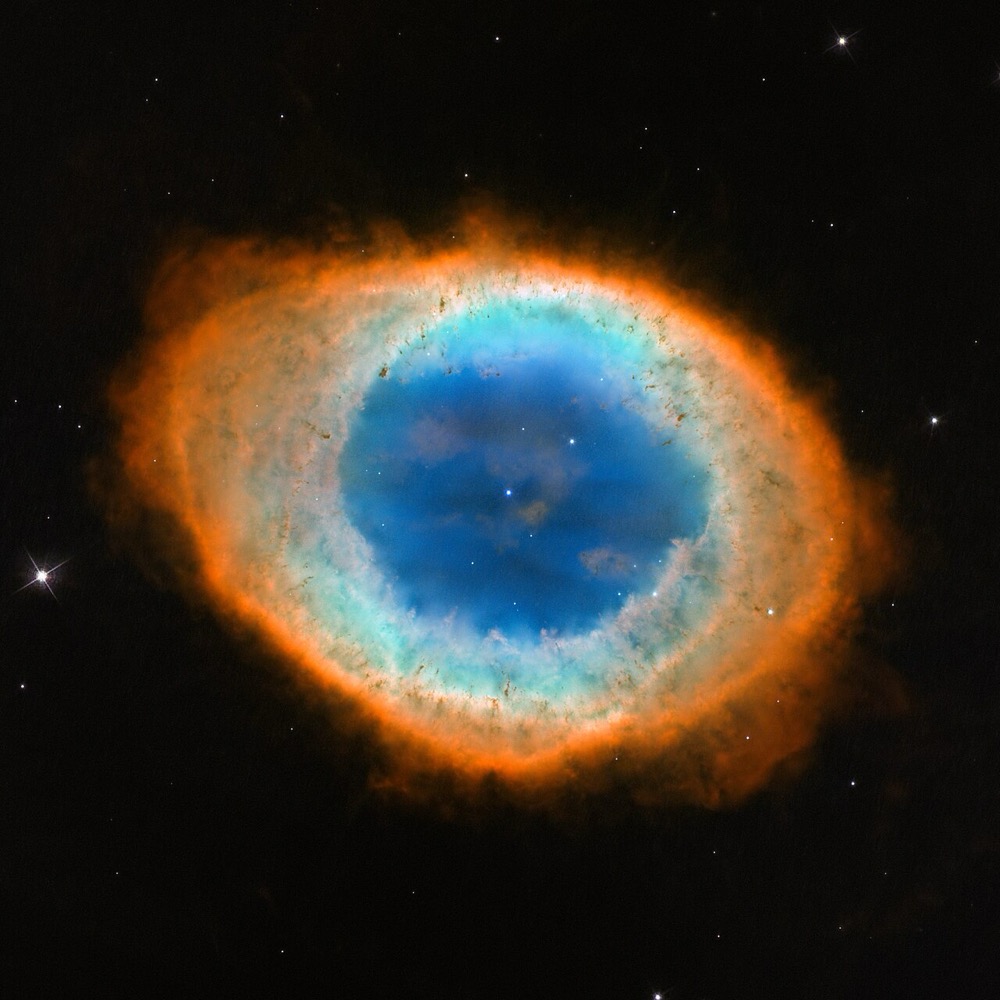
This nebula, M57, is the glowing shell of a dying star. What type of object is it?
A star-forming region
A planetary nebula
A reflection nebula around a young cluster
A supernova remnant
Planetary nebulae form when a Sun-like star sheds its outer layers; they have nothing to do with planets. The central star is a white dwarf.
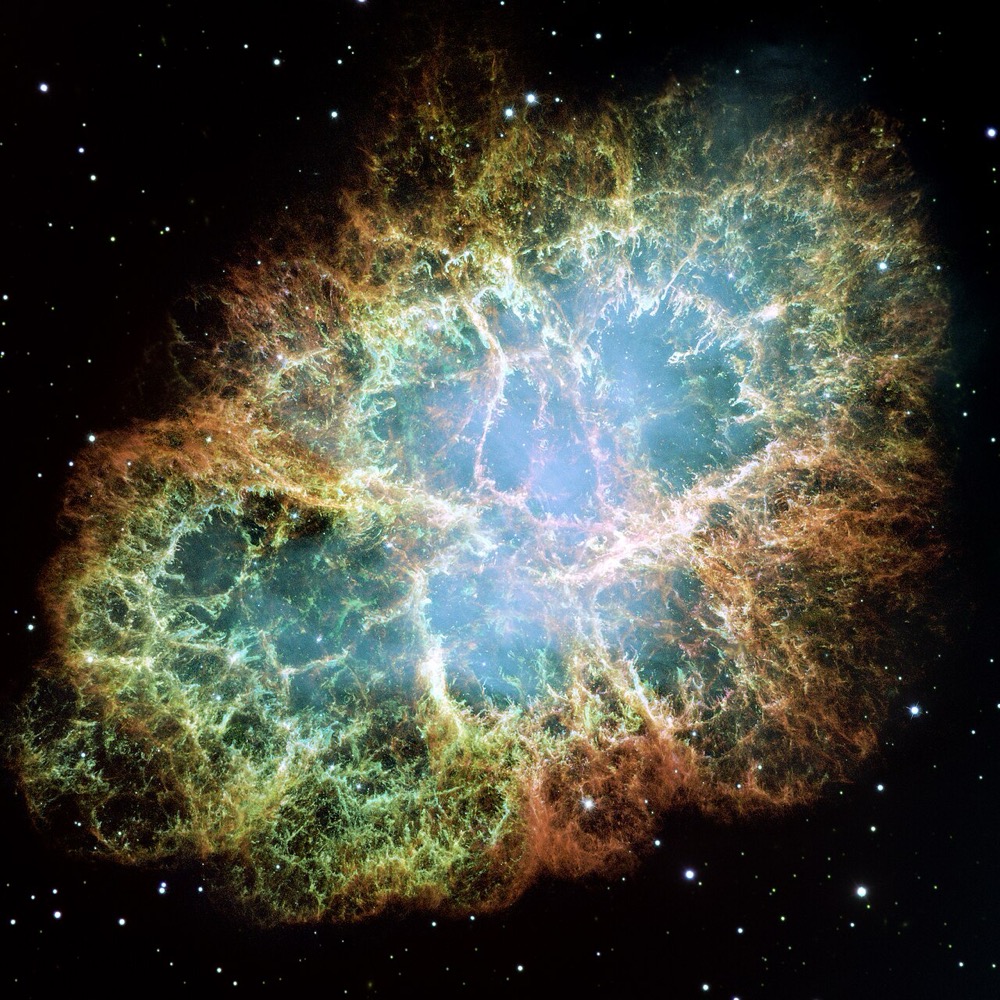
The Crab Nebula is the remnant of which kind of event?
A nova in 1572
A planetary nebula
A core-collapse supernova observed in 1054 AD
A Type Ia supernova from 1604
Chinese astronomers recorded a "guest star" in 1054. At the Crab's center is a pulsar.
What limit sets the maximum mass of a white dwarf?
About 0.08 solar masses
About 1.4 solar masses
About 20 solar masses
About 8 solar masses
The Chandrasekhar limit: above it electron degeneracy pressure cannot resist gravity. 0.08 is the limit for hydrogen fusion; roughly 8 is the threshold for core-collapse supernovae.
Why does fusion in a massive star end with iron?
Iron is the lightest element that can fuse
All remaining nuclei become radioactive
Fusing iron consumes energy instead of releasing it
The core becomes too cold
Iron-56 sits at the peak of binding energy per nucleon. After the iron core builds up, no energy supply is left to oppose gravity, and the core collapses.
What is the Schwarzschild radius of a black hole with the mass of the Sun?
About 30 km
About 3 km
About 3 m
About 3,000 km
R_s = 2GM/c^2 = about 2.95 km. The Sun is not dense enough to be a black hole, but a stellar remnant of that mass would be tiny.
Which observation first showed pulsars to be rotating neutron stars?
Gravitational waves detected by LIGO
The Crab Nebula's expansion rate
Extremely regular radio pulses discovered by Jocelyn Bell in 1967
The detection of neutrinos from SN 1987A
The pulses were too fast and too regular for a pulsating star, pointing to a rapidly rotating compact object, a neutron star.
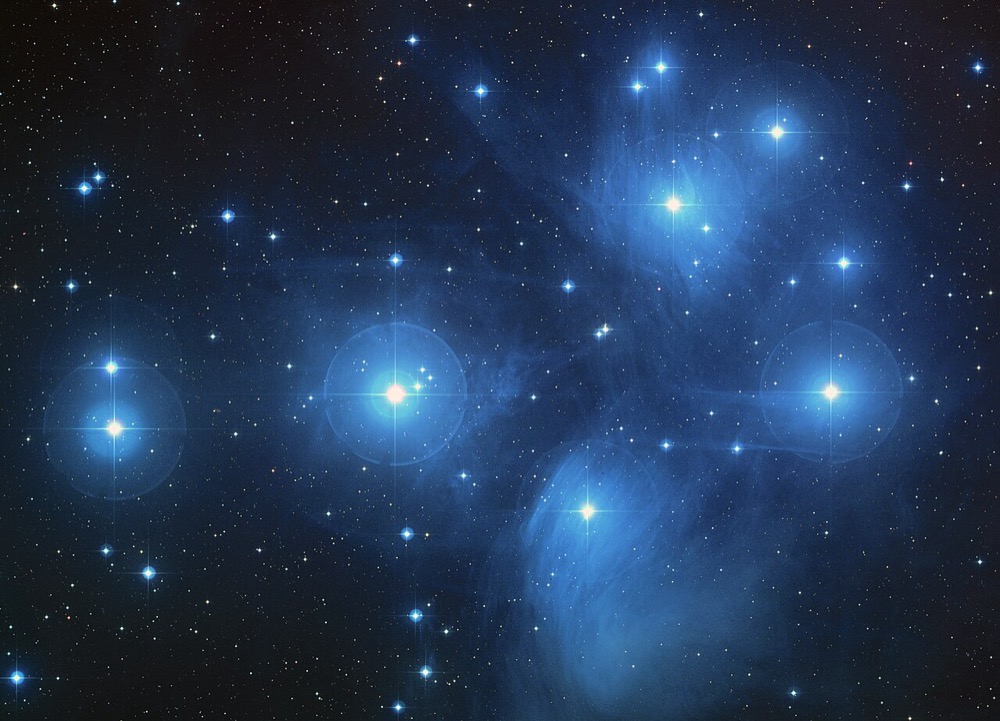
Which pairing of cluster type and age is correct?
Open clusters are older than globular clusters
Globular clusters are old (about 12 billion years); open clusters like the Pleiades are young
Globular clusters form only in the galactic disk
Both types are about 12 billion years old
The Pleiades is about 100 million years old, while globular clusters in the halo are among the oldest objects in the Milky Way.
Which statement about the Orion Nebula is true?
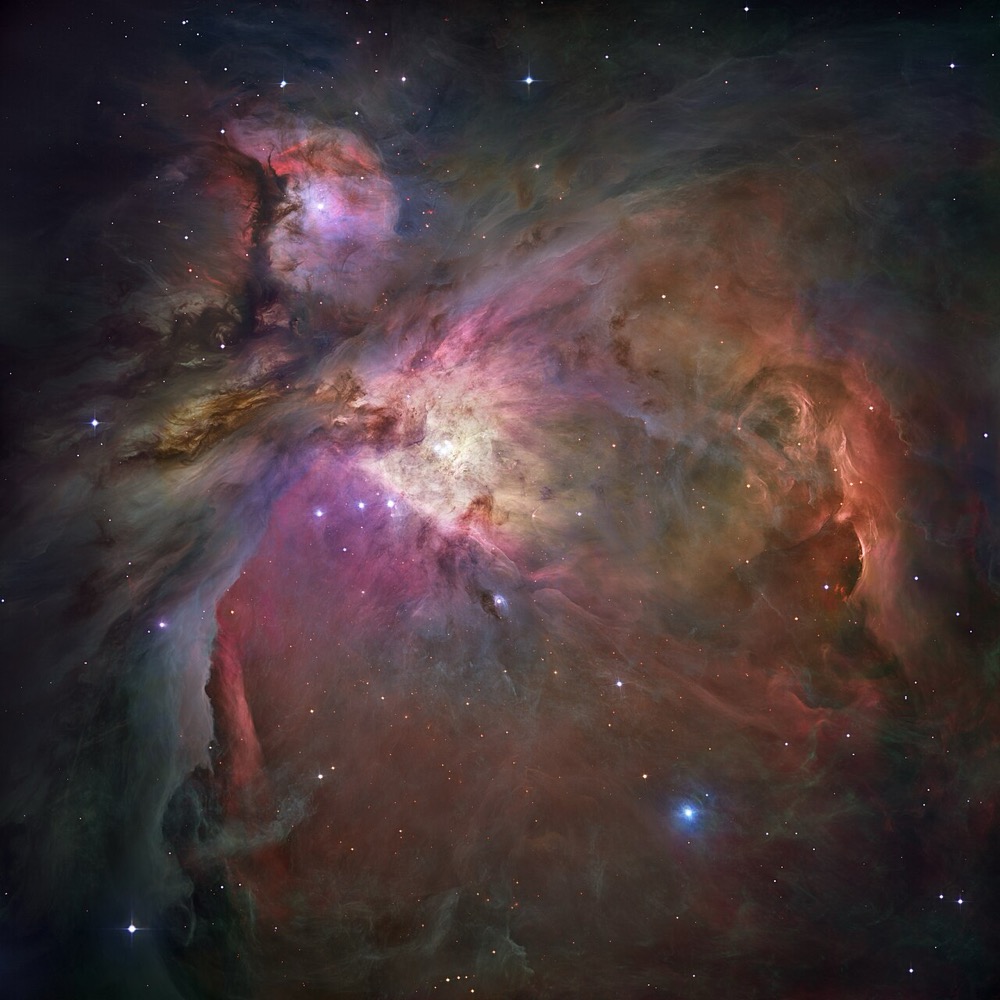
It contains only old red giants
Hot young stars are illuminating gas in an active star-forming region
It is a supernova remnant
It is a galaxy outside the Milky Way
It is an HII region, glowing as young massive stars ionize the surrounding hydrogen. Protostars and protoplanetary disks have been imaged there.
Which method gives accurate distances to nearby stars directly with geometry, no assumptions about luminosity?
Stellar parallax
Cepheid period-luminosity relation
Redshift
Main-sequence fitting
Parallax is pure trigonometry using Earth's orbit as the baseline. The others depend on calibrations from known luminosities.
What is a Cepheid variable useful for?
Determining a cluster's age
Measuring a star's mass directly
Measuring distances, because its pulsation period tells its luminosity
Measuring a star's temperature
Henrietta Leavitt found that longer-period Cepheids are more luminous. Comparing luminosity with apparent brightness gives the distance.
A white dwarf is supported against gravity by ongoing nuclear fusion.
True
False
White dwarfs no longer fuse; they are held up by electron degeneracy pressure and slowly cool.
A binary system has stars separated by 2 AU with an orbital period of 1 year. What is their combined mass?
8 solar masses
1 solar mass
4 solar masses
2 solar masses
M1 + M2 = a^3/P^2 = 8/1 = 8. Using a rather than a^3 would give the tempting but wrong result of 2.
Which feature distinguishes Type Ia from Type II supernovae?
Type Ia spectra lack hydrogen and come from an exploding white dwarf
Type II always leaves a white dwarf
Type II happens only in binary systems
Type Ia involves the collapse of a massive star's iron core
A Type Ia is a thermonuclear explosion of a white dwarf near 1.4 solar masses. Type II is core collapse and leaves a neutron star or black hole.
