Quiz · Hard
Applied questions: radiative forcing and sensitivity calculations, unit conversions, interpreting the energy budget and graphs, feedbacks, carbon budgets and policy analysis.
Atmospheric CO2 rises from 280 ppm to 560 ppm. Using , what is the radiative forcing?
About 5.35 W/m2
About 3.7 W/m2
About 1.9 W/m2
About 7.4 W/m2
W/m2. Using ln of the ratio, not the difference (280), is the key; 5.35 alone would be for e-fold increases, not doubling.
An emissions inventory reports 10 GtC released in a year. How many GtCO2 is that?
2.7 GtCO2
36.7 GtCO2
12 GtCO2
44 GtCO2
Multiply by 44/12 = 3.67: . Dividing would give 2.7. The molar mass ratio is CO2 (44) to C (12).
If the global climate sensitivity is 3 degrees C per doubling of CO2, and CO2 is 420 ppm versus 280 ppm pre-industrial, which estimate of equilibrium warming from CO2 alone is closest?
About 3 degrees C
About 0.5 degrees C
About 5 degrees C
About 1.8 degrees C
Warming scales with the log of concentration: degrees C. Actual observed warming is lower (about 1.1 to 1.2 degrees C) because the ocean delays warming and aerosols mask some of it; equilibrium would eventually be higher.
A graph shows global temperature rising 1 degree C while solar irradiance has been flat since 1985. What conclusion is best supported?
The Sun cannot explain the recent warming trend.
The Sun is the main driver of recent warming.
CO2 has no role in the warming.
The measurements must be wrong.
If solar output is flat but temperature rises, solar variation cannot explain the trend. Other lines of evidence (stratospheric cooling, isotope signatures) point to greenhouse gases.
Stratospheric temperatures have fallen while lower atmosphere temperatures have risen. Why does this favor greenhouse gases over solar changes?
Greenhouse gases heat the stratosphere directly.
The Sun heats only the stratosphere.
More heat is trapped below, so less reaches the stratosphere, whereas a brighter Sun would warm both layers.
Ozone depletion warms the troposphere.
A rise in solar output would warm the whole atmosphere, but greenhouse gas build-up traps heat near the surface and reduces the infrared reaching the stratosphere, which cools. This 'fingerprint' matches observations.
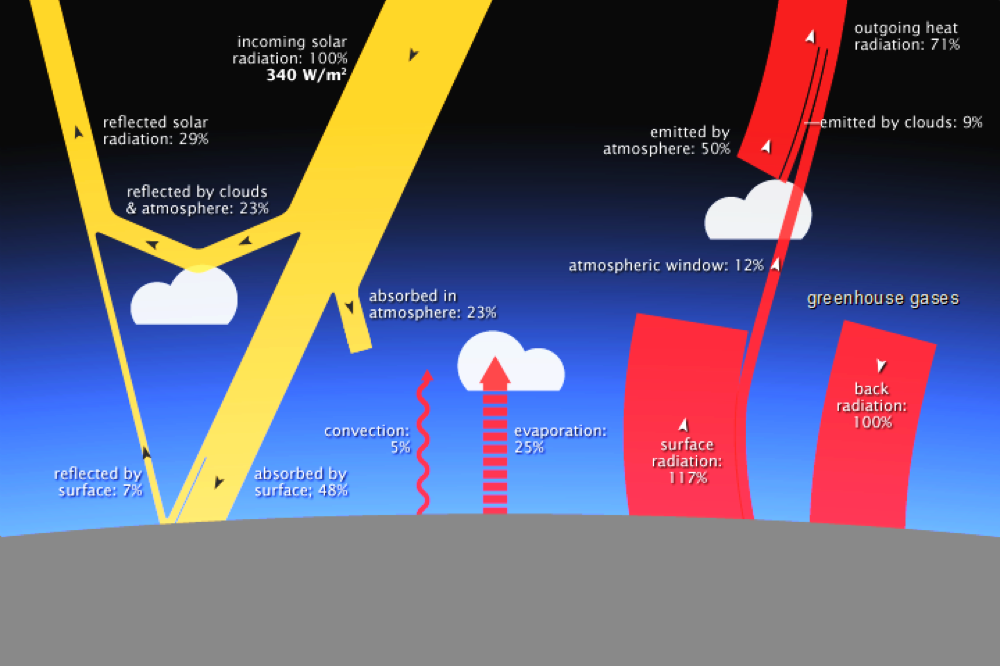
In the Earth energy budget diagram, sunlight absorbed by Earth is 71 percent of incoming. The surface radiates 117 percent while only 48 percent is absorbed there. Where does the extra 69 percent come from?
From geothermal heat flowing out of Earth's interior
From sunlight reflected by clouds back to the surface
From greenhouse gas back radiation (downward infrared from the atmosphere)
From ultraviolet radiation absorbed by the ozone layer
The surface is warmed by the Sun (48%) and by downward infrared from the atmosphere (back radiation, about 100%), minus losses from convection and evaporation. Without back radiation the surface would be much cooler.
A country halves its coal use but doubles its natural gas use for electricity, which has leaks of 3 percent. Which analysis is the most complete?
Gas burns cleaner than coal in CO2 terms, but methane leakage can erode the benefit, so leak rates matter.
Gas has no climate impact because it is a 'clean' fuel.
The change has no effect because both are fossil fuels.
Methane is not a greenhouse gas.
Combustion of gas emits about half the CO2 of coal per unit of energy, but methane, the main component, is a potent greenhouse gas, so upstream leakage must be counted.
A farmer wants to reduce emissions per kg of rice. Which change addresses the main greenhouse gas from flooded paddies?
Burning rice straw
Using more nitrogen fertilizer
Planting a monoculture
Draining paddies periodically (alternate wetting and drying)
Flooded paddies produce methane from anaerobic decomposition; periodic drying reduces methane. Burning straw releases CO2 and soot, and extra nitrogen fertilizer raises N2O.
Sea level rise projected for 2100 is much larger under high emissions than low emissions. Which factor mostly explains the difference after 2100?
Melting of floating sea ice
Ice sheet loss from Greenland and Antarctica continues for centuries as the ocean and ice respond slowly.
Changes in ocean salinity alone
Lower evaporation from the oceans
Thermal expansion and ice sheet melt respond slowly, so sea level continues to rise for centuries even after emissions fall. Melting sea ice contributes little.
A climate model includes only the ice-albedo feedback (positive) but ignores clouds. Which statement is correct about uncertainty?
Clouds have no effect on climate.
Cloud feedback is the largest source of uncertainty in climate sensitivity, so ignoring it would weaken the projection.
Cloud feedback has been precisely known since the 1980s.
Clouds only matter at night.
High clouds trap heat and low clouds reflect sunlight, and how cloud cover changes in a warmer world is the biggest source of spread in sensitivity estimates.
Permafrost carbon feedback: which sequence is correct?
Warming -> permafrost thickens -> carbon stored -> cooling
Warming -> permafrost thaws -> ocean absorbs the carbon -> cooling
Cooling -> permafrost thaws -> CO2 released
Warming -> permafrost thaws -> microbes decompose carbon -> CO2 and CH4 released -> more warming
Thawing exposes frozen organic matter to microbes. It is a positive feedback, adding to warming.
The remaining carbon budget for a 50 percent chance of 1.5 degrees C shrinks every year. Why?
Because cumulative CO2 emissions are what drive warming, each tonne emitted uses up part of the budget.
Because the Sun is getting brighter.
Because the target changes yearly.
Because CO2 disappears from the atmosphere within a decade.
Warming is roughly proportional to cumulative CO2 emissions. Each year of emissions consumes budget. CO2 persists for centuries, and the target stays fixed at 1.5 degrees C.
A city adds trees, parks and cool roofs. Which two impacts is this mostly addressing?
Ozone depletion and sea level rise
Ocean acidification and volcanic activity
Urban heat and flood risk
Methane leaks and nuclear waste
Vegetation shades surfaces and cools by evapotranspiration, lowering the heat island effect, and green spaces absorb stormwater, reducing flooding. These are adaptation measures.
Which policy would most directly make polluters bear the cost of emissions while leaving them free to choose how to cut?
A ban on all vehicles
A subsidy for fossil fuel exploration
A carbon price (tax or emission trading)
A voluntary recycling program
Carbon pricing internalizes the external cost of emissions (a market-based instrument) without prescribing how to reduce them. Subsidizing fossil fuels does the opposite.
Which statement about historical and current emissions is correct?
The US has the largest cumulative emissions, while China currently has the largest annual emissions.
India has the largest cumulative emissions.
Per-person emissions are highest in the least developed countries.
The EU has the largest annual emissions.
Cumulative emissions since 1850 are largest for the US, then China and the EU. China has been the largest annual emitter since about 2006. Per person, high-income and oil-producing countries have the highest emissions.
