Quiz · Medium
Foundational questions on major transmitters, their receptors, synthesis, brain pathways and common drug mechanisms.
Why do SSRIs take weeks to relieve depression even though serotonin levels rise within hours?
They need to be converted to an active metabolite
Longer-term adaptations (receptor desensitization, plasticity) are probably needed
They have a slow absorption
Serotonin cannot reach its receptors for weeks
The delay suggests that downstream adaptations, not just raised serotonin, drive recovery.
Which structure is marked D in the diagram?
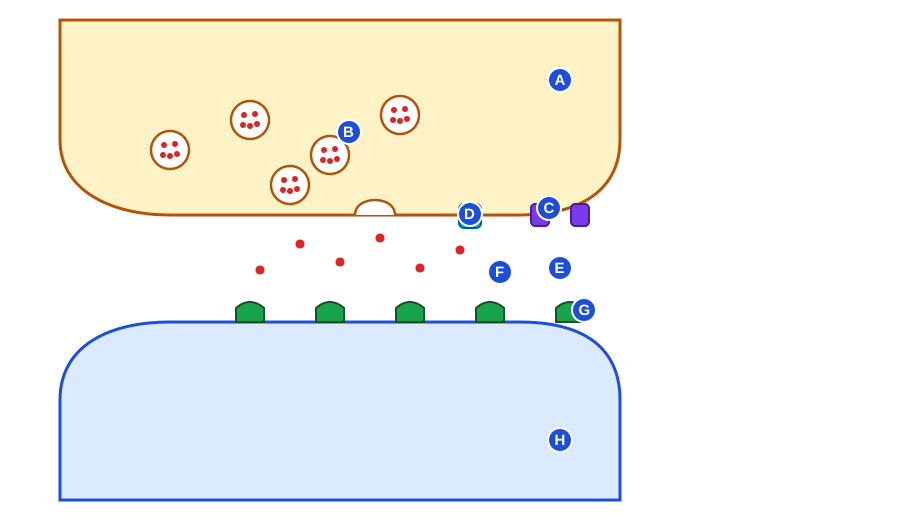
Reuptake transporter (the target of SSRIs)
Synaptic vesicle
Voltage-gated Ca2+ channel
Ionotropic receptor
SSRIs block the serotonin transporter, so serotonin stays in the cleft longer.
Which structure is marked G in the diagram?
Reuptake transporter
Synaptic vesicle
Presynaptic Ca2+ channel
Postsynaptic receptor
Postsynaptic receptors bind transmitter; ionotropic ones are channels, metabotropic ones are GPCRs.
Which neurotransmitter is the main excitatory transmitter in the brain?
Glycine
Serotonin
Glutamate
GABA
GABA is the main inhibitory transmitter in the brain; glycine is the main one in the spinal cord.
Which enzyme is rate-limiting in the synthesis of catecholamines?
Monoamine oxidase
Tyrosine hydroxylase
Dopamine beta-hydroxylase
DOPA decarboxylase
Tyrosine hydroxylase converts tyrosine to L-DOPA. DOPA decarboxylase works quickly and is not limiting; MAO breaks transmitters down.
Which transmitter is made from the amino acid tryptophan?
GABA
Serotonin
Norepinephrine
Dopamine
Dopamine and norepinephrine come from tyrosine; GABA comes from glutamate.
L-DOPA rather than dopamine is given for Parkinson's disease because...
L-DOPA crosses the blood-brain barrier and dopamine does not
L-DOPA blocks MAO
Dopamine is toxic to neurons
Dopamine is not made from L-DOPA
Once in the brain, L-DOPA is decarboxylated into dopamine. Carbidopa prevents peripheral conversion.
Which dopamine pathway is most associated with reward and addiction?
Tuberoinfundibular
Mesocortical only
Nigrostriatal
Mesolimbic (VTA to nucleus accumbens)
Nigrostriatal handles movement, and the tuberoinfundibular pathway controls prolactin.
Antipsychotic drugs raise prolactin levels by blocking D2 receptors in which pathway?
Mesolimbic
Mesocortical
Tuberoinfundibular
Nigrostriatal
Dopamine normally inhibits prolactin release from the anterior pituitary.
Which group of neurons is the main source of norepinephrine in the brain?
Raphe nuclei
Substantia nigra
Locus coeruleus
Nucleus basalis
The locus coeruleus in the pons controls arousal and attention.
Raphe nuclei neurons release which transmitter?
Dopamine
Serotonin
Histamine
Acetylcholine
Histamine comes from the tuberomammillary nucleus, ACh from basal forebrain and brainstem nuclei.
How does GABA-A receptor activation affect a neuron?
Cl- influx hyperpolarizes (inhibits) it
K+ efflux through a GPCR only
Na+ influx depolarizes it
Ca2+ influx triggers release
GABA-A is an ionotropic Cl- channel. GABA-B opens K+ channels via G proteins.
Benzodiazepines act by...
Activating GABA-B receptors
Blocking GABA reuptake
Blocking glutamate NMDA receptors
Increasing the frequency of GABA-A channel opening
They are positive allosteric modulators needing GABA. Barbiturates increase the duration of opening.
Which drug class directly prevents the breakdown of ACh?
SSRIs
COMT inhibitors
MAO inhibitors
Cholinesterase inhibitors
Donepezil and organophosphates inhibit AChE; MAOIs act on monoamines.
Which receptor is the only ionotropic serotonin receptor?
5-HT1A
5-HT7
5-HT3
5-HT2A
All other 5-HT receptors are G-protein-coupled.
Which drug combination risks serotonin syndrome?
An SSRI with an MAOI
An SSRI with an antihistamine
L-DOPA with carbidopa
Benzodiazepine with alcohol
Blocking both reuptake and breakdown of serotonin can overload the system: hyperthermia, clonus, agitation.
Which is a typical effect of mu-opioid receptor agonists?
Respiratory depression and miosis
Hyperventilation
Diarrhea
Mydriasis and tachycardia
Opioids cause pinpoint pupils and constipation. Naloxone reverses the effects.
Which drug blocks adenosine receptors?
Cocaine
Nicotine
Alcohol
Caffeine
Caffeine counteracts adenosine's sleep-promoting signal.
Amphetamine increases dopamine in the synapse primarily by...
Inhibiting dopamine synthesis
Activating autoreceptors
Reversing the dopamine transporter and releasing dopamine
Blocking dopamine receptors
Methylphenidate and cocaine instead block reuptake.
What is the primary action of cocaine?
Activates nicotinic receptors
Blocks reuptake of dopamine, norepinephrine and serotonin
Activates opioid receptors
Blocks GABA-A
This raises synaptic monoamines, especially dopamine in the nucleus accumbens.
Strychnine causes convulsions by blocking which receptor?
NMDA receptor
Glycine receptor
Nicotinic receptor
GABA-B receptor
Without glycine inhibition in the spinal cord, motor neurons fire excessively.
Which is TRUE of neuropeptides?
They are made in the soma and released with high-frequency firing
They are synthesized in the terminal
They are cleared by reuptake
They act only on ion channels
Neuropeptides are cleaved from precursors and degraded by peptidases; they usually act on GPCRs.
True or false: the effect of a neurotransmitter is determined by the transmitter alone.
True
False
The receptor determines the effect: ACh excites skeletal muscle via nicotinic receptors but slows the heart via M2 receptors.
True or false: dopamine, norepinephrine and epinephrine are all catecholamines.
True
False
They share the catechol ring and tyrosine-derived synthesis; serotonin and histamine are monoamines but not catecholamines.
