Quiz · Medium
Questions on atmospheric layers, humidity, cloud identification, pressure and winds, fronts, thunderstorms, tornadoes and hurricanes, with photo and diagram questions.
In which layer of the atmosphere does nearly all weather occur?
Stratosphere
Troposphere
Mesosphere
Thermosphere
The troposphere contains about three quarters of the atmosphere's mass and nearly all water vapor, so clouds and storms form there. Above it, the stratosphere is stable and dry.
A front brings thunderstorms, a sharp temperature drop and a wind shift from southwest to northwest. It is a:
Warm front
Stationary front
Cold front
Occluded front
Cold, dense air pushes under warm air on a steep slope, causing a narrow band of storms followed by cooler, drier air.
Why does temperature increase with height in the stratosphere?
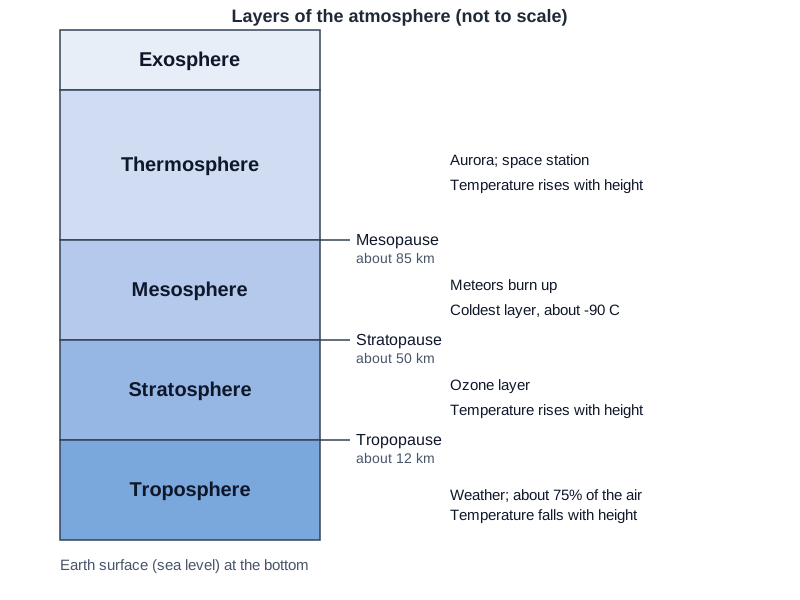
Ozone absorbs ultraviolet radiation and heats the layer
The ground is hotter there
Air pressure increases
Clouds trap heat
Ozone converts UV energy to heat. In the troposphere temperature falls with height because the ground, not the air, is heated first.
Relative humidity of an air parcel at constant moisture will increase when:
The air warms
The pressure is increased and temperature stays the same
The dew point falls
The air cools
Cooler air can hold less vapor, so the same amount of vapor is a larger percentage of capacity. At the dew point, relative humidity reaches 100%.
The air temperature is 18 °C and the dew point is 18 °C. What is most likely?
It is a very dry day
The air is unsaturated with 50% humidity
Fog or dew is forming, relative humidity is 100%
Rain must be falling
When the temperature equals the dew point, the air is saturated, so condensation (dew, fog or cloud) occurs, though not necessarily rain.
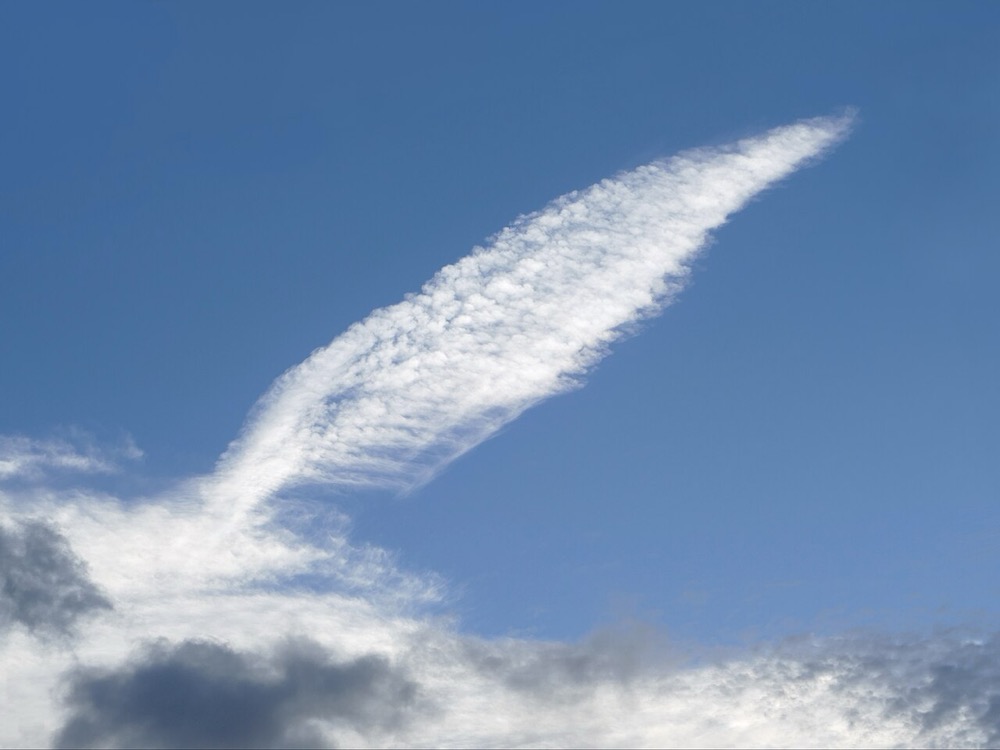
Which is the cloud shown, a thin, wispy, high-altitude cloud made of ice crystals?
Stratus
Cirrus
Cumulus
Nimbostratus
Cirrus clouds form above about 6 km. Stratus is a low, gray sheet; cumulus is a puffy fair-weather cloud; nimbostratus is a thick, rain-producing layer.
Image: W.carter, CC0, via Wikimedia Commons.
What cloud type is the large tower with an anvil top?
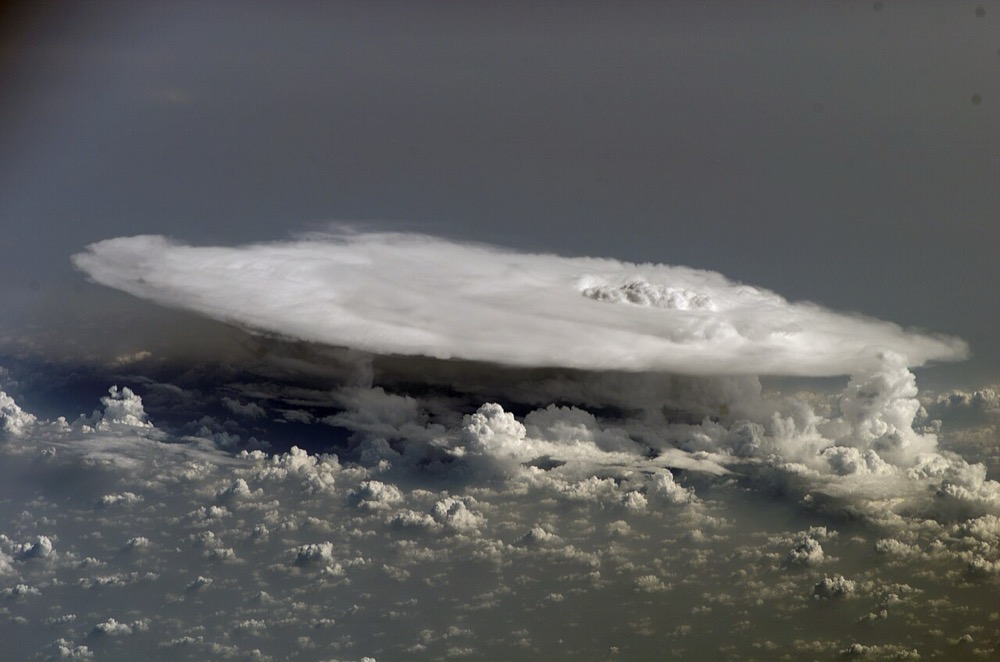
Cumulonimbus
Altocumulus
Cirrostratus
Stratocumulus
The anvil spreads out when the updraft reaches the tropopause. Cumulonimbus clouds produce thunderstorms, hail and heavy rain.
Image: NASA, Public domain, via Wikimedia Commons.
Which cloud type is most likely associated with steady, widespread rain or snow ahead of a warm front?
Cumulus
Cirrus
Lenticular
Nimbostratus
A warm front lifts warm air gradually, producing a thick gray layer of nimbostratus. Cumulus is a fair-weather cloud, and lenticular clouds form over mountains.
What is the main reason the Great Basin and Death Valley are so dry?
They are near the equator
They are on the windward side of mountains
Rain-shadow effect of the Sierra Nevada
The ocean is too far away to evaporate water
Moist Pacific air loses its moisture as it rises up the western slope of the Sierra Nevada, then descends dry and warm on the leeward side.
In the Northern Hemisphere, winds around a surface low-pressure system flow:
Clockwise and inward
Counterclockwise and inward
Clockwise and outward
Counterclockwise and outward
Pressure gradient force pulls air inward, and Coriolis deflection to the right gives counterclockwise rotation. High pressure is the opposite.
Which pair gives the correct names for the circulation cells shown at 0-30 degrees and 60-90 degrees latitude?
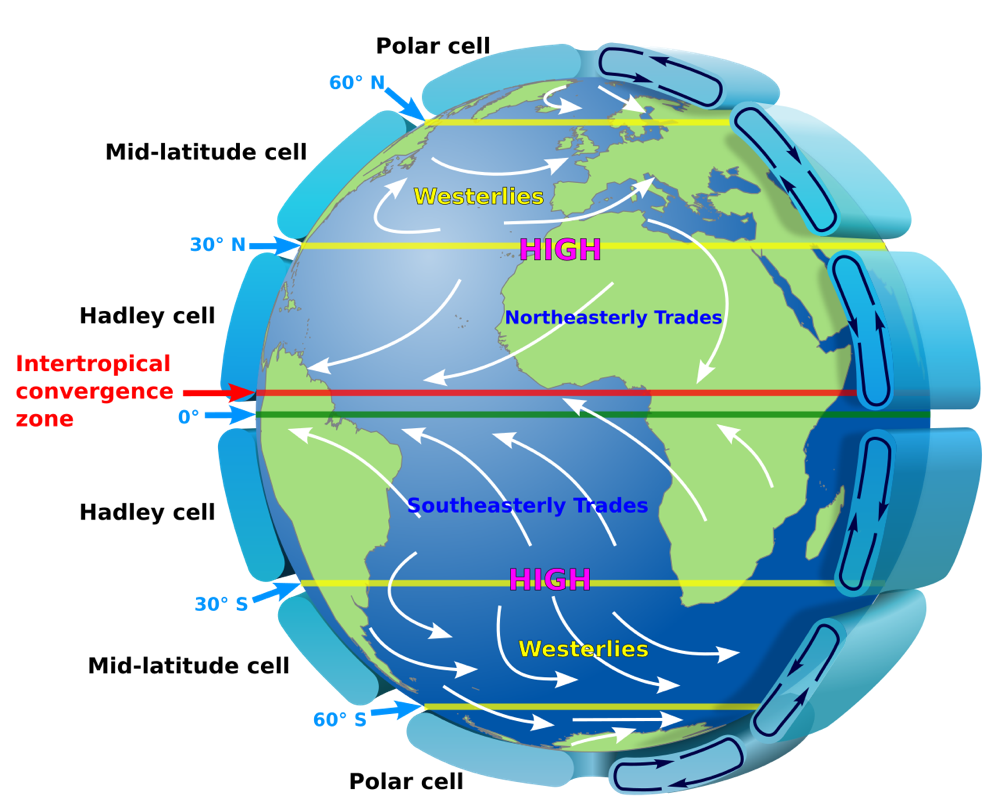
Hadley cell and polar cell
Ferrel cell and Hadley cell
Polar cell and Ferrel cell
Hadley cell and Ferrel cell
Hadley cells lie between the equator and about 30°, Ferrel (mid-latitude) cells between 30° and 60°, and polar cells poleward of 60°.
Image: Kaidor, CC BY-SA 3.0, via Wikimedia Commons.
Most of the world's hot deserts lie near 30 degrees latitude because:
Air rises there and cools
Trade winds bring moisture
Ocean currents are cold
Air sinks and warms in the descending branch of the Hadley cell
Sinking air is compressed and warmed, so its relative humidity drops and clouds disappear. Rising air near the equator makes the rain belt.
In the cross sections, how does the cold front (left) differ from the warm front (right)?
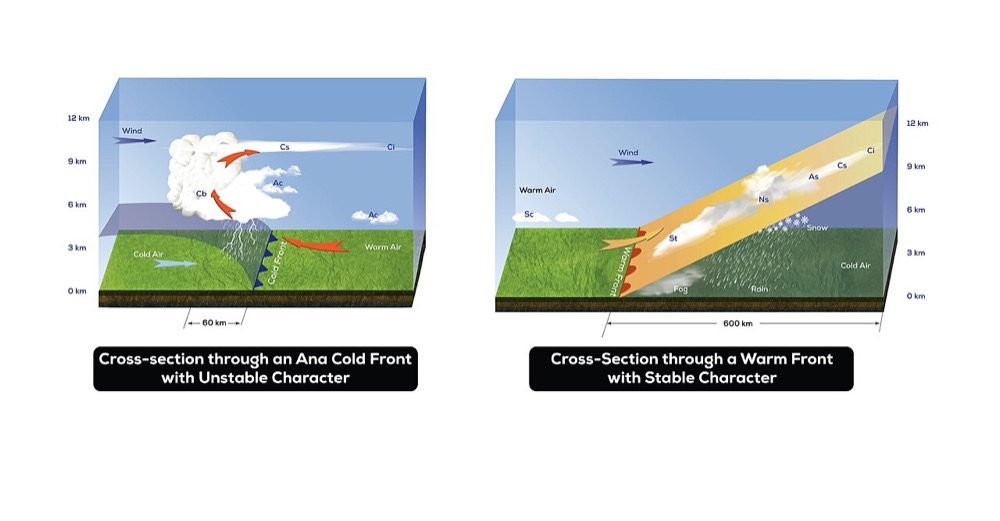
The cold front has a gentle slope and layered clouds
The cold front has a steeper slope and more intense, narrower rain
Both have the same slope
The warm front has the steeper slope
Cold fronts are steep (about 1:50-1:100) with cumulonimbus clouds. Warm fronts have a gentle slope (about 1:200) with layered clouds and steady rain.
Image: Kh1604, CC BY-SA 4.0, via Wikimedia Commons.
Which three ingredients are necessary for thunderstorm development?
Moisture, instability and lift
Cold air, wind shear and high pressure
Dry air, a front and low humidity
Moisture, high pressure and stable air
Warm, moist air must be lifted into an unstable environment. Wind shear additionally organizes severe storms such as supercells.
What is the defining feature of a supercell thunderstorm?
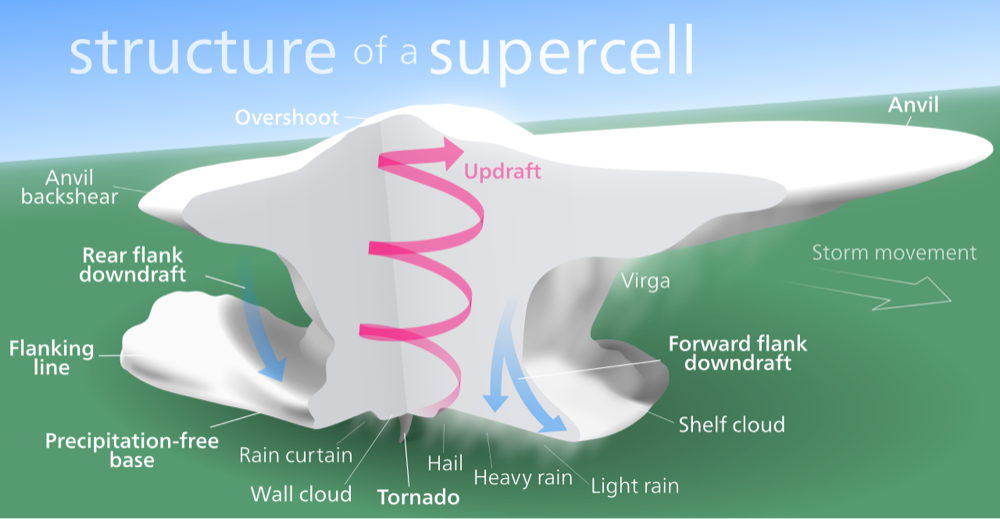
A line of storms along a cold front
Having no lightning
Being less than 10 km wide
A persistent rotating updraft (mesocyclone)
Supercells form in strong wind shear and rotate. They produce the largest hail and the strongest tornadoes.
Image: Kelvinsong, CC BY-SA 3.0, via Wikimedia Commons.
A tornado with winds estimated at 150 mph would be rated on the Enhanced Fujita scale as:
EF1
EF2
EF3
EF5
EF3 covers 136-165 mph. EF2 is 111-135 mph, and EF5 is above 200 mph.
You see lightning and count 15 seconds before the thunder. About how far away is the strike?
15 miles
3 miles (about 5 km)
1 mile
30 miles
Sound travels about 1 mile in 5 seconds (or 1 km in 3 seconds). Light arrives essentially instantly.
Which of the following is NOT required for a tropical cyclone to form?
A cold ocean surface
Warm sea surface (at least about 26.5 °C)
Low wind shear
A location at least a few degrees from the equator
Tropical cyclones are fueled by evaporation from warm water. Without the Coriolis effect near the equator, the storm cannot rotate.
In the satellite image, what is the calm, clear center of the hurricane called?
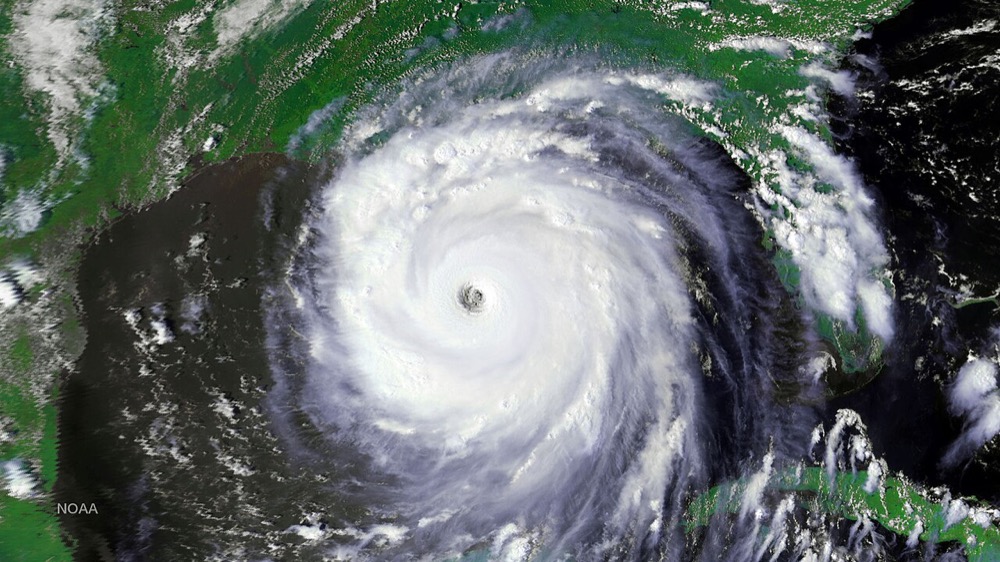
The eyewall
The rainband
The outflow
The eye
The eye has sinking air and light winds. The eyewall around it has the strongest winds and heaviest rain.
Image: NOAA, Public domain, via Wikimedia Commons.
Which hurricane hazard is responsible for the most deaths historically?
Wind gusts
Hail
Storm surge
Lightning
Surge floods coastal areas rapidly, and rainfall flooding often kills inland. Wind causes damage but fewer deaths.
The instrument shown measures:
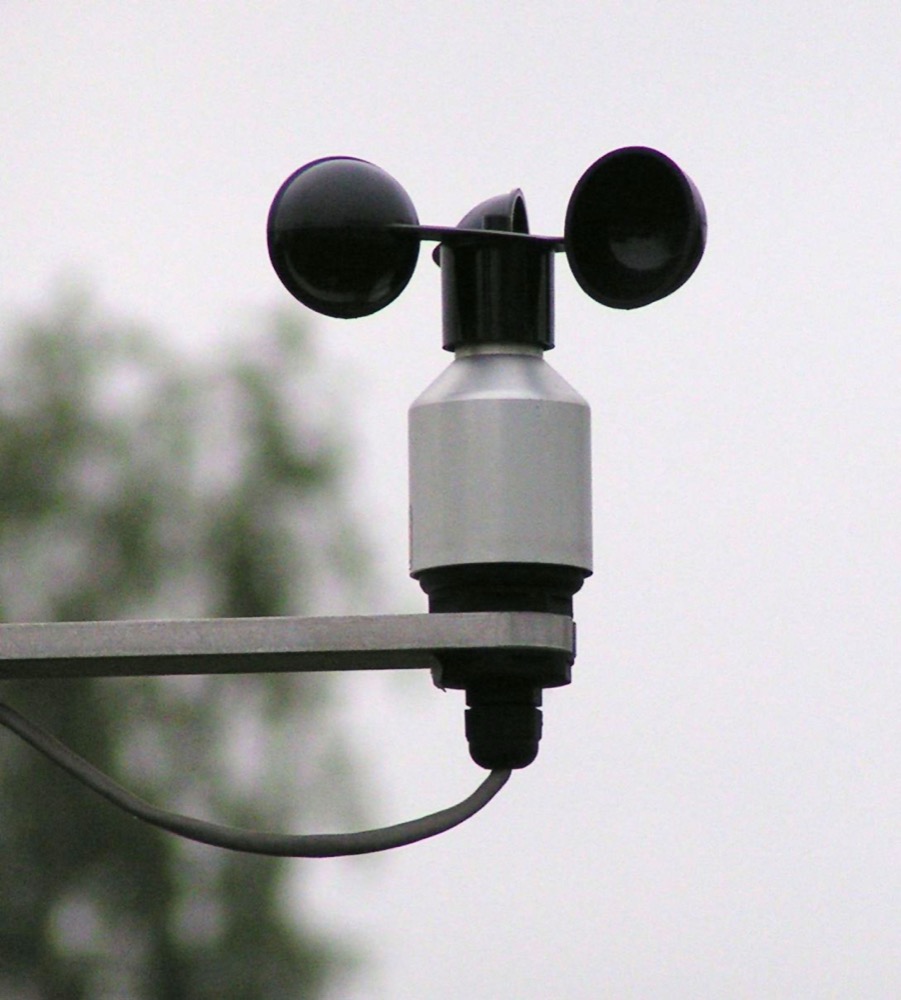
Wind direction
Wind speed
Humidity
Air pressure
A cup anemometer rotates faster in stronger wind. A wind vane shows direction; a hygrometer measures humidity; a barometer measures pressure.
Image: Stefan Kühn, CC BY 3.0, via Wikimedia Commons.
A Stevenson screen is painted white and has louvers in order to:
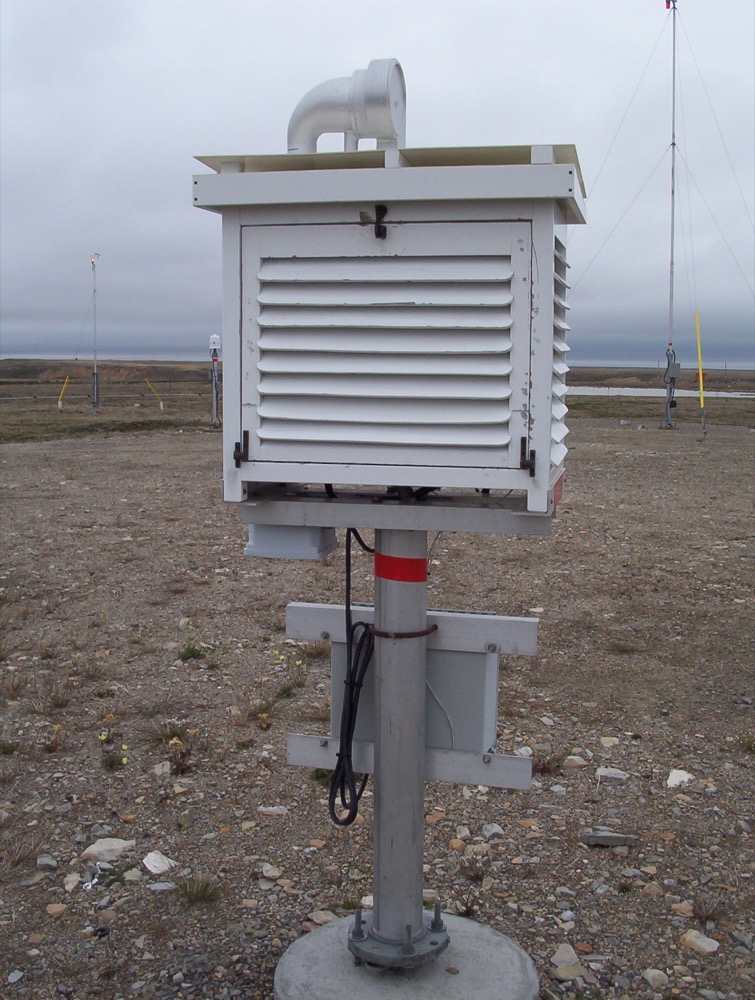
Shield the thermometer from direct sunlight while allowing air to flow through
Keep the thermometer warm
Prevent wind from entering
Attract rain
Instruments must measure air temperature in the shade with free ventilation. A closed black box would heat up and give a false reading.
Image: unknown, Public domain, via Wikimedia Commons.
True or false: A high-pressure system usually brings cloudy, wet weather.
True
False
High pressure means sinking air, which warms and dries as it descends, so skies are usually clear. Low pressure brings rising air and clouds.
