Quiz · Hard
Applied multi-step questions: calorie math, glycemic load, protein needs, malabsorption cases and deficiency diseases.
A 70 kg adult follows the RDA for protein. How many grams of protein per day is this?
56 g
35 g
70 g
112 g
0.8 g/kg × 70 kg = 56 g. 70 g would be 1.0 g/kg; 112 g would be 1.6 g/kg.
A food label shows 3 g fat, 20 g carbohydrate (4 g fiber), and 5 g protein. Using 4-4-9 and ignoring fiber's different energy, about how many kcal per serving?
107
127
147
180
20×4 = 80, 5×4 = 20, 3×9 = 27; total 127 kcal.
A food provides 200 kcal with 8 g of fat. What percent of calories come from fat?
8%
24%
36%
72%
8 g × 9 = 72 kcal; 72/200 = 36%. 8% is a mistake using grams; 72% forgets to divide by total calories.
A food has a GI of 80 and 15 g of available carbohydrate per serving. What is its glycemic load?
1.2
65
95
12
GL = GI × carbohydrate (g) / 100 = 80 × 15 / 100 = 12 (medium: 11 to 19).
Why does liver glycogen but not muscle glycogen help maintain blood glucose?
Only the liver has glucose-6-phosphatase to release free glucose.
Muscle glycogen is a different molecule
Muscle cells have no glycogen phosphorylase
Insulin blocks muscle glycogen breakdown
Muscle glycogen is the same polymer and is broken down by phosphorylase, but without glucose-6-phosphatase the glucose-6-phosphate stays inside the muscle cell.
A patient has a lactase deficiency. Which sign is most consistent?
Hives and wheezing within minutes of milk
Bloating and watery diarrhea after drinking milk, relieved by lactose-free milk
Fat in the stool after any meal
Jaundice after dairy
Lactose intolerance is non-immune and caused by undigested lactose fermented by colon bacteria. Hives and wheezing suggest milk allergy; steatorrhea suggests fat malabsorption.
Which change in a diet most reliably lowers LDL cholesterol?
Replacing saturated fat with refined carbohydrate
Eating less dietary cholesterol only
Replacing saturated fat with polyunsaturated fat
Adding more medium-chain triglycerides
Substituting unsaturated for saturated fat lowers LDL. Refined carbohydrate does not provide a benefit; dietary cholesterol has a smaller effect; MCTs are mostly saturated.
A child with swollen abdomen, edema and a diet mainly of cassava gruel is most likely suffering from
marasmus
rickets
scurvy
kwashiorkor
Edema, swollen belly and a diet high in starch but low in protein suggest kwashiorkor. Marasmus involves severe wasting without edema.
Why is a diet of only corn (low in lysine and tryptophan) a risk for growth failure?
Lysine is a limiting amino acid in corn.
Corn contains no carbohydrate.
Corn proteins cannot be digested.
Corn lacks all essential fatty acids.
Limiting amino acids restrict protein synthesis even if total protein is adequate. Lysine and tryptophan are low in corn; adding legumes complements it.
Which sequence is the correct pathway of dietary long-chain fat after absorption?
Enterocyte, portal vein, liver, VLDL
Enterocyte re-esterification, chylomicron, lymph, bloodstream
Stomach, lymph, chylomicron, portal vein
Micelle, portal vein, albumin, adipose
Long-chain fats become triglycerides in enterocytes, are packaged into chylomicrons and enter the lymph (thoracic duct) before reaching the blood. Short- and medium-chain fats use the portal vein.
A runner eats 60 g of protein, 330 g of carbohydrate and 70 g of fat. About what percent of calories come from carbohydrate?
About 40%
About 75%
About 60%
About 30%
Protein 60×4 = 240; carbohydrate 330×4 = 1,320; fat 70×9 = 630; total 2,190 kcal. 1,320/2,190 = 60%. A common error is to compare grams instead of kilocalories.
Which finding would indicate a positive nitrogen balance?
A burn patient losing more nitrogen than intake
A fasting person after 3 days
A person eating no protein
A pregnant woman excreting less nitrogen than she consumes
Positive balance means retention of nitrogen for tissue building (growth, pregnancy, recovery). Burns, fasting and low intake produce negative balance.
Which statement best explains why ketone bodies protect protein during prolonged fasting?
The brain shifts to using ketones, reducing the need for gluconeogenesis from amino acids.
Ketones are converted to amino acids.
Ketones inhibit all urea production.
Ketones are used only by red blood cells.
Ketones reduce brain glucose requirement so muscle protein is spared. Red blood cells cannot use ketones; ketones are not converted to amino acids.
Which food swap increases trans fat intake?
Using olive oil in place of butter
Using shortening made with partially hydrogenated oil in place of butter
Using canola oil in place of lard
Eating fish in place of beef
Partial hydrogenation creates trans double bonds; many countries restrict it. The other swaps reduce saturated fat.
In the amino acid diagram, which feature distinguishes one amino acid from another?
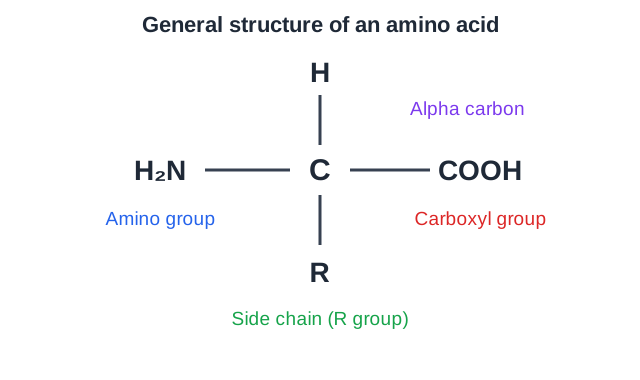
The amino group
The carboxyl group
The side chain (R group)
The alpha carbon
All amino acids share the amino group, carboxyl group, hydrogen and alpha carbon. The R group is unique.
