Quiz · Medium
Foundational questions on safe temperatures, bacterial pathogens, preservation methods and cooking chemistry.
What is the safe minimum internal temperature for cooked poultry?
165 °F (74 °C)
145 °F (63 °C)
155 °F (68 °C)
180 °F (82 °C)
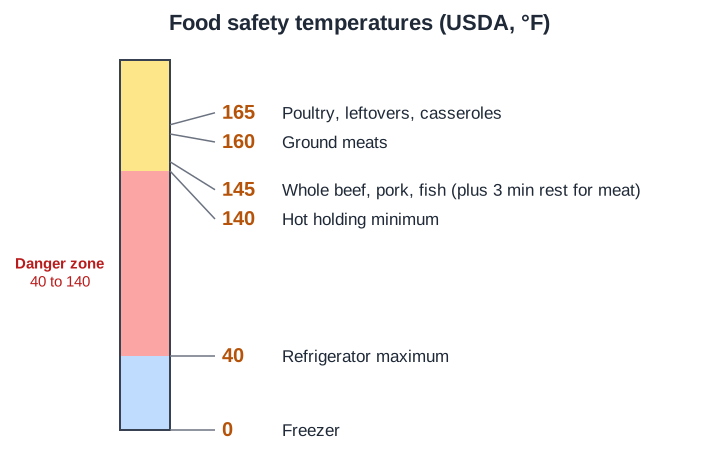
Poultry needs 165 °F. 145 °F is for whole cuts of beef, pork and fish.
What is the safe minimum internal temperature for ground beef?
145 °F
160 °F (71 °C)
165 °F
135 °F
Grinding mixes surface bacteria throughout, so it needs 160 °F. Whole beef steaks are 145 °F.
The temperature danger zone for bacterial growth is:
0 to 32 °F
140 to 200 °F
40 to 140 °F
90 to 120 °F only
Bacteria multiply fastest between 40 and 140 °F (4 to 60 °C).
Which reaction browns seared meat and bread crust?
Gelatinization
Retrogradation
Emulsification
Maillard reaction
Maillard involves amino acids and reducing sugars. Caramelization involves sugar alone.
Which statement about the pH 4.6 value is correct?
Foods above pH 4.6 are low-acid and need pressure canning
Foods below 4.6 need pressure canning
It is the pH of milk pasteurization
It is the minimum pH for yeast
C. botulinum spores can grow in low-acid conditions, so low-acid foods require pressure canning.
Which pathogen is associated with honey and infant botulism?
Salmonella
Clostridium botulinum
Listeria
Campylobacter
Honey may contain spores, which can germinate in an infant's gut.
A person has vomiting 3 hours after eating potato salad that sat out at a picnic. Which cause is most likely?
Listeria
Trichinella
Staphylococcus aureus toxin
Vibrio vulnificus
Rapid onset after high-protein/handled food suggests a preformed toxin from S. aureus.
Which pathogen can grow at refrigerator temperature?
Salmonella
Clostridium perfringens
Staphylococcus aureus
Listeria monocytogenes
Listeria is psychrotrophic, so it can grow in refrigerated ready-to-eat foods.
Which method is safest for thawing frozen chicken?
In the refrigerator
On the counter overnight
In a warm water bath
In a closed car
Counter or warm water thawing lets the outer layers sit in the danger zone.
What does lowering water activity do to food?
Increases bacterial growth
Prevents microbial growth
Increases enzymatic browning
Makes food acidic
Salt, sugar and drying bind water so it is unavailable to microbes.
Which of these is a hazard control at a critical control point under HACCP?
Making a nice presentation
Using a larger pan
Cooking chicken to 165 °F with temperature monitoring
Cleaning only once a week
A critical control point has a critical limit (165 °F), monitoring and corrective actions.
Enrichment of flour restores which nutrients?
Vitamin D and calcium
Vitamin C and potassium
Fiber and vitamin E
Thiamin, riboflavin, niacin, folic acid and iron
These are added back after milling. Fiber, vitamin E and magnesium are not restored.
Which claim means 140 mg or less of sodium per serving?
Low sodium
Sodium free
Reduced sodium
Light in sodium
Sodium free is under 5 mg; reduced sodium means at least 25% less than the regular product.
Which pathogen is the most common cause of foodborne illness outbreaks in the US?
Botulism
Norovirus
Salmonella typhi
Trichinella
Norovirus spreads through food handlers and contaminated food.
How long can perishable food sit out at room temperature (below 90 °F)?
30 minutes
4 hours
2 hours
8 hours
Above 90 °F it is 1 hour.
Which of these is a nonnutritive sweetener?
Sorbitol
Sucrose
Maltose
Sucralose
Sorbitol is a sugar alcohol with calories; sucrose and maltose are sugars.
True or false: Freezing food kills all bacteria.
False
True
Freezing only stops growth; bacteria resume growing when thawed.
Which gas produced by ripening fruit speeds up ripening of other produce?
Methane
Ethylene
Nitrogen
Oxygen
Storing apples near other produce hastens ripening and spoilage.
