Quiz · Hard
Multi-step clinical questions on drug interactions, toxicity, antipsychotic and opioid problems, Parkinson's therapy and anesthesia emergencies.
A patient taking sertraline is given tramadol for pain and develops agitation, fever, diaphoresis, tremor, clonus and diarrhea. What is the best management?
Give dantrolene
Give naloxone
Stop the serotonergic drugs, give benzodiazepines and consider cyproheptadine
Increase sertraline
This is serotonin syndrome (clonus, hyperreflexia, autonomic instability). Stop the offending agents, give supportive care and benzodiazepines, and cyproheptadine if needed. Dantrolene is for malignant hyperthermia or NMS, and naloxone does not help.
A patient on lithium for 5 years develops polyuria and polydipsia with dilute urine. Which is the most likely cause?
Lithium-induced hypothyroidism
Lithium-induced nephrogenic diabetes insipidus
Primary polydipsia from hyperglycemia
SIADH
Lithium impairs the response of the collecting duct to ADH (nephrogenic DI). SIADH produces concentrated urine and hyponatremia; hypothyroidism is another lithium effect but does not cause dilute polyuria.
A patient on lithium starts ibuprofen and hydrochlorothiazide, then develops coarse tremor, vomiting and confusion. Which action is most urgent?
Check a lithium level, hold lithium and give IV fluids; consider hemodialysis if severe
Add haloperidol
Give flumazenil
Increase lithium
NSAIDs and thiazides reduce lithium clearance. Check the level, hold lithium, restore volume and sodium, and use hemodialysis in severe or neurologic toxicity.
A 20-year-old on haloperidol has sudden severe neck spasm and eyes rolled upward. What is the best treatment?
Increase the haloperidol dose
Oral lithium
IV flumazenil
IV benztropine or diphenhydramine
This is acute dystonia, treated with an anticholinergic (benztropine) or diphenhydramine. Increasing haloperidol would worsen it.
A patient on olanzapine gains 12 kg and has a new fasting glucose of 140 mg/dL. Which switch is most reasonable?
Chlorpromazine
Clozapine
Aripiprazole or ziprasidone
Quetiapine at a higher dose
Aripiprazole and ziprasidone have the lowest metabolic liability among atypicals. Clozapine and olanzapine have the highest; chlorpromazine and quetiapine also carry notable metabolic risk.
Which laboratory monitoring is required for clozapine therapy?
INR
Absolute neutrophil count
Digoxin level
Serum lithium
Clozapine can cause severe neutropenia, so regular ANC monitoring is standard, and the drug is stopped if ANC falls below set thresholds. The others are unrelated.
A patient is started on carbamazepine and a few weeks later develops sodium of 124 mmol/L. What is the mechanism?
SIADH-like effect
Adrenal insufficiency
Hyperaldosteronism
Diabetes insipidus
Carbamazepine (and oxcarbazepine) enhance ADH action, causing SIADH and hyponatremia; it also causes aplastic anemia, SJS/TEN (HLA-B*1502) and induces CYP3A4.
A woman on stable lamotrigine is started on valproate. What dose change is needed?
Double the lamotrigine dose
No change
Stop lamotrigine permanently
Reduce the lamotrigine dose (about half) and titrate slowly
Valproate inhibits lamotrigine glucuronidation and roughly doubles its half-life, increasing the risk of serious rash. Use half the usual lamotrigine dose and titrate slowly.
An elderly patient on phenytoin has a total level of 18 mcg/mL on 300 mg/day. The prescriber increases the dose to 400 mg/day. What is the likely result and why?
A small, predictable rise in level
A fall in level
A disproportionately large rise in level because of saturable kinetics
No change because of enzyme induction
Phenytoin shows Michaelis-Menten kinetics: near the therapeutic range the elimination enzymes saturate, so a small dose increase can cause toxicity (nystagmus, ataxia, confusion).
A patient with opioid use disorder on methadone develops syncope. Which ECG abnormality should be suspected?
Short PR interval
QT prolongation with torsades de pointes
ST elevation in all leads
First-degree block only
Methadone prolongs the QT interval in a dose-related way. Check QTc at baseline and with dose changes, and review interacting drugs.
A patient taking buprenorphine is given naloxone in the ED after taking fentanyl. Which statement is correct?
Large or repeated naloxone doses may be needed because of buprenorphine's high receptor affinity
One tiny dose is always enough
Flumazenil should be used instead
Naloxone is contraindicated
Buprenorphine binds mu receptors very tightly and dissociates slowly, so higher naloxone doses may be needed to reverse respiratory depression. Naloxone is not contraindicated.
A 9-year-old child is prescribed codeine after a tonsillectomy and later has severe respiratory depression. What is the most likely explanation?
Allergy to codeine
Low gastric pH
Slow CYP2D6 metabolism
CYP2D6 ultra-rapid metabolism converting codeine to morphine
Codeine is a prodrug activated to morphine by CYP2D6. Ultra-rapid metabolizers form excess morphine; codeine and tramadol are contraindicated in children after tonsillectomy/adenoidectomy.
A patient receiving levodopa/carbidopa for 7 years has dyskinesias and 'wearing-off' between doses. Which add-on prolongs levodopa's effect by blocking peripheral breakdown?
Benztropine
Pimavanserin
Entacapone
Haloperidol
COMT inhibitors (entacapone) reduce peripheral breakdown of levodopa and extend 'on' time. Benztropine treats tremor but does not help wearing-off; haloperidol worsens Parkinson's.
A patient with Parkinson's disease has visual hallucinations. Which antipsychotic is appropriate?
Metoclopramide
Quetiapine or pimavanserin
Haloperidol
Risperidone
D2 blockers worsen Parkinson's motor symptoms. Quetiapine, clozapine and pimavanserin (5-HT2A inverse agonist) are used. Metoclopramide is a D2 blocker and also contraindicated.
A patient on bupropion for smoking cessation has a generalized seizure. Which history item most increases this risk?
Bulimia nervosa or abrupt alcohol withdrawal
Mild asthma
Hypertension
Chronic constipation
Bupropion lowers the seizure threshold, so it is contraindicated with seizure disorders, eating disorders and abrupt cessation of alcohol or benzodiazepines.
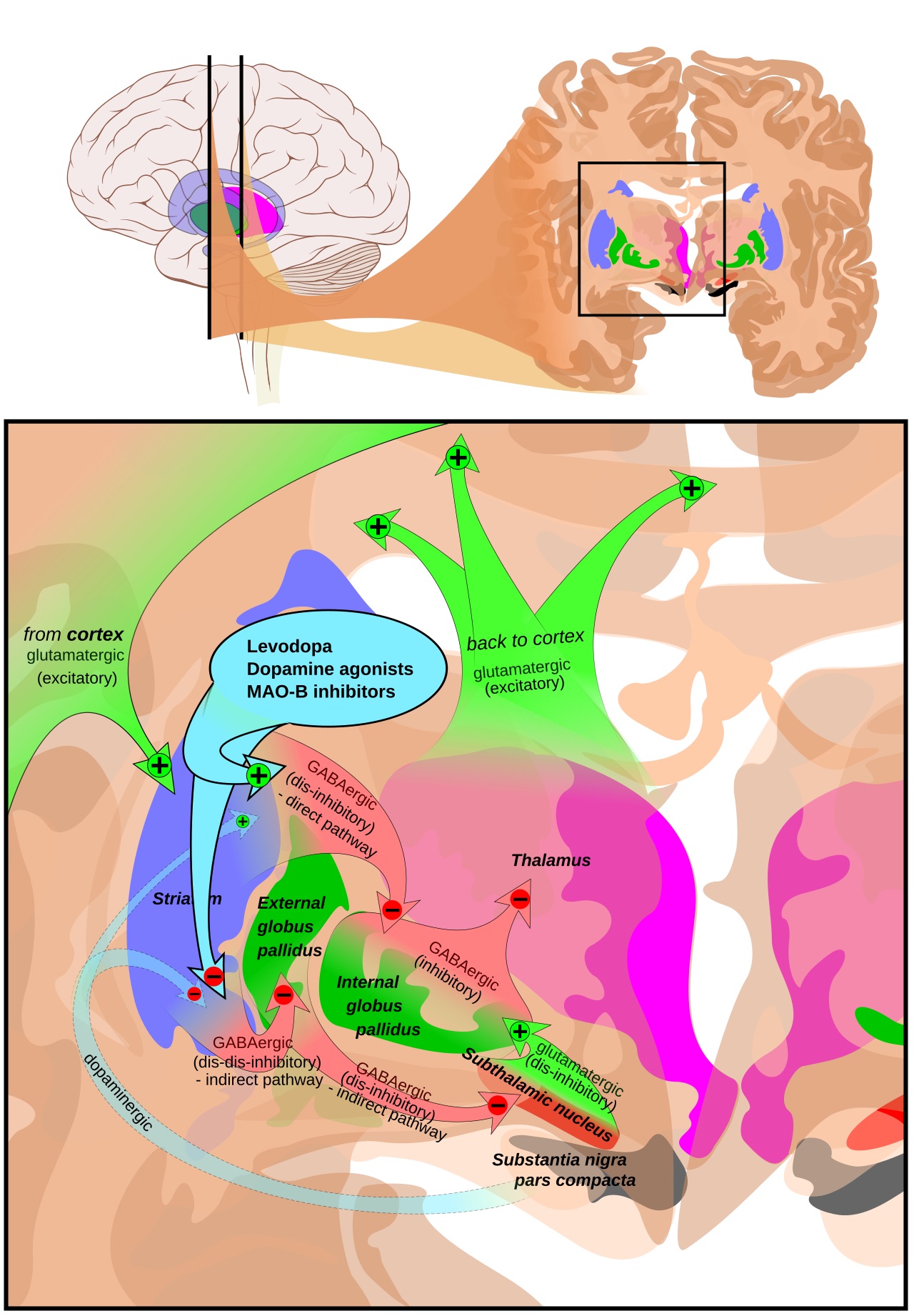
In this basal ganglia schematic (loss of dopamine), which change explains parkinsonian bradykinesia?
Increased dopamine in the striatum
Increased cortical excitation of the thalamus
Decreased GABA release in the globus pallidus interna
Increased inhibition of the thalamus and reduced motor cortex stimulation
Without dopamine, the output nuclei (GPi/SNr) become overactive, strongly inhibiting the thalamus and reducing cortical drive.
Image: Mikael Häggström, CC BY-SA 3.0, via Wikimedia Commons.
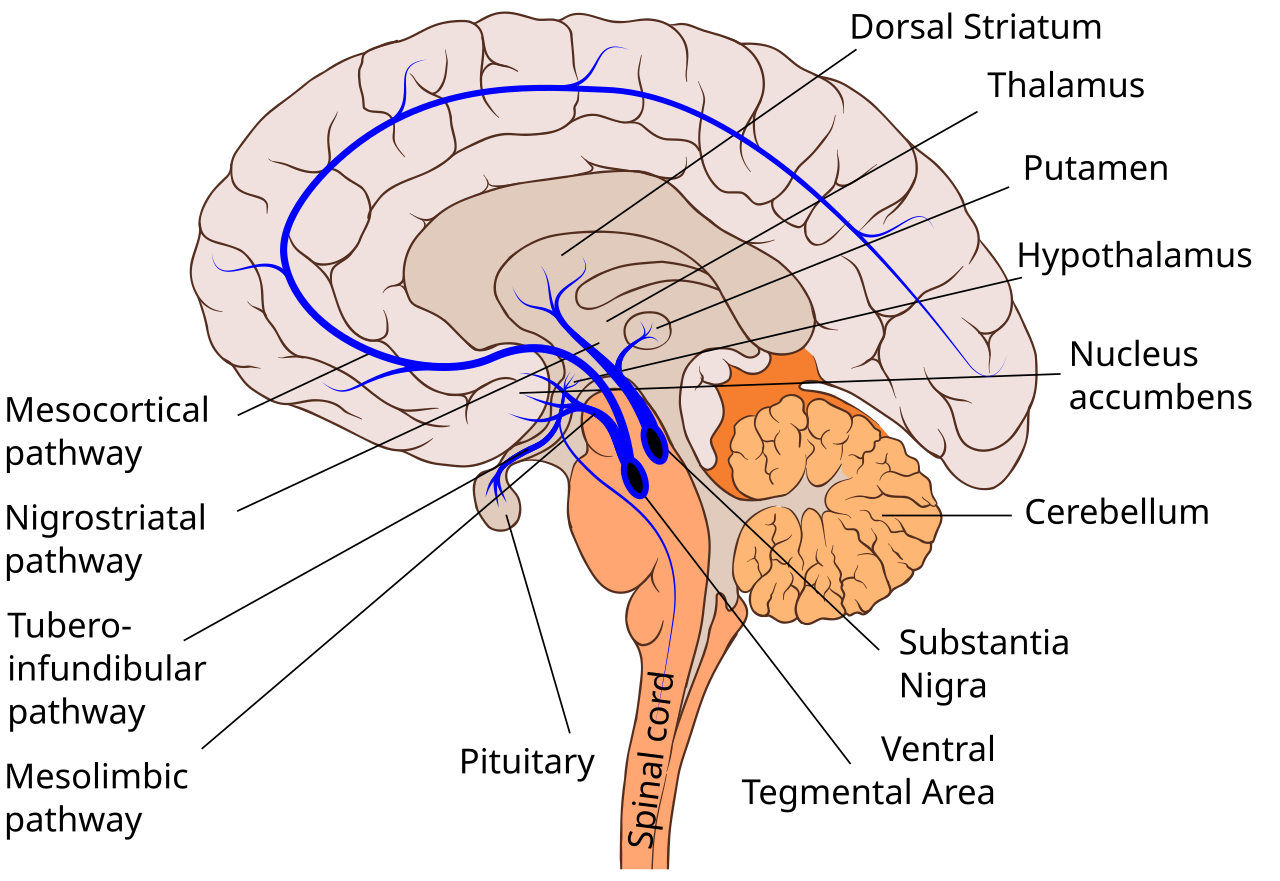
In this dopamine pathway diagram, blockade of which pathway by risperidone is responsible for galactorrhea and amenorrhea?
Nigrostriatal pathway
Mesocortical pathway
Tuberoinfundibular pathway
Mesolimbic pathway
Dopamine from the hypothalamus normally inhibits prolactin release from the pituitary; D2 blockade removes the brake. Nigrostriatal blockade causes EPS; mesolimbic blockade is therapeutic for positive symptoms.
Image: Slashme, Patrick J. Lynch and Fvasconcellos, CC BY-SA 4.0, via Wikimedia Commons.
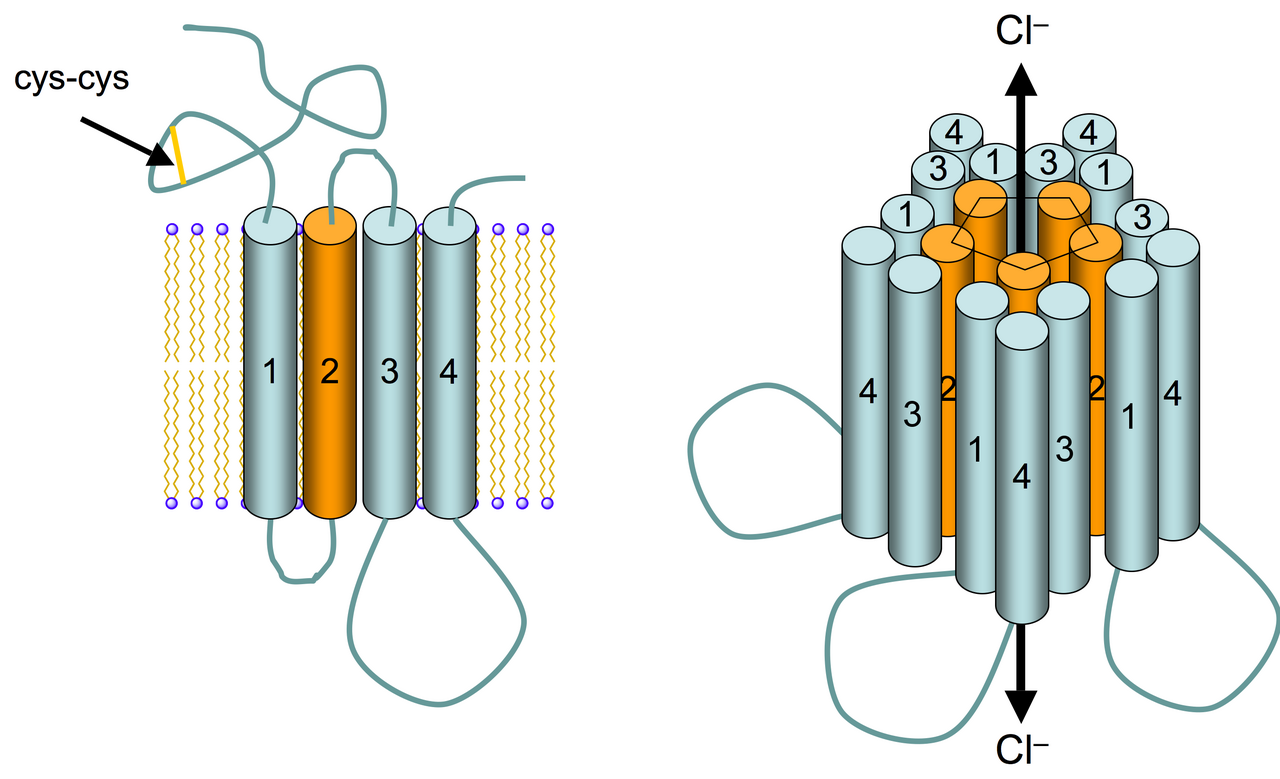
Which statement about the GABA-A receptor is true?
Barbiturates and benzodiazepines act by identical mechanisms
Chloride enters the neuron and causes hyperpolarization
Sodium enters the neuron and causes depolarization
It is a G-protein-coupled receptor
GABA-A is a ligand-gated chloride channel. Benzodiazepines increase the frequency, barbiturates the duration of opening, and barbiturates can open the channel directly at high dose.
Image: User:Shao, public domain, via Wikimedia Commons.
A patient receives succinylcholine for rapid-sequence intubation and develops peaked T waves and cardiac arrest. The patient had extensive burns two weeks earlier. What is the mechanism?
Hyperkalemia from upregulated extrajunctional acetylcholine receptors
Local anesthetic toxicity
Anaphylaxis to latex
Malignant hyperthermia only
After burns, crush injury or denervation, extrajunctional receptors proliferate and succinylcholine causes massive potassium efflux. Use rocuronium instead in such patients.
A patient in the ICU with a TCA overdose has QRS widening to 140 ms and ventricular arrhythmias. What is the best treatment?
Flumazenil
Physostigmine
IV haloperidol
IV sodium bicarbonate
Sodium bicarbonate treats Na+ channel blockade and acidosis in TCA cardiotoxicity. Physostigmine and flumazenil can provoke seizures or arrhythmias in TCA overdose; haloperidol prolongs QT.
